

Deep tissue massage uses slower, firmer pressure to work on deeper layers of muscle and connective tissue. It can ease muscle soreness and tension, and for post-exercise soreness (DOMS) a 2018 meta-analysis found massage was the most effective recovery method studied. But "no pain, no gain" doesn't apply: there's no good reason a massage needs to be agonising to help, and the benefits are mostly short-term. It works best as part of a plan that includes exercise.
Key takeaways
- For post-exercise soreness, massage came out as the most effective recovery technique in a 2018 meta-analysis.
- For low back pain, a Cochrane review found short-term pain relief but said there was "very little confidence" massage is an effective treatment on its own.
- It doesn't need to hurt. Firm pressure is fine; pain you have to brace against is not the goal.
- Claims that deep tissue massage "breaks up scar tissue" or "flushes out toxins" aren't supported by good evidence.
- Some soreness for a day or two afterwards is common. Bruising or sharp pain is not.
What is deep tissue massage?
Compared with a relaxation (Swedish) massage, deep tissue massage uses:
- slower strokes and more sustained pressure
- firmer pressure, often with forearms, knuckles or elbows
- focus on specific areas, such as tight calves, hamstrings, upper back or shoulders
It's popular with runners, gym-goers and people with muscle tension from desk work. At Athos, it's offered as part of our sports and deep tissue massage service.
What does the research say about tissue massage?
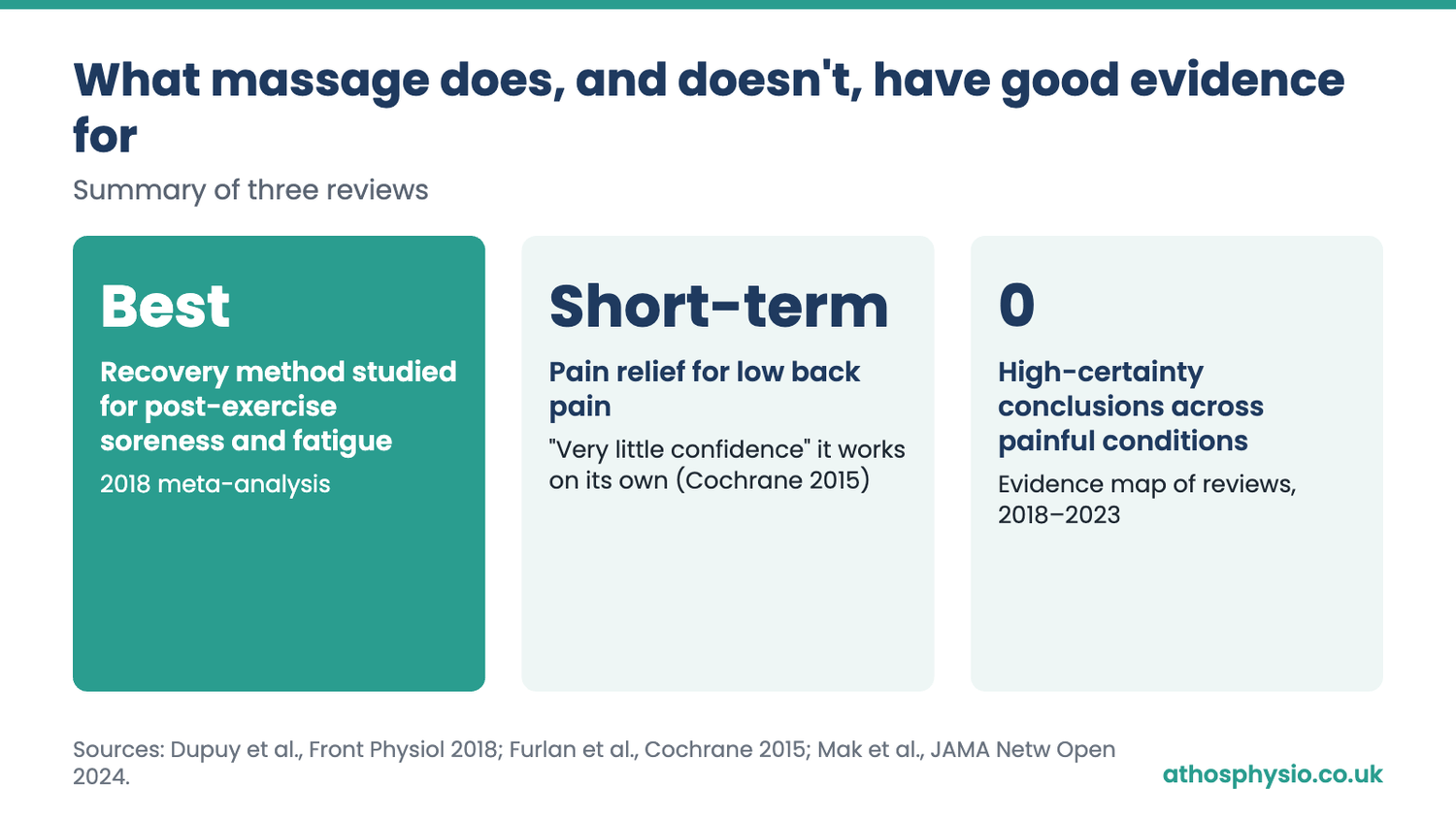
For recovery after exercise: a 2018 meta-analysis compared recovery methods, including massage, compression, cold-water immersion, cryotherapy and stretching. Massage was the most effective technique for reducing muscle soreness (DOMS) and perceived fatigue, and it also produced small reductions in blood markers of muscle damage and inflammation.
For low back pain: a 2015 Cochrane review found massage reduced pain in the short term compared with inactive treatments, but the authors had "very little confidence" that massage is an effective treatment for low back pain overall. Function didn't consistently improve, and benefits faded.
Across painful conditions: a 2024 evidence map in JAMA Network Open looked at reviews of massage for pain published from 2018 to 2023. None of the conclusions were rated high certainty, a handful were moderate certainty (all favouring massage), and evidence that massage beats other active treatments was rare.
What this means: massage can help you feel better in the short term, especially after hard training. It's less convincing as a long-term fix for persistent pain on its own.
The myth: "No pain, no gain"
Many people believe a massage has to hurt to be doing anything. There's no good evidence for that.
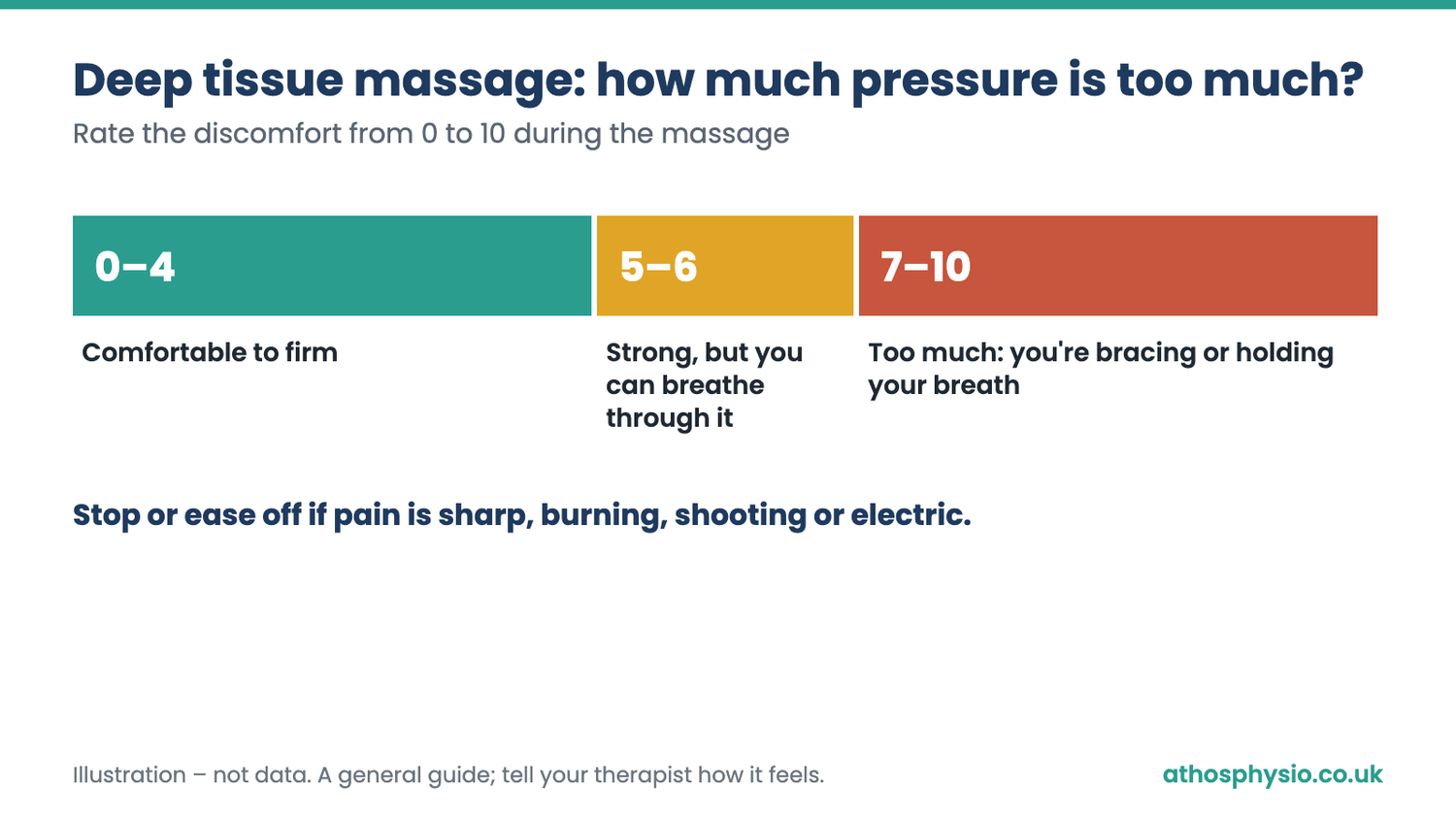
Firm pressure can feel intense, and some discomfort is normal, but you shouldn't be holding your breath, tensing up or bracing against it. If you're fighting the pressure, the muscles tighten rather than relax. A good therapist adjusts the pressure as they go, and checks in with you.
Useful rule of thumb: "good pain" feels like a strong stretch or pressure you can breathe through, around 5–6/10 at most. Sharp, burning, shooting or electric pain means ease off.
Other myths worth retiring
- "It breaks up scar tissue and adhesions." There's no good evidence for this. The looser feeling afterwards is more likely to come from the nervous system relaxing the muscle and reducing sensitivity.
- "It flushes out lactic acid and toxins." Lactate clears naturally within hours of exercise, and there's no good evidence massage removes "toxins".
- "Soreness the next day means it worked." Mild soreness is common, but it isn't a measure of benefit.
When is deep tissue massage useful?
- After hard training or a race, to reduce soreness and feel fresher
- Alongside rehab for a muscle or tendon problem, to make movement and exercise more comfortable
- For general muscle tension, for example from long hours at a desk
- As a regular maintenance session during heavy training blocks, such as marathon preparation
It's less useful as the only treatment for persistent pain. For that, an exercise-based plan has much stronger evidence. Read more in benefits of sports massage and physio massage vs relaxation massage.
Who should avoid deep tissue massage?
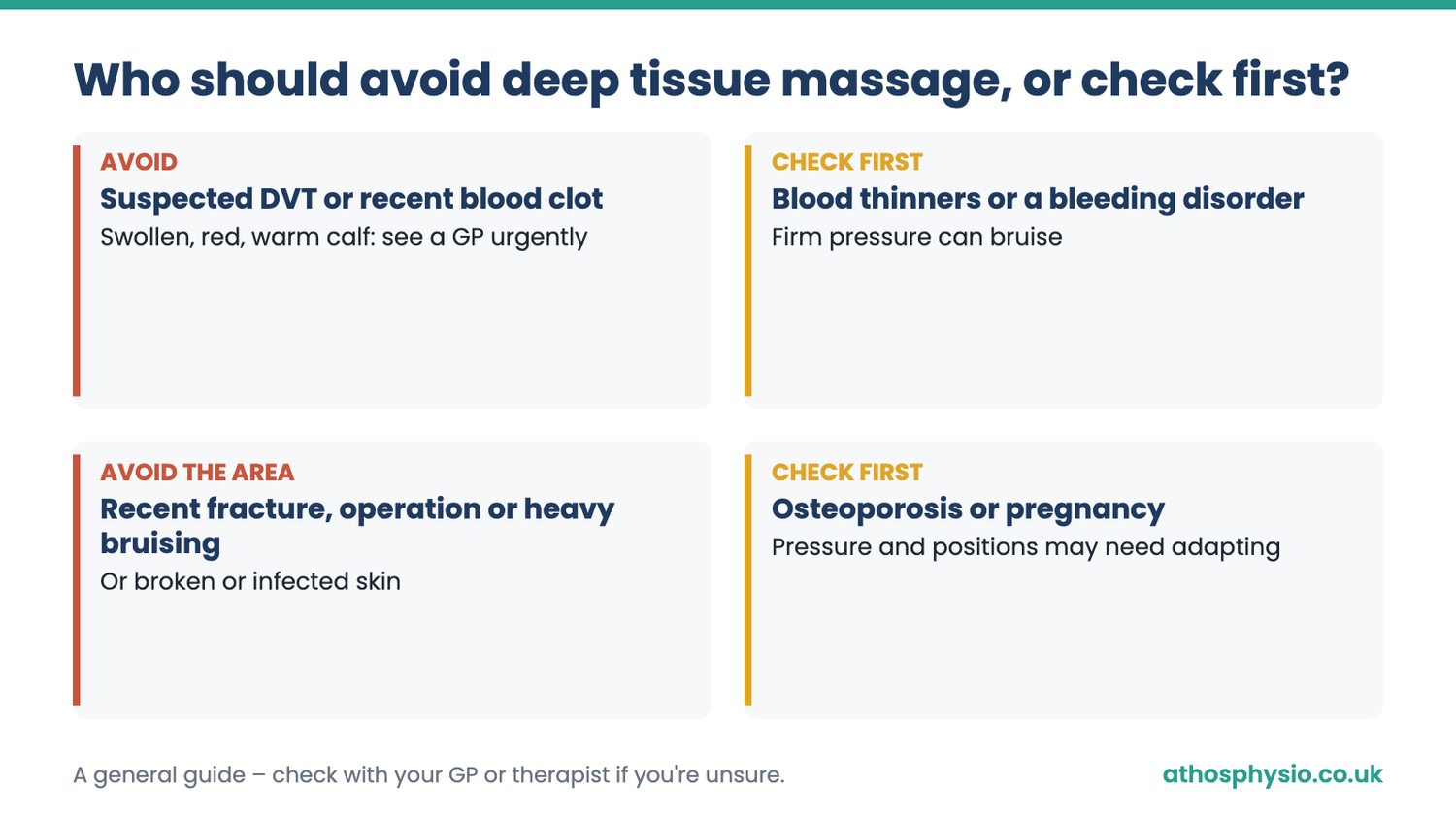
Avoid it, or check with your GP first, if you have:
- a suspected deep vein thrombosis (a swollen, red, warm calf) or a recent blood clot
- blood thinners or a bleeding disorder
- a recent fracture, acute injury with heavy bruising, or a recent operation in the area
- skin infections, open wounds or burns in the area
- osteoporosis (firm pressure may need to be avoided)
- pregnancy, unless the therapist is trained in pregnancy massage
How to get the most from a deep tissue massage
- Tell your therapist about injuries, medical conditions and the pressure you like.
- Breathe slowly and keep talking. Say if pressure is too much.
- Drink normally and move gently afterwards. A walk or easy spin can help.
- Expect mild soreness for 24–48 hours. It should fade, not build.
- Pair it with exercise. The long-term change comes from strengthening and loading the area.
When to see a physio or GP instead
See your GP urgently if you have a calf that's swollen, red or warm, or pain with fever. Call 999 if you have chest pain or sudden breathlessness.
See a physio if pain keeps coming back after massage, you have pins and needles or numbness, or the pain started after an injury. You may need an assessment and a rehab plan rather than (or as well as) massage.
Deep tissue massage at Athos Physio
Our clinic is inside F45 Training Studio at 77 Piccadilly in Manchester city centre. Sports and deep tissue massage costs £50 for 30 minutes, and can be combined with physiotherapy if you have an injury. You don't need a GP referral, and we work with Bupa, WPA, Vitality and Aviva for physiotherapy. Book online.
FAQs
Is deep tissue massage supposed to hurt?
It can feel intense, but it shouldn't be painful enough that you're tensing up or holding your breath. Around 5–6/10 discomfort that you can breathe through is the upper limit. Sharp, burning or shooting pain means the pressure should be reduced.
How often should I get a deep tissue massage?
There's no evidence-based schedule. Many people book around hard training blocks or races, or when muscle tension builds up from desk work. It works best combined with regular exercise.
How long does soreness last after deep tissue massage?
Mild soreness usually lasts 24–48 hours. If soreness is getting worse after that, or you have bruising, swelling or sharp pain, let your therapist know.
Is deep tissue massage good for back pain?
It can relieve pain in the short term, but a Cochrane review had very little confidence it works as a treatment on its own. It's best used alongside an exercise-based plan.
This article is general information, not a substitute for an individual assessment.
Sources
- Dupuy O, et al. An evidence-based approach for choosing post-exercise recovery techniques to reduce markers of muscle damage, soreness, fatigue, and inflammation: a systematic review with meta-analysis. Front Physiol 2018;9:403. https://doi.org/10.3389/fphys.2018.00403
- Furlan AD, et al. Massage for low-back pain. Cochrane Database Syst Rev 2015;9:CD001929. https://doi.org/10.1002/14651858.CD001929.pub3
- Mak S, et al. Use of massage therapy for pain, 2018–2023: a systematic review. JAMA Netw Open 2024;7(7):e2422259. https://doi.org/10.1001/jamanetworkopen.2024.22259
Related: Sports and deep tissue massage · Benefits of sports massage · Physio massage vs relaxation massage · Does cupping work? · All conditions we treat
Written by Nick Chatziviltsos, PgDip, HCPC-registered physiotherapist (PH114351).