

The biggest review of sports massage found no evidence that it makes you stronger, faster or fitter. But it does seem to help you feel better: less muscle soreness after hard exercise, a little more flexibility, and less fatigue. That's still a real benefit, as long as you book it for the right reasons and at the right time. Here's what the research shows, how often to have one, and how it differs from deep tissue and relaxation massage.
Key takeaways
- What it helps: post-exercise muscle soreness (DOMS), short-term flexibility and how fatigued you feel.
- What it doesn't help: strength, sprint, jump or endurance performance. No good-quality evidence shows any improvement.
- Effects are small to moderate. Think "helps you recover and feel ready", not "performance enhancer".
- Timing matters. Have a lighter massage before a race and a firmer one after hard training blocks, not the day before a key session.
- "No pain, no gain" is wrong. Firm pressure can be useful, but you don't need to grit your teeth for it to work.
What is sports massage?
Sports massage is hands-on soft tissue treatment for people who train, whether they're marathon runners, gym-goers, footballers or F45 regulars. A sports massage therapist or physio uses techniques such as kneading, stripping along the muscle, trigger point pressure and stretching. They focus on the muscles you work hardest and the areas that feel tight or sore.
It differs from a spa massage in its purpose rather than any secret technique. A sports massage is aimed at recovery, comfort and getting you back to training, so pressure and focus follow what you need that week.
What does the research actually say?
Three large reviews have pulled together the controlled trials on massage and exercise.
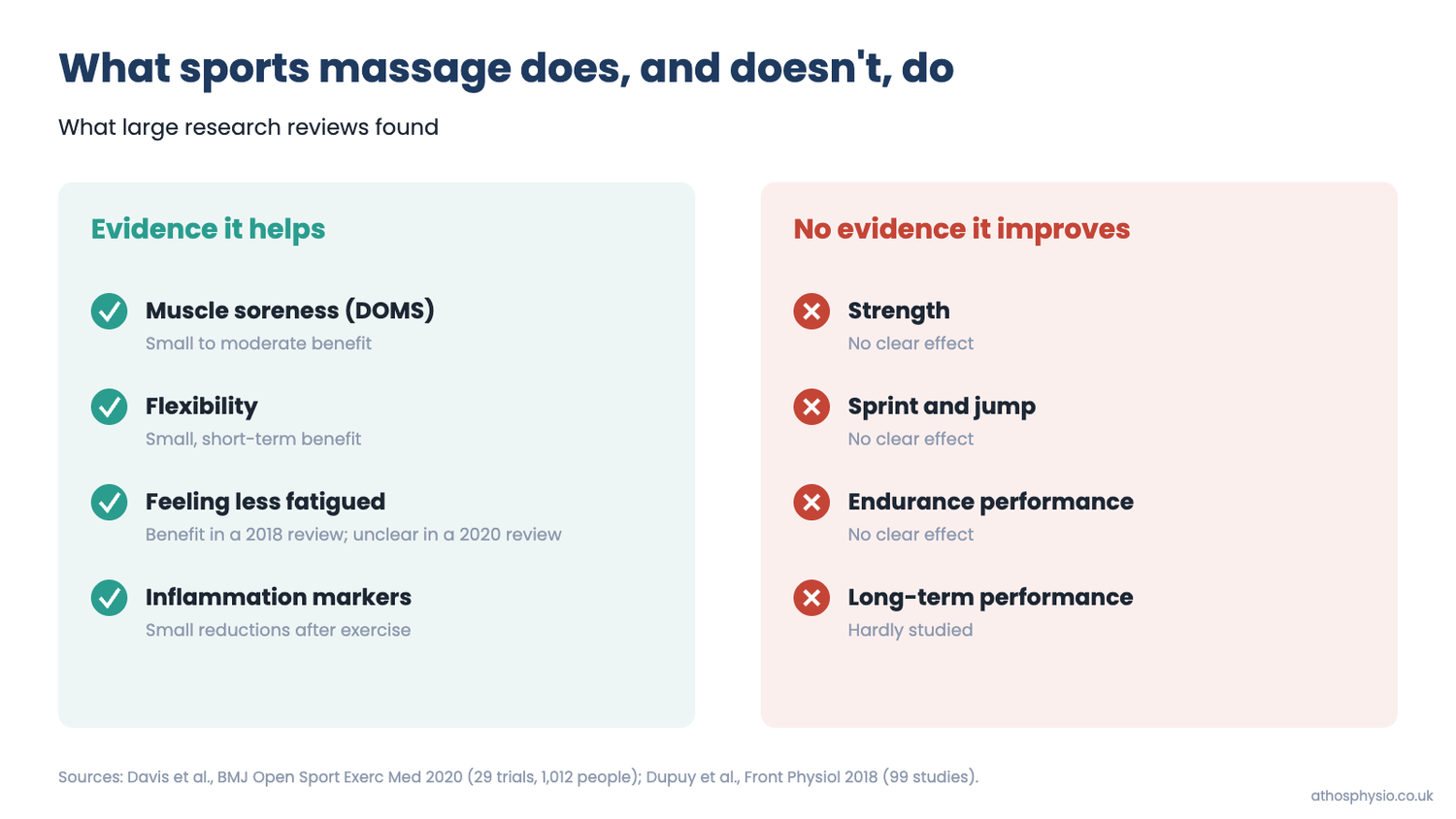
1. Performance: no clear benefit. A 2020 meta-analysis in BMJ Open Sport & Exercise Medicine pooled 29 randomised trials with 1,012 participants, the largest analysis of its kind. It found no evidence that massage improves strength, jump, sprint, endurance or fatigue. It did find small but significant improvements in flexibility and DOMS (the muscle soreness that peaks a day or two after hard exercise).
2. Soreness and fatigue: one of the better recovery tools. A 2018 meta-analysis of 99 studies compared recovery methods, including:
- active recovery
- compression garments
- cold-water immersion
- cryotherapy
- stretching
- massage
Massage came out as the most effective method for reducing DOMS and perceived fatigue, and it was among the best for lowering markers of inflammation.
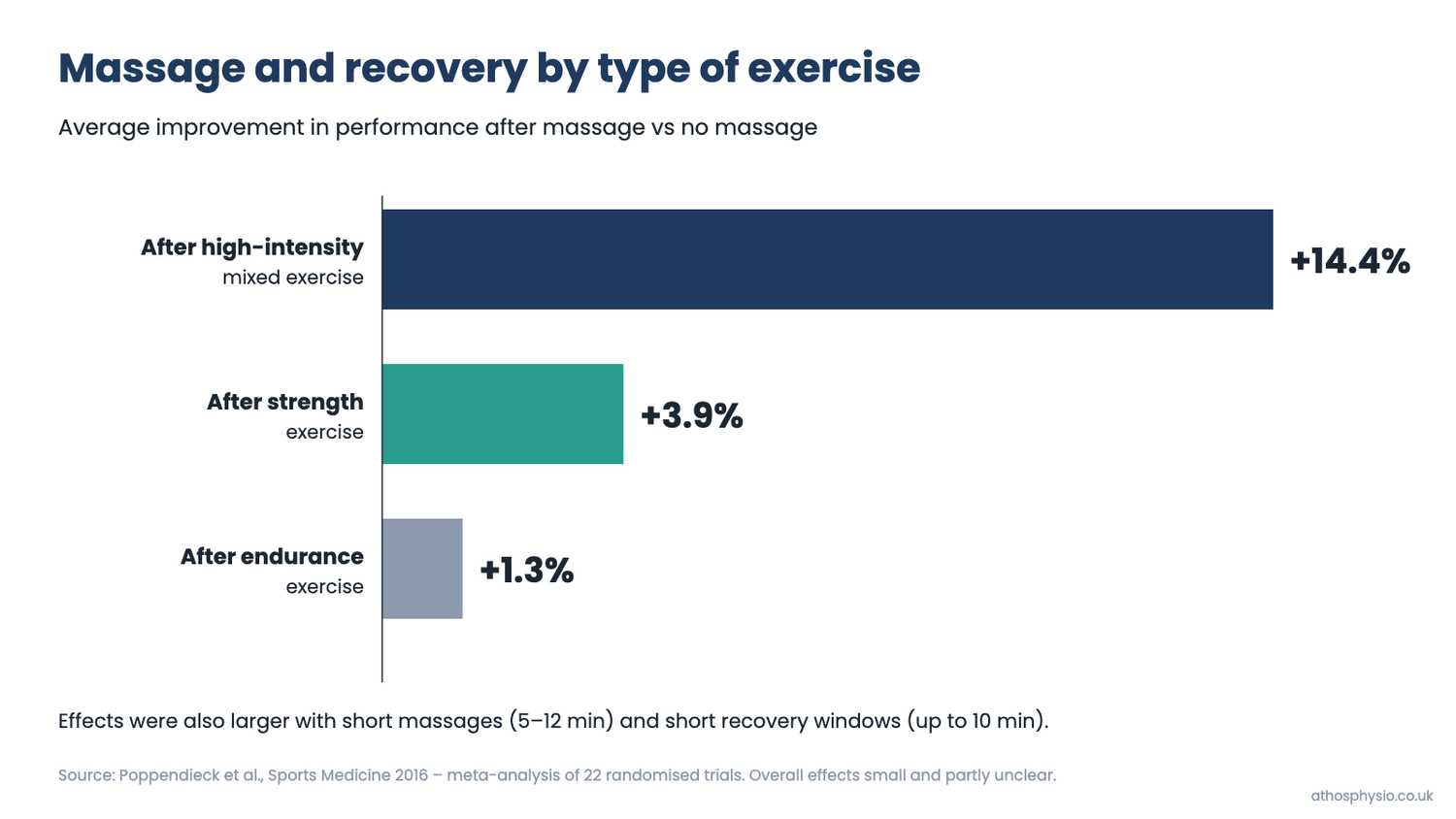
3. Recovery of performance: small, but bigger in some situations. A 2016 meta-analysis of 22 trials looked at whether massage helps you perform again after exercise. The overall effects were small, but they were larger after high-intensity mixed exercise (+14.4%) than after strength (+3.9%) or endurance exercise (+1.3%). They were also larger for short recovery windows of up to 10 minutes, and for shorter massages of 5–12 minutes.
Reading this critically:
- The studies are mostly small, with a few dozen people each, and the massage techniques vary a lot.
- You can't blind people to massage. Participants know they've had it, so feeling better may be partly expectation. For soreness and fatigue, though, feeling better is the outcome you care about.
- The two big reviews disagree slightly on fatigue. The 2018 review found massage helped perceived fatigue. The 2020 review didn't find a clear effect on fatigue measures. Treat it as "probably helps how fatigued you feel" rather than a certainty.
- Very few trials look at long-term use, such as weekly massage over a whole marathon block. That's a gap in the evidence, not proof it doesn't help.
Three sports massage myths
Myth 1: "Massage flushes out toxins and lactic acid."
Lactate isn't what makes you sore a day or two later, and your body clears it on its own after exercise. Massage may help soreness, but not by "flushing" anything out.
Myth 2: "Regular massage will make me faster."
The best evidence finds no direct improvement in performance. Any benefit to your racing comes indirectly, by helping you feel recovered enough to train consistently.
Myth 3: "It has to hurt to work."
Firm pressure can feel "good-sore", but very painful massage can make you tense up and leave you bruised and sore for days. Tell your therapist where your limit is. A useful guide is 5–7 out of 10 at most.
Sports massage vs deep tissue vs relaxation massage
| Sports massage | Deep tissue massage | Relaxation massage | |
|---|---|---|---|
| Main goal | Recovery and readiness for training | Treating specific tight or sore areas | Relaxation and stress relief |
| Pressure | Varies: lighter before events, firmer in training blocks | Firm and slow | Light to medium |
| Focus | Muscles you load most in your sport | Specific problem areas | Whole body |
| Best for | Active people and athletes | Persistent tightness or niggles | General wellbeing |
In practice, a good sports massage often includes deep tissue work where it's needed. Read more in our guide to physio massage vs relaxation massage.
How often should you get a sports massage?
No study has worked out an ideal frequency, so be wary of anyone who says you need weekly massage. A practical guide:
- Recreational exercise (2–4 sessions a week): every 4–6 weeks, or when you feel tight or sore.
- Building towards a race or event: every 2–4 weeks in the hardest part of your training, plus one before and one after the event.
- After a race or very hard session: one massage 1–3 days later, once the worst soreness has eased.
When to book it: timing around training and races
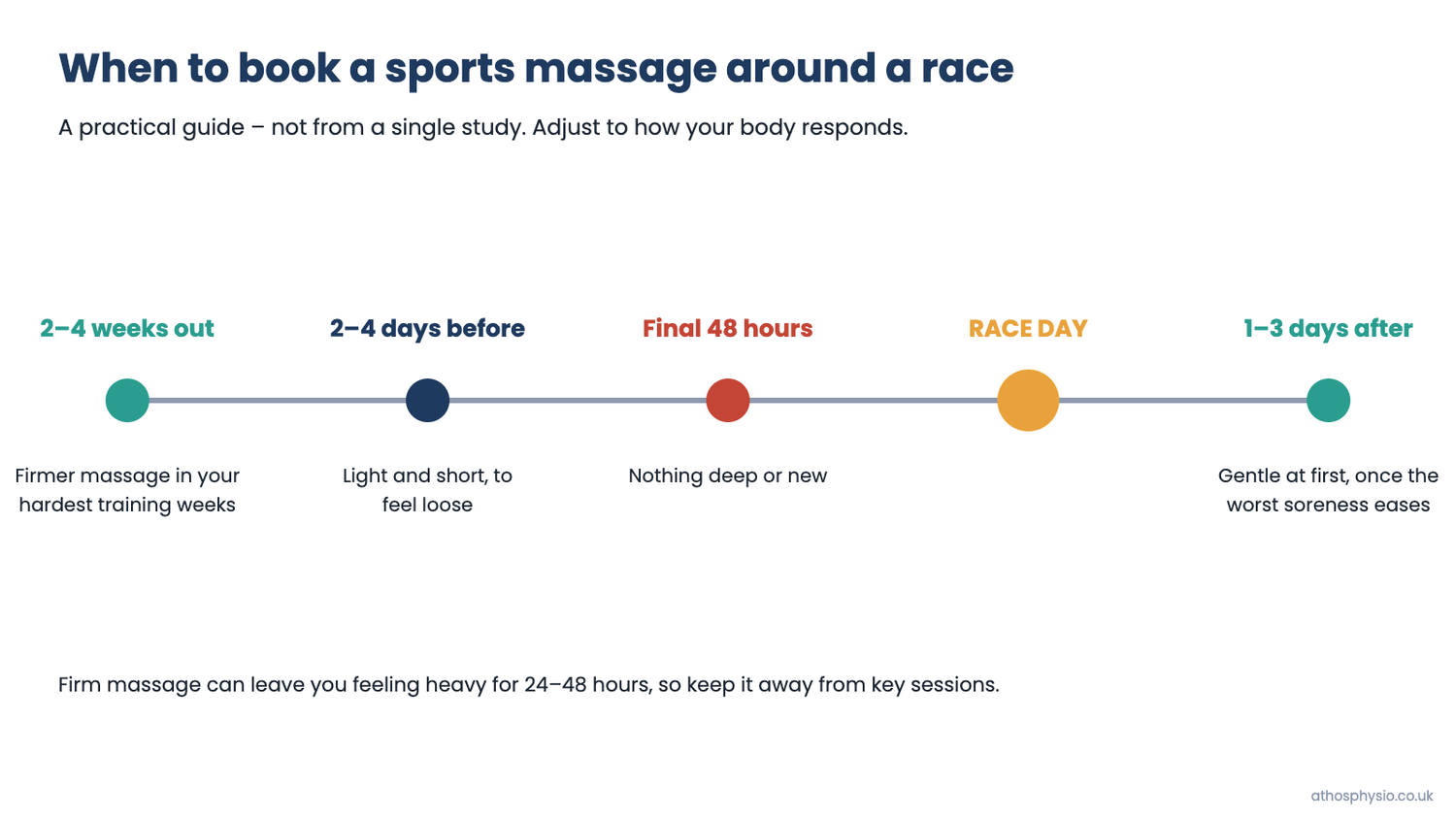
- In heavy training weeks: book on or before an easy or rest day, not the day before your long run or key session. Firm work can leave you feeling heavy for 24–48 hours.
- Before a race: have a lighter, shorter massage 2–4 days out. Avoid anything deep or new in the final 48 hours.
- After a race: wait until the day after, or 2–3 days after a marathon, and keep the pressure gentle at first.
Is sports massage painful?
It shouldn't be very painful. Expect firm pressure and some "good" discomfort in tight areas. You might feel a little tender for a day afterwards, a bit like after a workout. Sharp pain, pins and needles, or bruising aren't the goal, so tell your therapist straight away if you feel any of these.
When massage isn't the answer
Massage helps soreness and tightness, but it doesn't fix an injury on its own. Get assessed by a physio first if you have:
- pain in one spot on a bone, or pain that's getting worse with each run
- swelling, bruising or a sudden "pop" during exercise
- pins and needles, numbness or weakness
Don't have a massage, and seek medical advice, if you have:
- a hot, red, swollen calf, especially after travel or surgery
- a fever or infection
- a recent fracture
Contact NHS 111 or your GP, or call 999 for chest pain or sudden breathlessness.
If your "tight muscle" keeps coming back, there's usually a training load or strength issue behind it. A physio assessment plus a strength plan will usually do more than massage alone.
Sports massage in Manchester at Athos Physio
We offer sports and deep tissue massage at our clinic inside F45 Manchester NQ, at 77 Piccadilly in Manchester city centre. Because we're a physio clinic, we can tell when something needs more than a massage, and combine the two when it helps.
- Hours: Monday to Friday, 7am–8pm.
- Insurers: we work with Bupa, WPA, Vitality and Aviva.
- Prices: see our price list.
- Book a sports massage.
FAQs
What are the benefits of sports massage?
The best-supported benefits are less muscle soreness after hard exercise (DOMS), a short-term gain in flexibility, and feeling less fatigued. There's no good evidence that it directly improves strength, speed or endurance.
What does a sports massage do?
It works on the muscles and soft tissues you load in your sport, using techniques like kneading, stripping and stretching. The aim is to ease soreness and tightness so you feel ready to train again.
How often should you get a sports massage?
There's no proven ideal. Every 4–6 weeks suits most recreational exercisers. Every 2–4 weeks suits people in a hard training block, plus around big events.
Is sports massage good before a race?
A light, short massage 2–4 days before can help you feel loose. Avoid deep or unfamiliar massage in the final 48 hours.
Is sports massage the same as deep tissue massage?
Not quite. Sports massage is defined by its purpose, which is recovery and training. Deep tissue is a firmer technique that's often used within a sports massage.
This article is general information, not a substitute for an individual assessment.
Sources
- Davis HL, Alabed S, Chico TJA. Effect of sports massage on performance and recovery: a systematic review and meta-analysis. BMJ Open Sport Exerc Med 2020;6(1):e000614. https://doi.org/10.1136/bmjsem-2019-000614
- Dupuy O, et al. An evidence-based approach for choosing post-exercise recovery techniques to reduce markers of muscle damage, soreness, fatigue, and inflammation: a systematic review with meta-analysis. Front Physiol 2018;9:403. https://doi.org/10.3389/fphys.2018.00403
- Poppendieck W, et al. Massage and performance recovery: a meta-analytical review. Sports Med 2016;46(2):183–204. https://doi.org/10.1007/s40279-015-0420-x
Related: Sports and deep tissue massage · The science of deep tissue massage · Running injury physio · Manchester Marathon 2027 training guide · All conditions we treat
Reviewed by Nick Chatziviltsos, PgDip, HCPC-registered physiotherapist (PH114351).