

Knee pain when bending is most often caused by irritation where the kneecap glides over the thigh bone (patellofemoral pain), an overloaded patellar tendon, a meniscus tear or osteoarthritis. Most cases aren't serious and improve with a progressive strengthening plan rather than rest. The surprising part: bending isn't wearing your knee out, and a scan "finding" may not be the cause of your pain at all. Get your knee checked promptly if it locks, gives way, swells quickly or you can't put weight on it.
Key takeaways
- Where it hurts is a strong clue: front, below the kneecap, inside, back or outside of the knee each point to different causes.
- Strengthening works. International experts recommend hip and knee exercise as the main treatment for kneecap pain, and NICE recommends exercise for everyone with knee osteoarthritis.
- Scans can mislead. In people with no knee pain at all, MRI shows a meniscus tear in about 1 in 5 over-40s, and cartilage changes in over 4 in 10.
- Modify, don't stop. Reduce what flares it, keep moving, and use a simple pain guide.
- Get urgent help for a locked knee, a hot swollen knee with fever, or a swollen, red calf.
Why does my knee hurt when I bend it?
Bending the knee under load squeezes the joint in two places. The kneecap presses harder against the thigh bone, and the back of the meniscus (the cartilage cushions inside the knee) gets compressed. That's why so many problems show up when you squat, kneel, take the stairs or get up from a low chair, but feel easier with the leg straight.
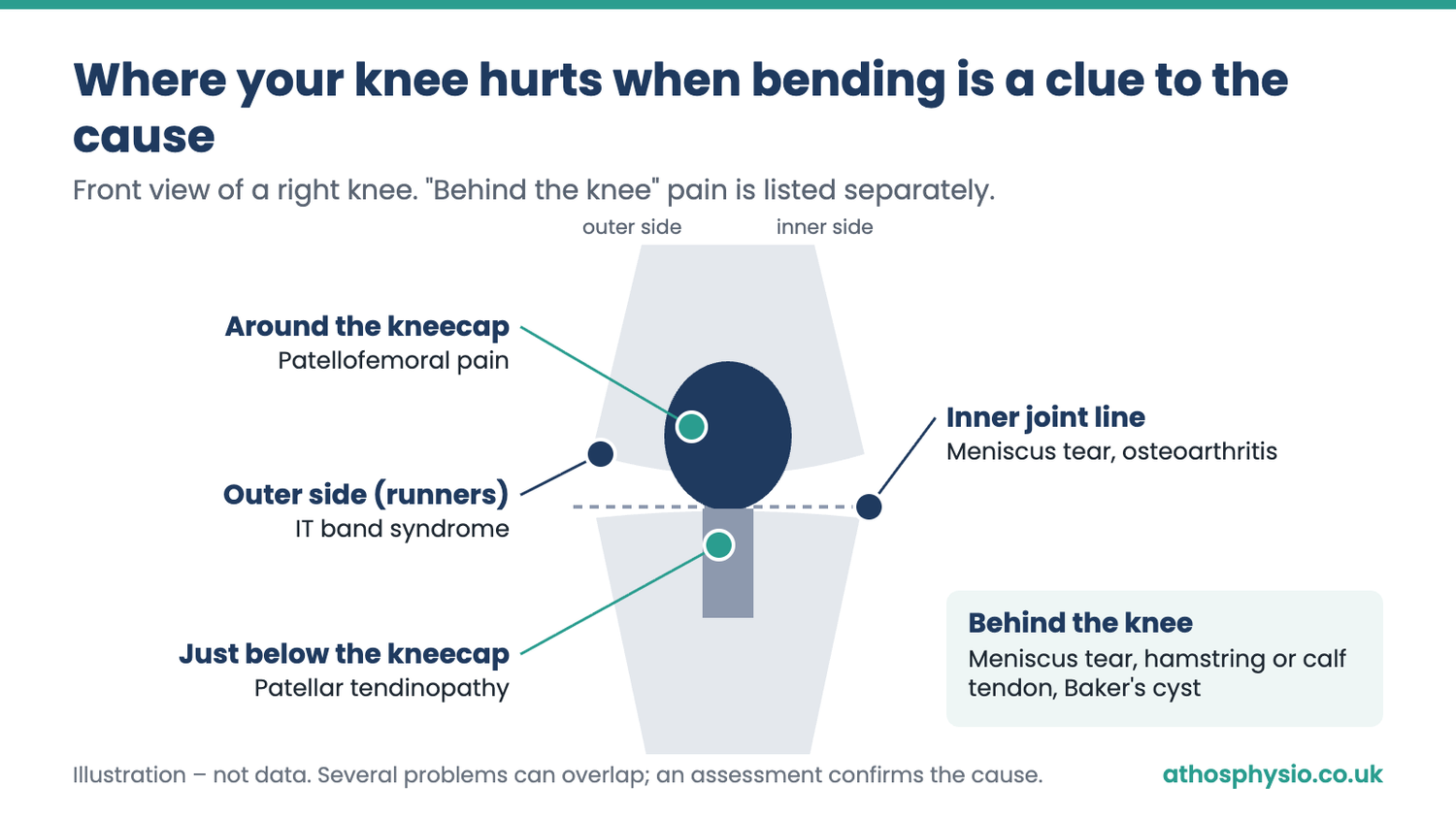
| Where it hurts | Most likely cause | What it typically feels like |
|---|---|---|
| Around or behind the kneecap | Patellofemoral pain (often called runner's knee) | Ache with squats, stairs (especially down), kneeling, or sitting for a long time with bent knees |
| Just below the kneecap | Patellar tendinopathy | A small, sore spot; stiff at the start of exercise, eases as you warm up, worse later or the next day |
| Inside of the knee, along the joint line | Meniscus tear | Pain with deep bending or twisting; swelling over a day or so; catching or locking |
| Behind the knee | Meniscus tear, hamstring or calf tendon, or a Baker's cyst | Tightness or fullness behind the knee when you bend fully |
| Outside of the knee (runners) | IT band syndrome | Sharp pain at a predictable point in a run, often worse downhill |
| General ache and stiffness (usually over 45) | Osteoarthritis | Activity-related ache; stiffness after rest that eases within about 30 minutes |
Patellofemoral pain: the most common cause in active people
This is the classic ache at the front of the knee in runners, gym-goers and people who've suddenly done more stairs, hills or squats. It's linked to how well the thigh and hip muscles cope with load, not to damage you can see on a scan.
What the research says: a 2018 international consensus statement, based on systematic reviews and trials, recommends exercise therapy, especially combining hip and knee exercises, as the main treatment. It found that treatments such as knee mobilisations on their own and electrotherapy machines are not recommended. A 2023 review of 37 trials found that hip and knee exercise combined with movement coaching (feedback on how you squat or step) was the most effective way to change how the knee moves. The certainty of that evidence was moderate.
Read more about runner's knee.
Patellar tendinopathy: pain just below the kneecap
If the pain sits in a small spot at the bottom of the kneecap, the patellar tendon may be overloaded. It's common in people who jump, sprint or squat heavily. Deep bending under load, such as a low squat, tends to provoke it. Tendons respond to gradual, heavy loading, not rest. Find out more about patellar tendinopathy.
Meniscus tears: do you need surgery?
The menisci can tear with a twisting injury, or wear gradually from middle age without any clear injury. Typical signs are pain along the joint line when you bend deeply or squat, swelling that builds over a day or so, and catching.
For wear-related tears, a Norwegian trial compared 12 weeks of supervised exercise with keyhole surgery (partial meniscectomy) in 140 adults with an average age of 50. After 2 years there was no clinically relevant difference in knee function, and the exercise group had stronger thighs at 3 months. 19% of the exercise group later had surgery, with no extra benefit.
The limits: this trial was in middle-aged people with wear-related tears, not young athletes with an acute tear. A knee that's truly locked and won't straighten needs prompt assessment, as it may need surgery. Learn more about a meniscus tear.
Osteoarthritis: stiffness and aching with bending
Osteoarthritis becomes more common from middle age. Bending, kneeling and stairs are often the hardest tasks. NICE guidance (2022) says to:
- offer therapeutic exercise to everyone with osteoarthritis, such as local muscle strengthening and general fitness
- diagnose it clinically, without imaging, in people aged 45 or over with typical symptoms
- not offer arthroscopic "washouts" or debridement
NICE also advises that pain may increase a little when you start exercising, but regular, consistent exercise will benefit your joints. Read more about knee and hip osteoarthritis.
The myth: "The scan shows what's wrong"
Many people assume an MRI will reveal the cause of their knee pain. Sometimes it does. But a 2019 review of 63 studies looked at MRI scans of 5,397 knees in adults with no knee pain and no injury. It found:
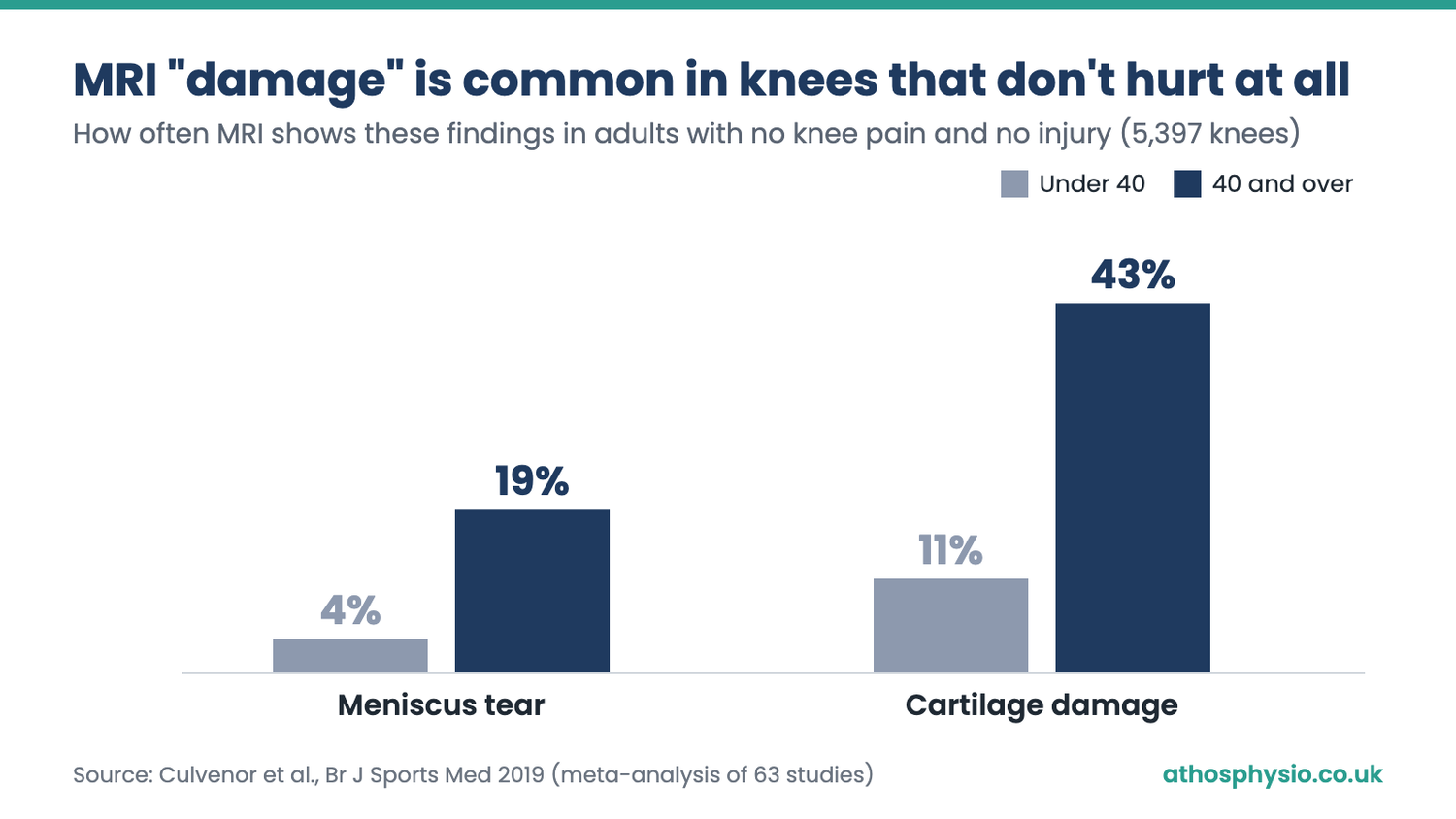
- Meniscus tears in 4% of under-40s and 19% of over-40s
- Cartilage damage in 11% of under-40s and 43% of over-40s
In other words, if you're over 40 and have a scan for knee pain, there's a fair chance it shows something that was there before your pain started and may have nothing to do with it. The authors concluded that imaging findings should be interpreted alongside the clinical picture. That's why most knee pain is diagnosed from your history and a hands-on assessment, and scans are saved for knees that lock, aren't improving with rehab, or may have a significant ligament or meniscus injury.
The second myth: "Bending and squatting wear out your knees"
Avoiding bending feels logical, but it tends to backfire. Cartilage, tendons and muscles adapt to the loads you give them. When you stop bending, the muscles that control and protect the knee weaken, and everyday tasks like stairs start to feel even harder. The aim isn't to avoid bending. It's to find a depth and load your knee tolerates today, then build it up.
What you can do at home
Modify rather than stop. Cut back on what clearly flares it, such as deep squats, kneeling or downhill running, but keep moving.
Use the pain traffic light. Rate your pain from 0 to 10 during and after exercise:
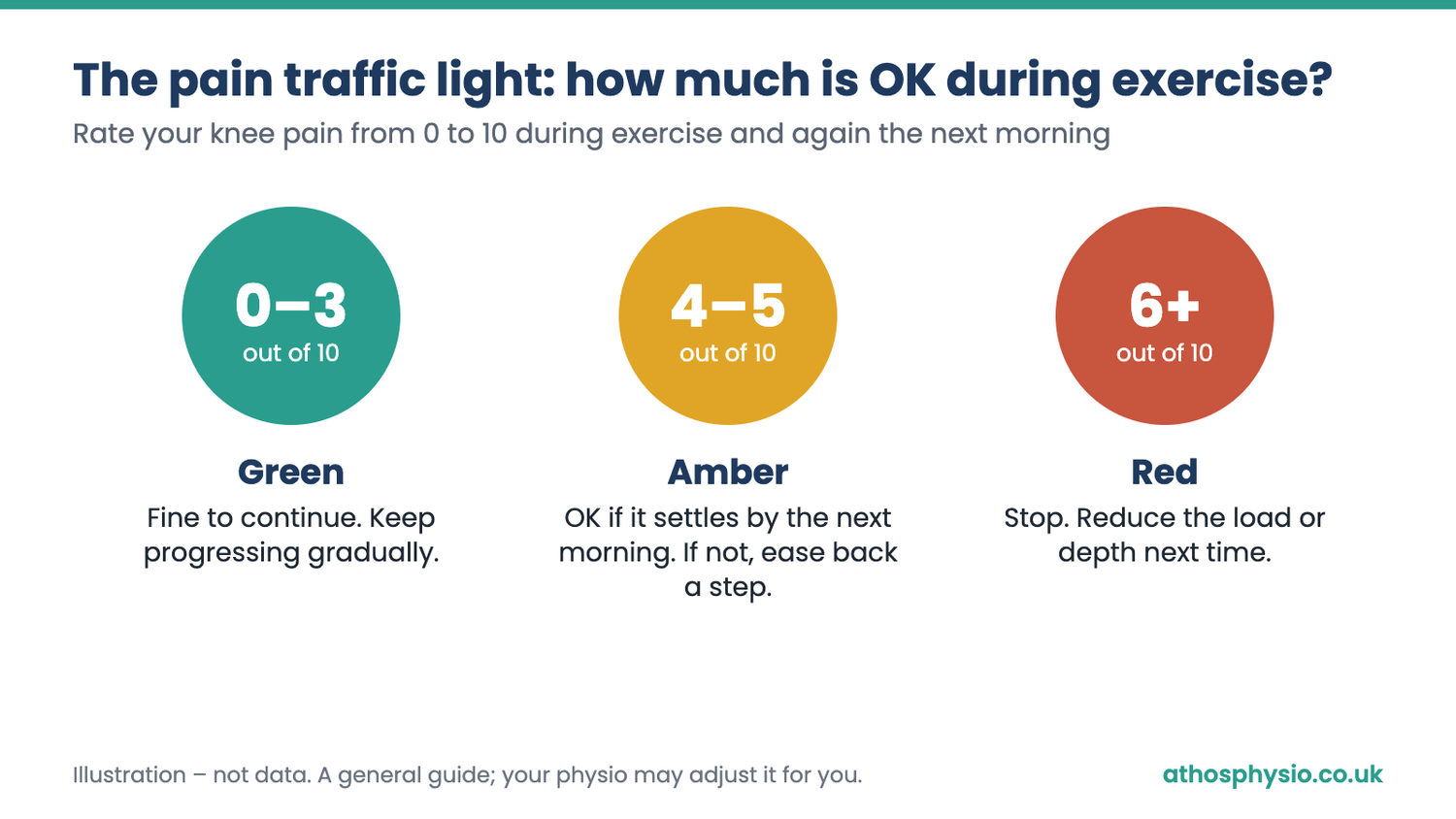
- 0–3/10 (green): fine to continue.
- 4–5/10 (amber): OK if it settles by the next morning. If not, ease back a step.
- 6+/10 (red): stop, and reduce the load or depth next time.
A simple strengthening plan (3 times a week; progress every 1–2 weeks if your pain stays green or amber):
- Stage 1: sit-to-stand from a higher chair, 3 × 10; bridges, 3 × 12; side-lying leg lifts, 3 × 12; calf raises, 3 × 15.
- Stage 2: sit-to-stand from a normal chair, holding a weight, 3 × 10; step-ups onto a low step, 3 × 10 each leg; wall sit at a comfortable depth, 3 × 30 seconds.
- Stage 3: goblet squats to a comfortable depth, 3 × 8–10; split squats, 3 × 8 each leg; step-downs from a low step, 3 × 8 each leg.
Other things that help:
- Ice or heat for comfort, whichever you prefer.
- An anti-inflammatory gel may help. Check with a pharmacist if you're unsure what's suitable.
- If you're carrying extra weight, losing some reduces the load through your knees, especially with osteoarthritis.
When to see a physio, GP, 111 or 999
Call 999 or go to A&E if:
- your knee looks misshapen after an injury, or you heard a crack
- you can't put any weight on your leg after an injury
- your lower leg is cold, pale or blue
- your knee is hot, red and swollen and you have a high temperature or feel shivery and unwell (a possible joint infection)
Call 111 or get an urgent GP appointment if:
- your calf is painful, swollen, red or warm on one side (a possible blood clot)
- your knee swells up quickly, or becomes very painful and you can't move it
- your knee locks and won't straighten
- you have numbness or tingling in your leg or foot
See a GP if several joints are swollen and stiff, or you feel generally unwell.
See a physio if your pain hasn't improved after two weeks of looking after it yourself, your knee catches or gives way, it keeps swelling, or it's stopping you exercising, working or sleeping.
How we help at Athos Physio
Our clinic is inside F45 Manchester NQ, at 77 Piccadilly. Your appointment starts with a thorough assessment: how your pain started, what makes it better or worse, then tests of movement, strength and the structures inside the knee. We'll usually watch you squat, step and, where relevant, hop or run. If anything suggests you need a scan or a medical opinion, we'll explain why.
Hands-on treatment can help settle pain in the short term. The long-term change comes from your custom rehab and strengthening plan, built around your knee, your sport or job, and your goals. You don't need a GP referral, and we work with Bupa, WPA, Vitality and Aviva. A 30-minute physio appointment costs £55. Book online, or see our knee pain physio in Manchester.
FAQs
Why do my knees hurt when I bend them but not when I straighten them?
Bending the knee under load increases the pressure between the kneecap and the thigh bone, and squeezes the back of the meniscus. That's why kneecap pain and meniscus problems often show up when you squat, kneel or take stairs, but feel easier with the leg straight.
Why does the back of my knee hurt when I bend it?
Common causes include a meniscus tear, irritation of the hamstring or calf tendons, and a Baker's cyst, which is a fluid-filled swelling often linked to a meniscus problem or arthritis. If your calf is also swollen, red or warm, call 111 or get an urgent GP appointment, as it can be a sign of a blood clot.
What does a sharp pain in the knee when bending mean?
A sharp, catching pain on the inside or outside of the joint, especially with twisting, can suggest a meniscus problem. A sharp pain on the outside during runs may be IT band syndrome. If the knee also locks, gives way or swells quickly, get it assessed promptly.
Why does my knee hurt when I kneel?
Kneeling puts direct pressure on the front of the knee. Pain there is often linked to patellofemoral pain, an irritated patellar tendon, or bursitis (an inflamed fluid sac at the front of the knee). A cushion helps in the short term, while strengthening builds tolerance.
Is it OK to squat with knee pain?
Usually, yes, with changes. Reduce how deep you go and how much weight you lift so your pain stays in the green or amber zone and settles by the next morning. Stop and get your knee checked if squatting makes it lock, give way or swell.
Should I rest my knee completely?
Complete rest is rarely needed and can weaken the muscles that support the knee. It's usually better to reduce the activities that flare your pain and keep up gentle movement and strengthening.
This article is general information, not a substitute for an individual assessment.
Sources
- Collins NJ, et al. 2018 Consensus statement on exercise therapy and physical interventions to treat patellofemoral pain. Br J Sports Med 2018;52(18):1170–1178. https://doi.org/10.1136/bjsports-2018-099397
- Nunes GS, et al. Effectiveness of interventions aimed at changing movement patterns in people with patellofemoral pain: a systematic review with network meta-analysis. J Orthop Sports Phys Ther 2023;53(12):748–760. https://doi.org/10.2519/jospt.2023.11956
- Culvenor AG, et al. Prevalence of knee osteoarthritis features on magnetic resonance imaging in asymptomatic uninjured adults: a systematic review and meta-analysis. Br J Sports Med 2019;53(20):1268–1278. https://doi.org/10.1136/bjsports-2018-099257
- Kise NJ, et al. Exercise therapy versus arthroscopic partial meniscectomy for degenerative meniscal tear in middle aged patients: randomised controlled trial with two year follow-up. BMJ 2016;354:i3740. https://doi.org/10.1136/bmj.i3740
- NICE. Osteoarthritis in over 16s: diagnosis and management (NG226), 2022. https://www.nice.org.uk/guidance/ng226
Related: Runner's knee · Patellar tendinopathy · Meniscus tear · Knee and hip osteoarthritis · The 5 most common running injuries · All conditions we treat
Reviewed by Nick Chatziviltsos, PgDip, HCPC-registered physiotherapist (PH114351).