

Hamstring tendinopathy (often searched for as "hamstring tendonitis") is an overload problem of the hamstring tendon where it attaches to your sitting bone. It causes a deep ache in the lower buttock that's worse when sitting, running uphill or bending forward. The surprise for many runners: the two things that feel most natural, stretching the hamstring and sitting it out, often make it worse, because they squeeze the tendon against the bone. It usually responds to a gradual, heavy strengthening plan, but recovery often takes a few months.
Key takeaways
- Where it hurts: a deep, localised ache at the sitting bone, often worse sitting on hard chairs or driving.
- Compression is the key irritant. Deep hamstring stretches, sitting for long periods and hill running all press the tendon against the bone.
- The evidence is thin. There are few good trials, so treatment borrows what works for other tendons: load management plus progressive strengthening.
- Recovery usually takes 3–6 months, sometimes longer, if you build up gradually.
- Pain that spreads below the knee with pins and needles may come from your back or the sciatic nerve instead.
What is hamstring tendinopathy?
Your three hamstring muscles join into a thick tendon that attaches to the sitting bone (ischial tuberosity) at the bottom of your pelvis. When that tendon is asked to do more than it's ready for, it becomes painful and less able to tolerate load. Doctors call this proximal hamstring tendinopathy: "proximal" means the top end.
"Tendonitis" suggests the main problem is inflammation. That's why tendinopathy is now the preferred term: the tendon's ability to cope with load has dropped, and treatment works by rebuilding it, not by "calming inflammation".
Typical symptoms:
- a deep ache at the sitting bone or lower buttock, sometimes spreading into the back of the thigh
- pain sitting on hard chairs, driving, or sitting for long periods
- pain running uphill or fast, and with lunges, deadlifts or deep stretches
- stiffness first thing in the morning or after rest
- a gradual onset, without the sudden pain and bruising of a muscle strain
Why does hamstring tendinopathy hurt when you sit?
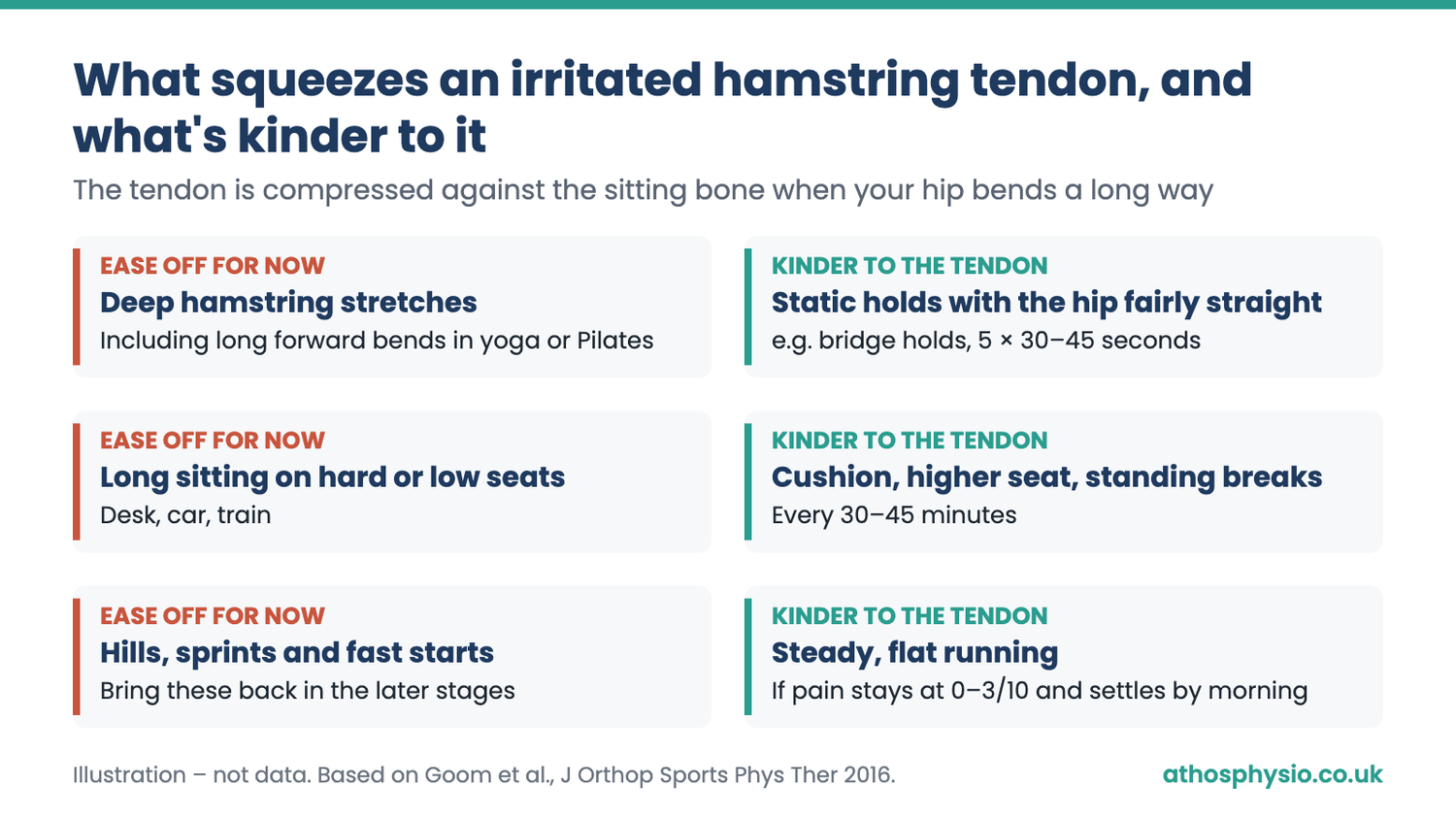
Tendons dislike two things: sudden jumps in load, and compression. At the sitting bone, the hamstring tendon wraps around the bone. When your hip bends a long way, as in sitting, a deep forward bend or the top of a hill-running stride, the tendon is squashed against the bone. Add a hard chair and your body weight, and an irritated tendon complains.
That's why the common advice to "stretch it out" tends to backfire. A long hamstring stretch puts the tendon in exactly its most compressed position. Many people feel briefly looser, then sorer the next day.
Common triggers:
- a sudden increase in running, especially hills, speed work or sprints
- starting deadlifts, deep lunges, yoga or Pilates with lots of forward bending
- long hours sitting at a desk or driving, especially on a hard seat
- a previous hamstring strain, or weakness in the hamstrings and glutes
The myth: "Stretch a tight hamstring and it will settle"
The hamstring often feels tight, so stretching seems logical. But in this condition the feeling of tightness usually reflects a sensitive tendon, not a short muscle. A 2016 clinical review in the Journal of Orthopaedic & Sports Physical Therapy described sustained stretches in deep hip bending (such as some yoga and Pilates postures), and even plain sitting, as common provoking loads. It recommended starting rehab with static (isometric) exercises in positions that don't compress the tendon, then building up the load in stages.
A caveat: that review also pointed out that, at the time, there were no randomised trials of rehab for this condition. The advice is based on how other tendons, such as the Achilles and patellar tendons, respond. That's sensible clinical reasoning, but it isn't proof.
What does the research say about treatment?
The honest answer is that the evidence is limited:
- A 2021 systematic review looked at every type of treatment studied, from exercise and shockwave to injections and surgery. It found the evidence was mostly very low quality and concluded there wasn't enough to recommend one treatment over another. It suggested starting with approaches that work for other tendinopathies.
- A 2023 systematic review of 13 studies of non-surgical care suggested the best results came from combining progressive tendon loading, eventually including positions with the hip bent, trunk and pelvic strengthening, and, in some cases, shockwave therapy.
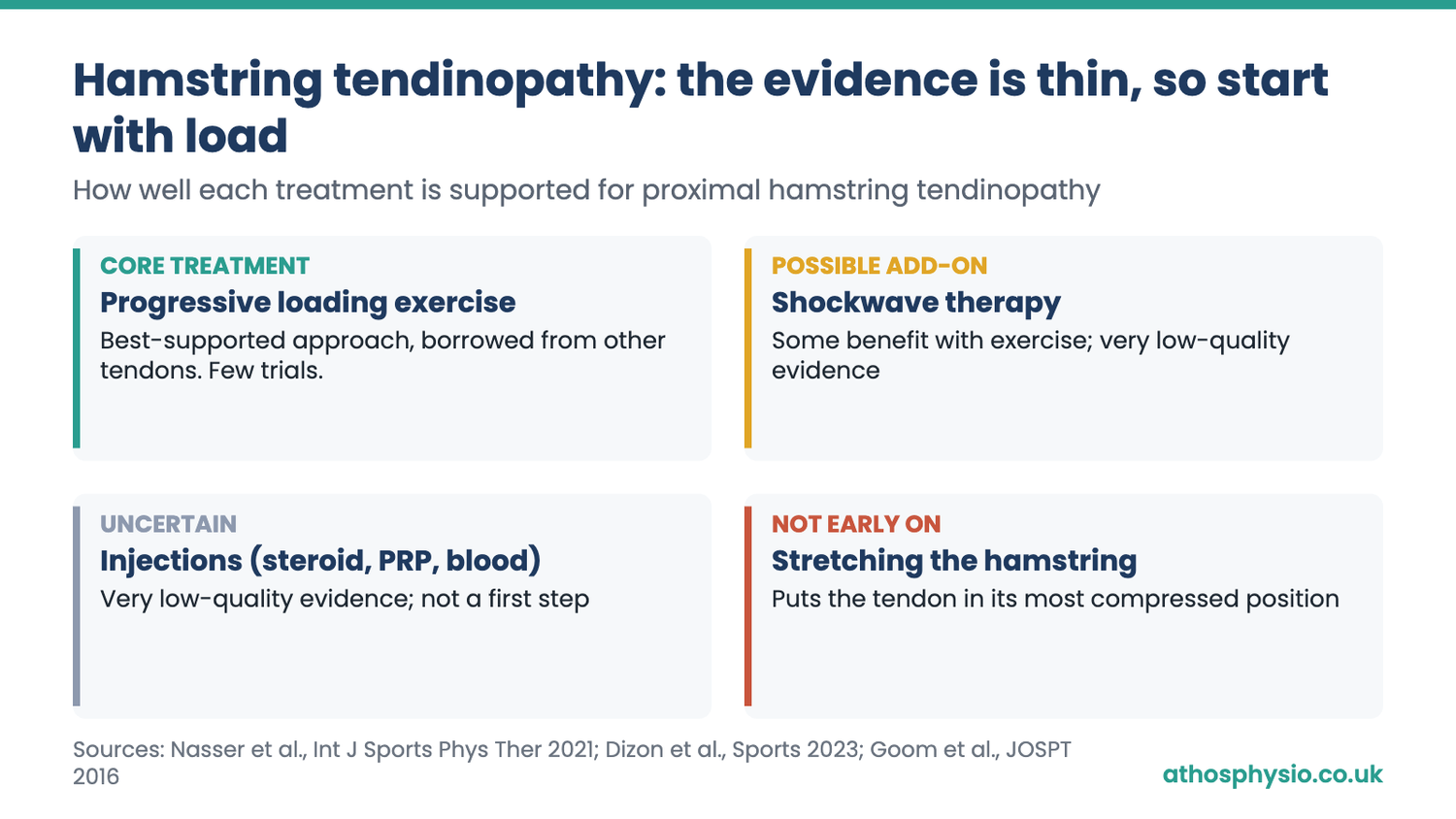
What this means for you: expect a plan built on load management and strengthening, with other treatments as add-ons rather than replacements. Be wary of anyone promising a quick fix from a single treatment.
What helps: a progressive loading plan
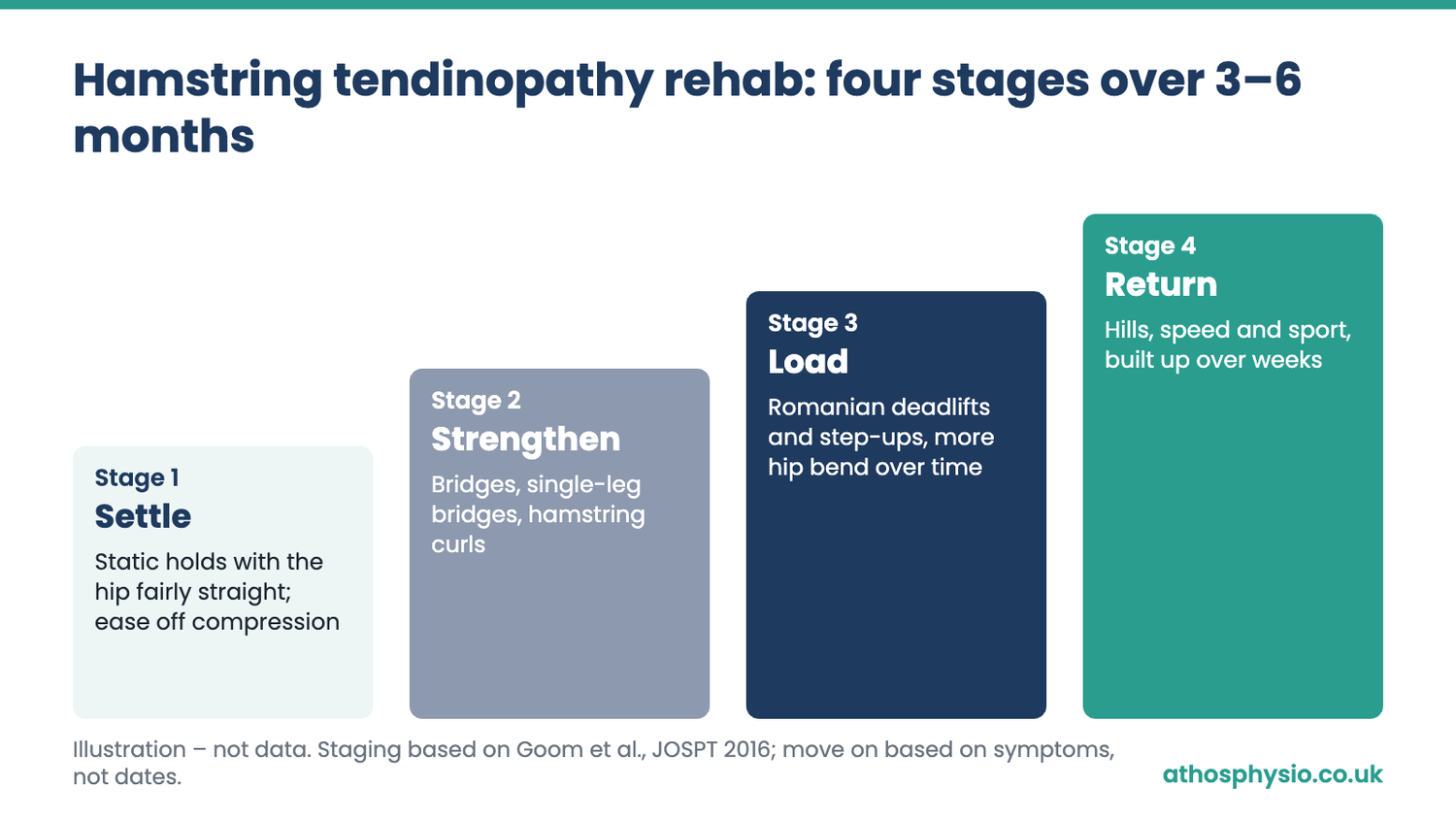
The aim is to calm the tendon first, then strengthen it in gradually more demanding positions. Do the exercises 3 times a week. Discomfort up to 3–4/10 that settles within 24 hours is OK. If the tendon is sorer the next morning, drop back a stage.
| Stage | Exercises | Dose | Move on when… |
|---|---|---|---|
| 1. Settle | Isometric bridge hold or hamstring hold against a step (no movement) | 5 × 30–45 seconds | Sitting and walking are more comfortable |
| 2. Strengthen (hip fairly straight) | Bridges, then single-leg bridges; hamstring curls | 3 × 8–12 | Little next-day pain |
| 3. Load (more hip bend) | Romanian deadlifts, starting light with a small range; step-ups | 3 × 6–10, adding weight gradually | Strong, comfortable through a bigger range |
| 4. Return to sport | Faster movements, hill and speed work, gradually reintroduced | Build over several weeks | Full training without a flare-up |
Day to day:
- Sit on a cushion, or a folded towel under your thighs so your sitting bones have less pressure, and take regular standing breaks.
- Avoid deep hamstring stretches for now.
- Reduce hills, fast starts and speed work until the later stages, but keep steady, flat running if it stays in the 0–3/10 zone.
How long does hamstring tendinopathy take to heal?
Tendons adapt slowly. The staged programme in the 2016 review is expected to take 3–6 months, with plenty of individual variation, and long-standing cases can take longer. Progress is rarely a straight line: expect good and bad weeks, especially after a long drive or a hilly run.
Is it my hamstring tendon, my back or the sciatic nerve?
Buttock pain has several possible sources, and they can overlap:
- Lower back: pain that changes with back movement, or comes with back stiffness. See our lower back pain page.
- Sciatic nerve: burning or shooting pain, pins and needles, or numbness below the knee. The nerve runs close to the tendon, so sometimes both are irritated. See sciatica.
- Hamstring strain: a sudden pain during sprinting, often with bruising. See hamstring injury.
A physio assessment can usually tell these apart without a scan.
When to see a physio, GP, 111 or 999
Call 999 or go to A&E if you have back or buttock pain with numbness around your genitals or bottom, or new problems controlling your bladder or bowels.
Get an urgent GP appointment or call 111 if you:
- felt a sudden pop at the top of the hamstring with severe pain and bruising (a possible tendon tear, which may need a surgical opinion)
- have weakness in your leg, or numbness that's getting worse
- have a fever, or feel unwell, with the pain
See a physio if the pain hasn't improved after 2–3 weeks of reducing aggravating activities, or it's stopping you from running, training or sitting at work.
How we help at Athos Physio
Our clinic is inside F45 Manchester NQ, at 77 Piccadilly. We'll confirm whether the pain is coming from the tendon, your back or the nerve, then build a custom rehab and strengthening plan that fits your running or gym training. We'll also help you adjust your desk set-up and training load while the tendon settles. You don't need a GP referral, and we work with Bupa, WPA, Vitality and Aviva. Book an appointment, or see our running injury physio.
FAQs
How should I sit with hamstring tendinopathy?
Reduce pressure on the sitting bone: use a cushion, or a folded towel under your thighs so the sitting bones are lifted slightly. Avoid low, hard seats, and stand up every 30–45 minutes. Sitting with your hips slightly higher than your knees can also help.
Can I run with hamstring tendinopathy?
Often, yes, if you keep it easy and flat and the pain stays at 3/10 or less and settles by the next morning. Cut back on hills, speed work and long strides first, as these load the tendon most. If running makes it steadily worse, pause and get it assessed.
Does hamstring tendinopathy go away?
Usually, yes, but rarely on its own with rest alone, as rest doesn't rebuild the tendon's capacity. With a progressive strengthening plan, most people improve over 3–6 months. Long-standing cases may take longer.
Can hamstring tendinopathy cause sciatica?
The sciatic nerve runs close to the hamstring tendon, so irritation in the area can sometimes cause nerve-type symptoms. But true sciatica usually comes from the lower back. Shooting pain, pins and needles or numbness below the knee should be assessed.
Can I cycle with high hamstring tendinopathy?
Often, yes. Cycling usually puts less load through the tendon than running, but a low, aggressive riding position bends the hip a lot and can compress it. Try a slightly more upright position and a well-padded saddle, and keep sessions comfortable.
This article is general information, not a substitute for an individual assessment.
Sources
- Goom TS, et al. Proximal hamstring tendinopathy: clinical aspects of assessment and management. J Orthop Sports Phys Ther 2016;46(6):483–493. https://doi.org/10.2519/jospt.2016.5986
- Nasser AM, et al. Proximal hamstring tendinopathy: a systematic review of interventions. Int J Sports Phys Ther 2021;16(2):288–305. https://doi.org/10.26603/001c.21250
- Dizon P, et al. Comparison of conservative interventions for proximal hamstring tendinopathy: a systematic review and recommendations for rehabilitation. Sports (Basel) 2023;11(3):53. https://doi.org/10.3390/sports11030053
Related: Hamstring injury · Running injury physio · Hip pain physio · The 5 most common running injuries · All conditions we treat
Reviewed by Nick Chatziviltsos, PgDip, HCPC-registered physiotherapist (PH114351).