

Hip pain at night is most often caused by irritated tendons on the outside of the hip, called gluteal tendinopathy (often labelled trochanteric bursitis), which hurts when you lie on your side. Hip osteoarthritis and pain referred from the lower back are the other common causes. The surprise: in a well-run trial, a physio-led education and exercise programme beat a steroid injection, both at 8 weeks and a year later. Pain that's constant whatever position you're in, or comes with fever, weight loss or feeling unwell, should be checked by a GP.
Key takeaways
- Most night-time hip pain is positional: it builds when you lie a certain way and eases when you move. That pattern is reassuring.
- The usual culprit is the gluteal tendons on the outside of the hip, not just the bursa.
- In a 2018 trial, 77% of people improved with education plus exercise at 8 weeks, compared with 58% after an injection and 29% with "wait and see".
- Pillow between the knees, not lying on the sore side and avoiding crossing your legs are simple first steps.
- See a GP promptly for constant night pain, fever, weight loss or a hip you can't put weight on.
Why does my hip hurt more at night?
At night your hip stays in one position for hours, often with pressure on one side. That's a problem for a sensitive tendon:
- Lying on the sore side presses the tendons against the bony point on the outside of the hip.
- Lying on the other side lets your top knee drop across the bed, which stretches and squeezes the same tendons.
- With arthritis, the joint stiffens when it's still, and you have fewer distractions from pain.
| Where it hurts | Most likely cause | Typical pattern |
|---|---|---|
| Outside of the hip, may spread down the side of the thigh | Gluteal tendinopathy ("trochanteric bursitis") | Worse lying on either side, climbing stairs, standing on one leg, crossing legs |
| Groin, sometimes the front of the thigh or knee | Hip osteoarthritis | Stiffness after rest, pain putting on socks or getting out of the car |
| Buttock, sometimes down the leg | Lower back or sciatic nerve | Changes with back movement; may have pins and needles |
| Pelvis, front or back, in pregnancy | Pregnancy-related pelvic girdle pain | Worse turning over in bed, on stairs or standing on one leg |
The myth: "It's bursitis, so you need an injection"
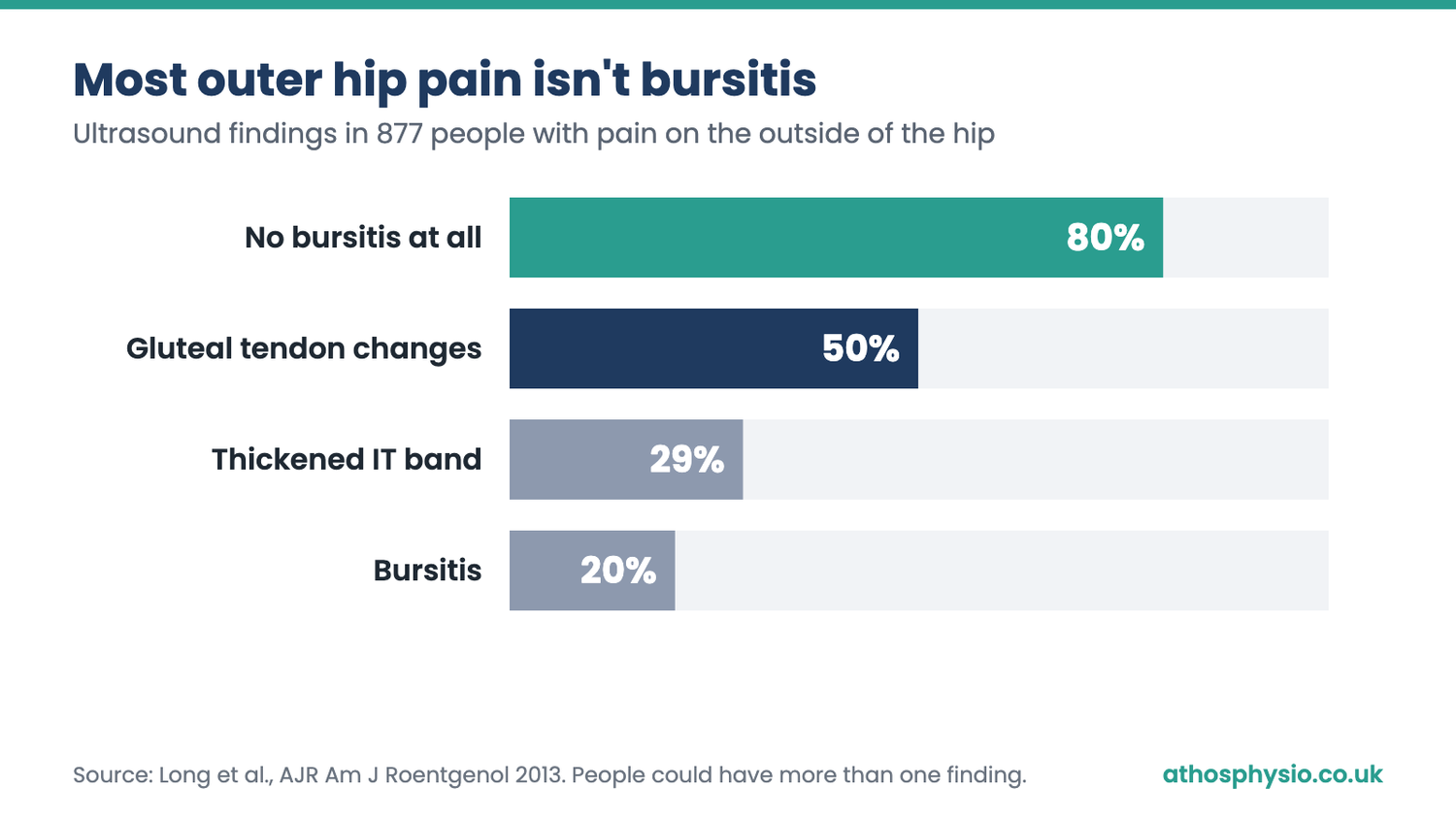
"Trochanteric bursitis" is still the label many people are given. But when researchers scanned 877 people with this kind of pain using ultrasound, 80% had no bursitis at all. Half had changes in the gluteal tendons, and over a quarter had a thickened iliotibial band. The bursa (a small fluid sac) is involved in only a minority. That's why the condition is now often called gluteal tendinopathy or greater trochanteric pain syndrome.
The label matters because it changes the treatment. If the problem is a tendon that's lost its tolerance to load, the fix is to reduce compression and rebuild strength, not just to dampen inflammation.
What the research says
The LEAP trial (BMJ, 2018) compared three approaches in 204 people aged 35–70 with at least 3 months of outer hip pain:
- education plus exercise: 14 physio sessions over 8 weeks
- one steroid injection
- wait and see
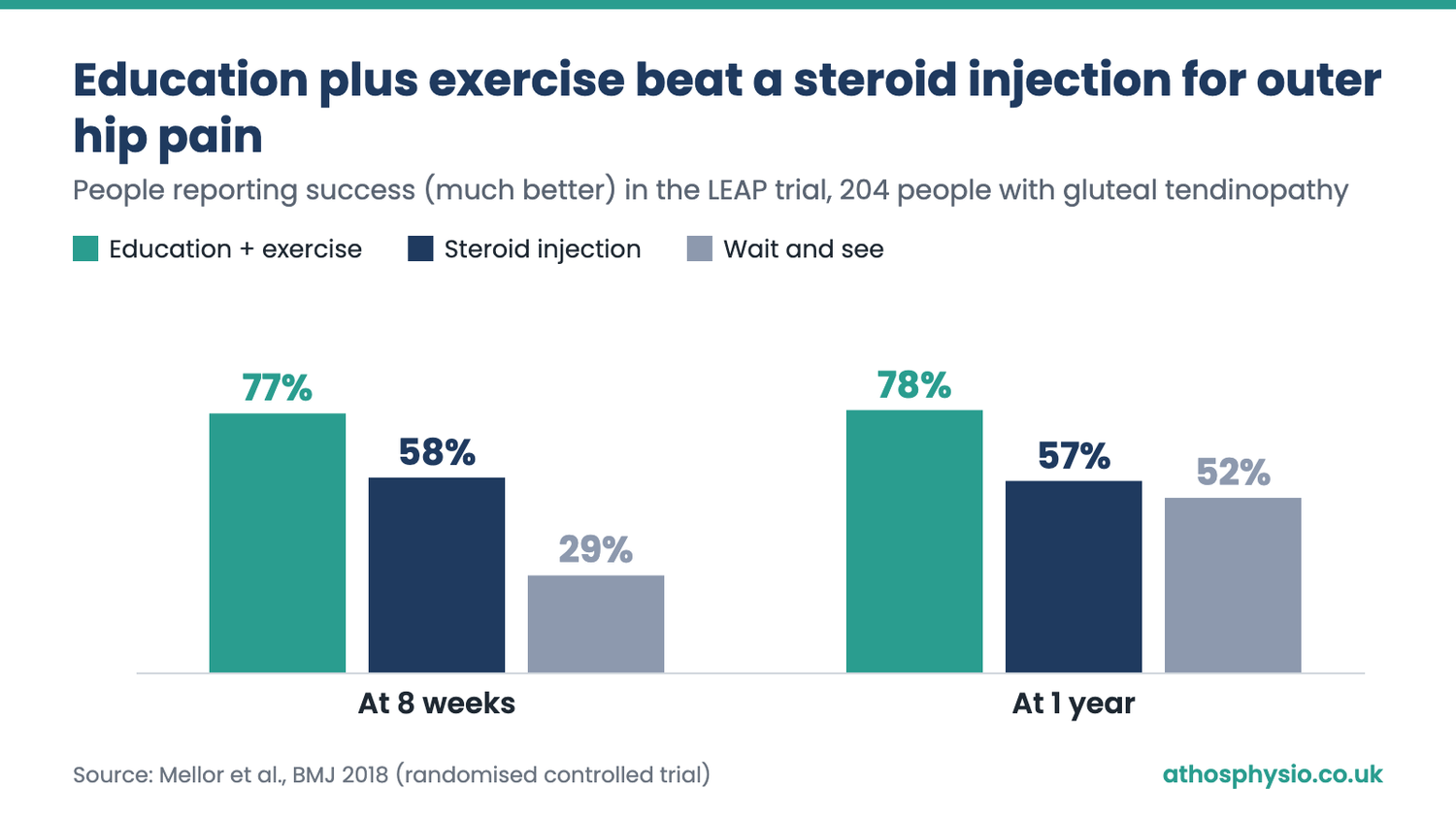
At 8 weeks, 77% of the education and exercise group reported success, compared with 58% after an injection and 29% with wait and see. At a year, education and exercise was still ahead on overall improvement (78% vs 57% vs 52%), although pain scores at a year were similar between exercise and injection.
A 2022 network meta-analysis of 13 trials (1,034 people) found that structured exercise was the only treatment that significantly improved function compared with no treatment at 1–3 months. Platelet-rich plasma (PRP) and shockwave therapy may give short-term pain relief. No treatment clearly beat no treatment for pain at 6–12 months.
Reading this critically: LEAP is a single, good-quality trial, mostly in women in their 50s, so it may not apply to everyone. The education and exercise programme was quite intensive, with 14 sessions. And injections do help in the short term, so they can still have a place if pain is stopping you sleeping and moving. But the evidence suggests an injection on its own isn't the best long-term answer.
Hip osteoarthritis: aching and stiffness
Hip osteoarthritis usually causes groin pain, stiffness after rest, and difficulty with socks, shoes and getting in and out of the car. Night pain can happen in more advanced cases.
NICE guidance (2022) recommends offering therapeutic exercise to everyone with osteoarthritis, and diagnosing it clinically, without imaging, in people aged 45 or over with typical symptoms. It suggests considering referral for joint replacement when symptoms are substantially affecting your quality of life and non-surgical treatment, such as exercise, weight loss and pain relief, hasn't worked. Night pain that stops you sleeping is worth raising with your GP in that conversation. Read more about knee and hip osteoarthritis.
What you can do tonight
In bed:
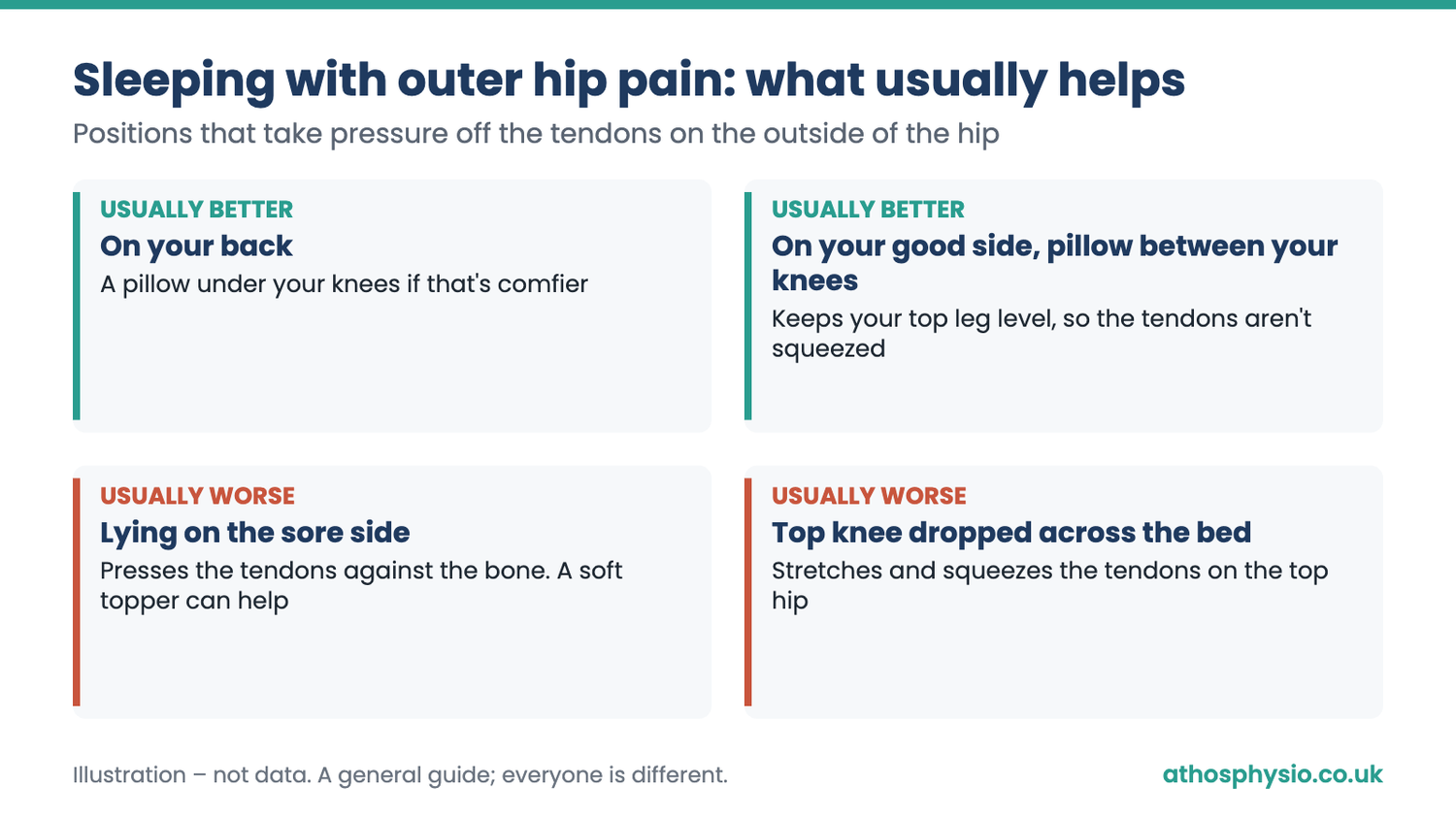
- Sleep on your back, or on your good side with a pillow between your knees so your top leg doesn't drop across.
- Avoid lying directly on the sore side. If you must, a soft mattress topper can reduce the pressure.
During the day:
- Don't cross your legs or stand with your weight hanging on one hip.
- Avoid low chairs where your knees end up higher than your hips.
- Break up long walks and stair climbs while it's sore, rather than stopping them.
- Avoid stretches that pull your knee across your body, such as the classic "ITB stretch". They squeeze the irritated tendons.
Exercises to start with (daily, or most days; discomfort up to 3–4/10 that settles by the next morning is OK):
- Static glute hold: lie on your back with your knees bent and a belt around your thighs. Gently push your knees out against the belt. 5 × 30–45 seconds.
- Bridges: 3 × 10, then progress to holding the top for 5 seconds.
- Sit-to-stand from a chair that keeps your hips above your knees: 3 × 10.
- Later: side-stepping, step-ups and single-leg balance, built up over several weeks.
How long does it take?
In LEAP, most people who did the education and exercise programme had improved by the end of its 8 weeks, and the benefit lasted at a year. If your pain has been going on for years, expect it to take longer. Sleep often improves before walking and stairs do.
When to see a physio, GP, 111 or 999
Call 999 or go to A&E if you can't put weight on your leg after a fall, or your leg looks shortened or turned outwards.
See a GP urgently or call 111 if:
- the hip is hot, swollen or very painful and you have a fever or feel unwell
- the pain is constant and severe, doesn't change with position, and wakes you every night
- you have unexplained weight loss, night sweats or a history of cancer
- your calf is swollen, red or warm
See a physio if night pain has lasted more than 2 weeks, keeps coming back, or is stopping you walking, exercising or sleeping well.
How we help at Athos Physio
Our clinic is inside F45 Manchester NQ, at 77 Piccadilly. We'll work out whether the pain is coming from the tendons, the joint or your back, explain what's going on, and build a custom rehab and strengthening plan based on what's worked in the research. If walking into the city centre is difficult, we also offer home visits. You don't need a GP referral, and we work with Bupa, WPA, Vitality and Aviva. Book an appointment, or read more about hip pain physio in Manchester.
FAQs
What is the best sleeping position for hip pain?
For pain on the outside of the hip, sleep on your back or on your good side with a pillow between your knees. This stops your top leg dropping across your body and squeezing the tendons. Avoid lying on the painful side, or use a soft mattress topper if you have to.
Is hip pain at night a sign of arthritis?
Not usually. Pain on the outside of the hip that's worse lying on your side is more often gluteal tendinopathy. Arthritis typically causes groin pain and stiffness, and night pain tends to come later on. A physio or GP can usually tell the difference without a scan.
Will a steroid injection help hip pain at night?
It may help in the short term. In the LEAP trial, an injection beat waiting, but an education and exercise programme did better at 8 weeks and on overall improvement at a year. An injection can be useful if pain is stopping you sleeping and moving, ideally alongside exercise.
When should I worry about hip pain at night?
See a GP if the pain is constant and doesn't change with position, wakes you every night, or comes with fever, weight loss, night sweats or feeling unwell. Get urgent help if you can't put weight on your leg after a fall.
Do I need a GP referral to see a physio for hip pain?
No. You can book directly with Athos Physio. If we think you need a GP, scan or specialist opinion, we'll explain why.
This article is general information, not a substitute for an individual assessment.
Sources
- Mellor R, et al. Education plus exercise versus corticosteroid injection use versus a wait and see approach on global outcome and pain from gluteal tendinopathy: prospective, single blinded, randomised clinical trial (LEAP). BMJ 2018;361:k1662. https://doi.org/10.1136/bmj.k1662
- Long SS, et al. Sonography of greater trochanteric pain syndrome and the rarity of primary bursitis. AJR Am J Roentgenol 2013;201(5):1083–1086. https://doi.org/10.2214/AJR.12.10038
- Gazendam A, et al. Comparative efficacy of nonoperative treatments for greater trochanteric pain syndrome: a systematic review and network meta-analysis of randomized controlled trials. Clin J Sport Med 2022;32(4):427–432. https://doi.org/10.1097/JSM.0000000000000924
- NICE. Osteoarthritis in over 16s: diagnosis and management (NG226), 2022. https://www.nice.org.uk/guidance/ng226
Related: Trochanteric bursitis · Hip pain physio · Knee and hip osteoarthritis · Lower back pain · Pregnancy physio · All conditions we treat
Reviewed by Nick Chatziviltsos, PgDip, HCPC-registered physiotherapist (PH114351).