

What is shockwave therapy? It's a non-invasive treatment that sends short, strong pressure waves through the skin into a painful tendon or fascia. Does it work? For some problems, yes: the evidence is strong for plantar fasciitis (heel pain). For others, such as patellar tendinopathy and non-calcific shoulder pain, it's weak or absent. So "does shockwave therapy work?" is really the wrong question. The useful one is: does it work for my problem, and alongside what? Here's an honest, condition-by-condition answer from a clinic that uses it.
Key takeaways
- It's not one answer. Shockwave has strong evidence for plantar fasciitis, promising but low-certainty evidence for calcific shoulder tendinopathy, and little or no benefit for several other tendon problems.
- It works best as an add-on. The clearest results come when shockwave is added to a strengthening (loading) programme, not used on its own.
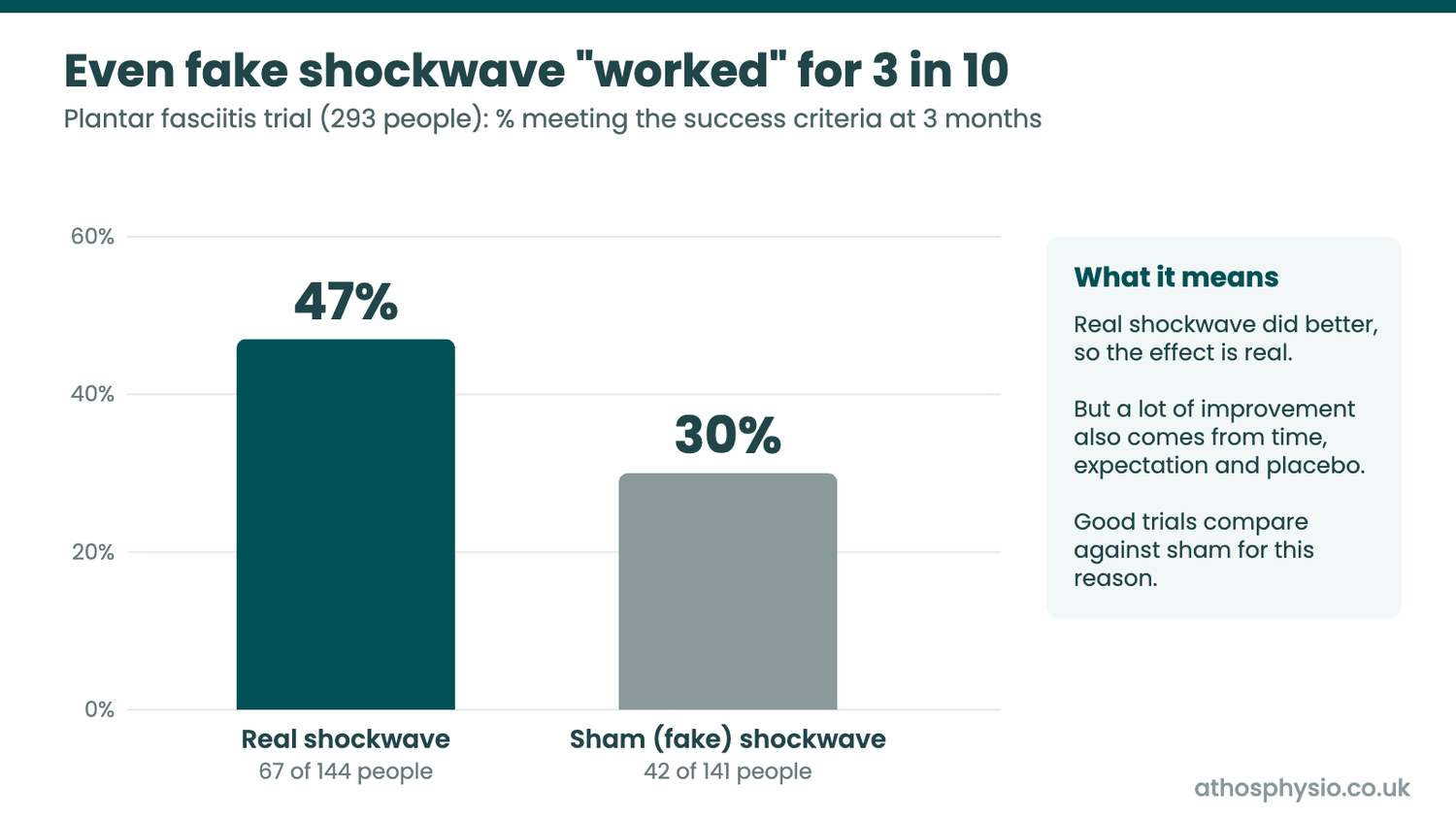
- Placebo is big. In one large trial, 30% of people having a fake shockwave treatment still met the "success" criteria. Good trials compare against sham for this reason.
- Nobody fully knows how it works. UK guidance says the mechanism is unknown. Claims that it "breaks up scar tissue" go beyond the evidence.
- It's generally safe. Expect redness, tenderness and sometimes bruising for a day or two. Serious problems are rare in the trials.
What is shockwave therapy?
Shockwave therapy (also written "shock wave therapy", and properly called extracorporeal shockwave therapy, or ESWT) uses a hand-held device to deliver rapid, high-pressure sound waves through gel on the skin. "Extracorporeal" just means the waves are produced outside the body. There are no needles and nothing breaks the skin.
It started as a way to break up kidney stones. There are two main types:
- Focused shockwave concentrates energy at a point deeper in the tissue.
- Radial shockwave spreads the energy out from the applicator, so it's strongest near the surface. This is what we use at Athos Physio (a Chattanooga Intelect RPW 2).
Treatment is usually 3–5 sessions about a week apart, each with 5–10 minutes of shockwave, for long-standing tendon or fascia pain that hasn't settled with rehab. See how a session runs on our shockwave therapy page.
How does shockwave therapy work? (The honest answer: we're not sure)
Many clinic websites say shockwave "creates micro-trauma that restarts healing", "breaks down scar tissue" or "boosts blood flow". These are hypotheses, not facts.
- NICE, which advises the NHS, says the mechanism is unknown.
- A 2023 review of the biological effects found new blood vessel growth and changes in tendon cells and collagen, but largely in animal and lab models. It also found that too high a dose can injure the tendon.
- The leading ideas are reduced pain sensitivity and a stimulus for tendon remodelling. Neither is proven in patients.
Why does this matter? If you're told shockwave is "breaking up" your problem, it's tempting to rest while the machine does the work. But tendons adapt to load, and the best results mostly come from combining shockwave with exercise.
Does shockwave therapy work? The evidence, condition by condition
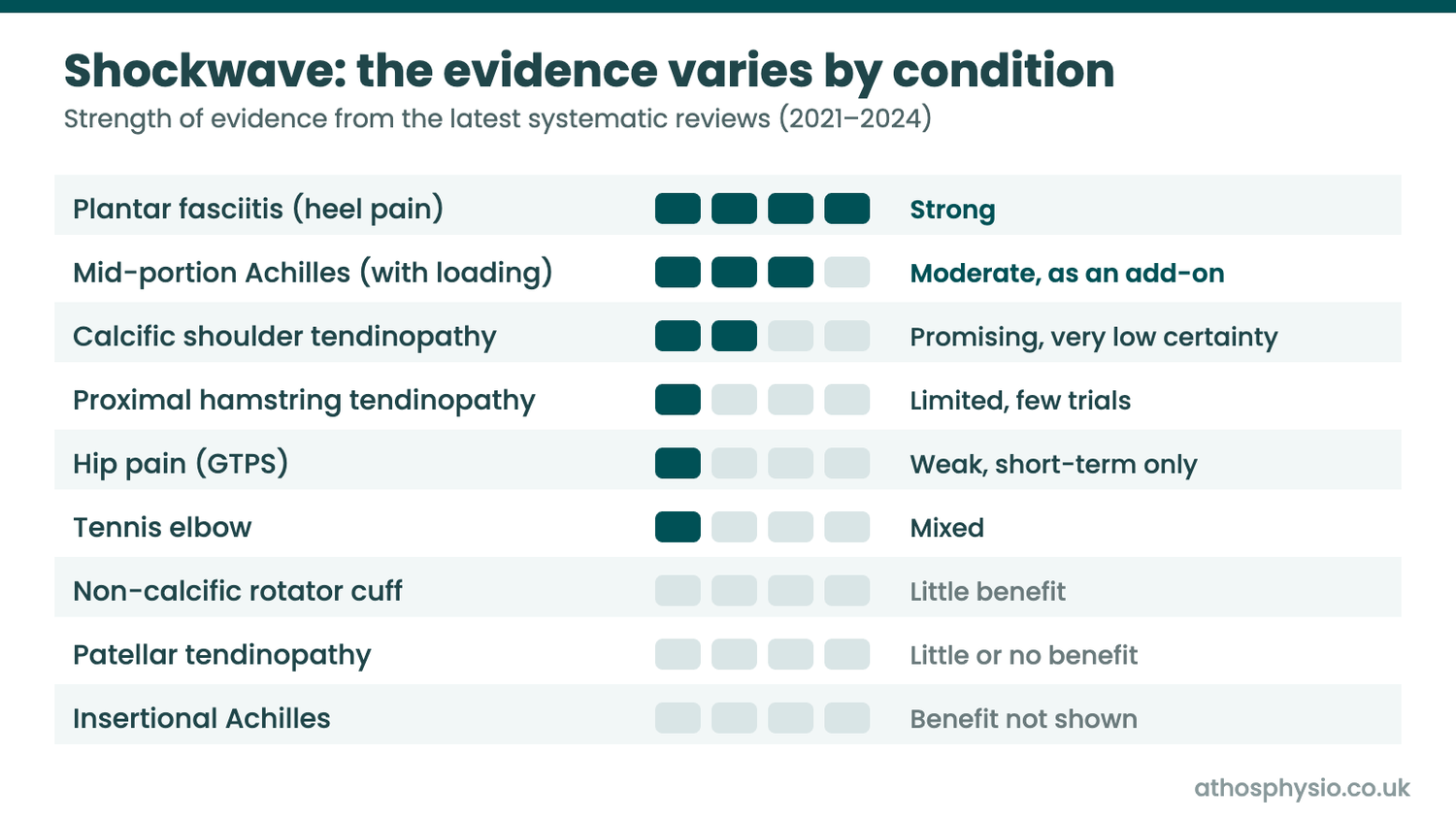
This is a summary of the most recent systematic reviews, the type of study that pools all the trials on a question. "Certainty" describes how much we can trust the result, not how big it is.
| Condition | What recent reviews found | Strength of evidence |
|---|---|---|
| Plantar fasciitis (heel pain) | Large effect on pain and function, short and long term. Radial and focused both reduced pain. | Strong – the best-supported use |
| Calcific shoulder tendinopathy | Beat sham treatment for pain and function at 24 weeks. Higher energy worked better than low. Ultrasound-guided needling did better still. | Promising, but very low certainty |
| Mid-portion Achilles tendinopathy | Added to a loading programme, it improved a standard Achilles score by about 10 points (out of 100). | Moderate, as an add-on only |
| Hip pain (greater trochanteric pain syndrome) | Less pain at 2–4 months; function gains at 6 months too small to matter. 7 of 8 trials at high risk of bias. | Weak, short-term only |
| Tennis elbow | 27 trials: no clinically meaningful benefit over sham or steroid injection, though it beat laser and ultrasound. | Mixed |
| Proximal hamstring tendinopathy | Some higher-quality trials in athletes suggest it may help. | Limited – few trials |
| Non-calcific rotator cuff (shoulder) pain | Small short-term pain benefit over sham; no better for function, and no better than other treatments. | Moderate certainty of little benefit |
| Patellar tendinopathy (jumper's knee) | Negligible effect compared with placebo. | Low–moderate certainty of no real benefit |
| Insertional Achilles (where the tendon meets the heel) | No added value over standard care. | Very low – benefit not shown |
Reading this critically:
- Plantar fasciitis has the best results. A 2023 meta-analysis rated the evidence high quality, with a large effect on pain and function. A 2024 review of 11 trials found radial and focused shockwave both reduced pain.
- UK guidance hasn't caught up. NICE's guidance on shockwave for stubborn plantar fasciitis dates from 2009. It raised no major safety concerns but called the evidence on effectiveness "inconsistent", and asks for special arrangements for consent and audit. Much of the stronger evidence came later.
- One tendon isn't another. Achilles is the clearest example: moderate evidence for the middle of the tendon, none where it attaches to the heel.
- Many trials are small, use different settings and follow people for only a few months. Most hip and shoulder trials were rated at high risk of bias. Treat anything below "moderate" as "might help", not "proven".
- Reviews sometimes disagree. A 2024 review in athletes suggested shockwave may help tennis elbow; a larger 2021 review found no meaningful benefit over sham.
Myth vs evidence
Myth: "I felt better after shockwave, so the shockwave worked."
Evidence: Maybe, but not necessarily. In a randomised trial of 293 people with plantar fasciitis summarised by NICE, 47% of people who had real shockwave met the trial's "success" criteria at 3 months, but so did 30% of those who had a sham (fake) treatment. Real shockwave did better, which is why plantar fasciitis is its strongest use. But a large share of the improvement people notice comes from time, expectation and the natural course of the condition. NICE noted "a substantial placebo response" across the trials.
Two more beliefs worth challenging:
- "Shockwave is a cure on its own, so I can rest while it works." The best Achilles evidence comes from shockwave added to a loading programme. Rest lowers a tendon's capacity, which is often why it hurts in the first place. See our guide to active vs passive physiotherapy.
- "If it works for heel pain, it'll work for any tendon." It doesn't. Patellar tendinopathy, non-calcific shoulder pain and insertional Achilles pain show little or no benefit. That's why we don't recommend shockwave for ordinary rotator cuff pain (read more in our rotator cuff tendinopathy guide).
Where shockwave fits in your rehab
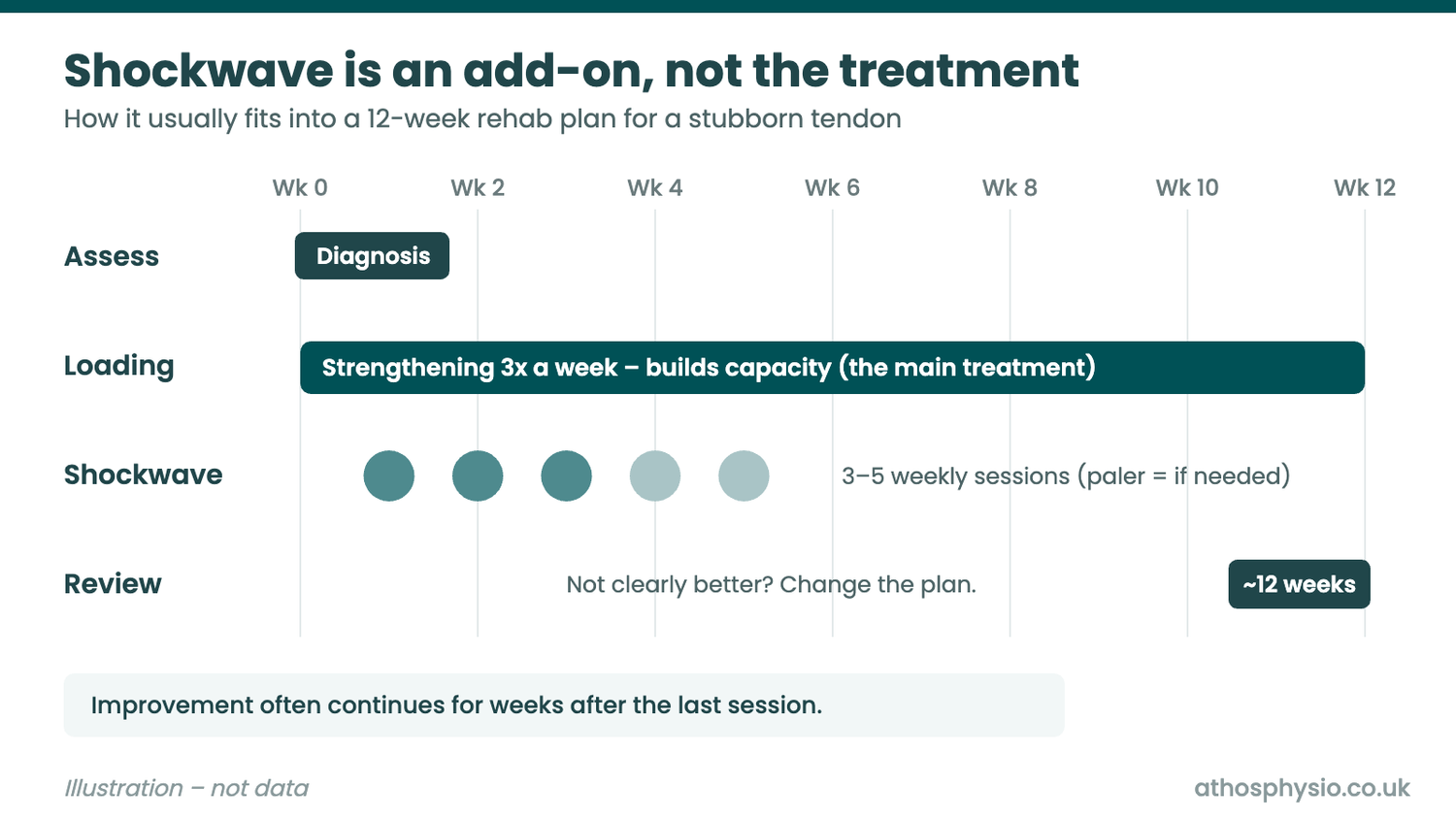
Think of shockwave as a way to calm pain and make loading easier, not as the treatment itself. A typical plan for a stubborn tendon or plantar fascia problem:
- Diagnosis first. Heel pain isn't always plantar fasciitis. Shockwave on the wrong diagnosis is wasted money.
- A loading programme, usually slow, heavy strengthening 3 times a week. This is what builds capacity.
- 3–5 weekly shockwave sessions, if the evidence for your condition is decent and pain is holding you back.
- Keep loading after the last session. Improvement often continues for weeks, and strength is what stops it coming back.
- Review at around 12 weeks. Not clearly better? Change the plan rather than adding sessions.
Pain guide for your exercises: discomfort of up to 3–4 out of 10 during exercise is usually fine, as long as it settles within 24 hours and isn't worse the next morning. If it's sharper, lasts longer or builds week on week, reduce the load and tell your physio.
Is it worth paying for? Most likely if you have plantar fasciitis, mid-portion Achilles or calcific shoulder tendinopathy, it's lasted 3 months or more, and proper rehab has only partly helped. Least likely for a new injury or the conditions where trials show little benefit.
Side effects and who shouldn't have it
Shockwave is generally safe. In the plantar fasciitis trials reviewed by NICE, the commonest problems were skin reddening (12% with real shockwave vs 4% with sham), pain during treatment and local swelling. Bruising and soreness for a day or two can also happen. It should feel like strong tapping: uncomfortable but tolerable.
You usually shouldn't have shockwave if you:
- are pregnant
- have a bleeding disorder or take blood-thinning medication
- have cancer or a tumour near the area
- have an infection, open wound or skin problem over the area
- had a steroid injection in the area recently
- are under 18 and the area is near a growth plate
- have a pacemaker or other implanted device near the area
When to see a professional first
Don't book shockwave for a new or changing problem without an assessment. Get checked by a physio or GP first if you have:
- pain in one spot on a bone that's worse with every run (possible stress fracture)
- numbness, pins and needles or burning pain (possible nerve involvement)
- pain that's constant, worse at night and not eased by rest
Seek urgent help (A&E or 999) if you feel a sudden snap or "kick" in the back of your ankle and can't push off or stand on tiptoe (possible Achilles rupture), or if your calf is hot, red, swollen and painful (possible blood clot). Contact your GP or NHS 111 if joint or tendon pain comes with fever, unexplained weight loss or feeling generally unwell.
Shockwave therapy at Athos Physio, Manchester
We offer radial shockwave at our clinic inside F45 Training Studio, 77 Piccadilly, as part of a physio plan, not instead of one. Every course starts with an assessment, so we only recommend it where your diagnosis and the evidence support it.
- No GP referral needed. We work with Bupa, WPA, Vitality and Aviva.
- Open Monday to Friday, 7am–8pm, a 5-minute walk from Piccadilly station.
- Shockwave is a £60 add-on to a physio session. See the price list and our shockwave therapy page.
- Book an assessment
FAQs
How does shockwave therapy work? It sends rapid pressure waves into the painful tissue. Researchers think it reduces pain sensitivity and may stimulate tendon remodelling, but NICE describes the mechanism as unknown. In practice it works best as a way to calm pain so you can load the tendon, which is what builds lasting strength.
Does shockwave therapy hurt? It's usually uncomfortable rather than painful: a strong, fast tapping over the sore spot. The intensity can be started low and increased as you get used to it. Mild soreness, redness or bruising for a day or two afterwards is normal.
Can shockwave therapy cause damage? Serious harm is rare in the trials, where side effects were mostly skin reddening, swelling and temporary pain. Lab studies show that very high doses can injure tendons, which is why settings matter and why screening for things like blood-thinning medication and pregnancy is essential.
Is shockwave therapy effective? It depends on the condition. The evidence is strongest for plantar fasciitis, promising for calcific shoulder tendinopathy, and moderate for mid-portion Achilles pain when combined with exercise. For patellar tendinopathy, non-calcific shoulder pain and insertional Achilles pain, trials show little or no benefit.
Can you exercise after shockwave therapy? Usually yes. Most people keep doing their rehab exercises and normal activity, sometimes easing back on running or high-impact training for a day or two if the area is sore. Your physio should tell you exactly what to adjust.
What if shockwave therapy doesn't work? If you're not clearly improving around 12 weeks after starting, more sessions are rarely the answer. Check the diagnosis, then look at your loading programme, training load and other options such as needling procedures for calcific shoulder deposits or injection, depending on the condition.
This article is general information, not a substitute for an individual assessment.
Sources
- Charles R, Fang L, Zhu R, Wang J. The effectiveness of shockwave therapy on patellar tendinopathy, Achilles tendinopathy, and plantar fasciitis: a systematic review and meta-analysis. Front Immunol 2023;14:1193835. https://doi.org/10.3389/fimmu.2023.1193835
- Lippi L, et al. Efficacy and tolerability of extracorporeal shock wave therapy in patients with plantar fasciopathy: a systematic review with meta-analysis and meta-regression. Eur J Phys Rehabil Med 2024;60(5):832–846. https://doi.org/10.23736/S1973-9087.24.08136-X
- Brindisino F, et al. The effectiveness of extracorporeal shock wave therapy for rotator cuff calcific tendinopathy: a systematic review with meta-analysis. Physiother Res Int 2024;29(3):e2106. https://doi.org/10.1002/pri.2106
- Paantjens MA, et al. Extracorporeal shockwave therapy for mid-portion and insertional Achilles tendinopathy: a systematic review of randomized controlled trials. Sports Med Open 2022;8(1):68. https://doi.org/10.1186/s40798-022-00456-5
- Rhim HC, et al. Extracorporeal shockwave therapy for greater trochanteric pain syndrome: a systematic review with meta-analysis of randomized clinical trials. JBJS Rev 2024;12(8). https://doi.org/10.2106/JBJS.RVW.24.00091
- Karanasios S, et al. Clinical effectiveness of shockwave therapy in lateral elbow tendinopathy: systematic review and meta-analysis. Clin Rehabil 2021;35(10):1383–1398. https://doi.org/10.1177/02692155211006860
- Kamonseki DH, et al. Extracorporeal shockwave therapy for the treatment of noncalcific rotator cuff tendinopathy: a systematic review and meta-analysis. Am J Phys Med Rehabil 2024;103(6):471–479. https://doi.org/10.1097/PHM.0000000000002361
- Rhim HC, et al. Use of extracorporeal shockwave therapies for athletes and physically active individuals: a systematic review. Br J Sports Med 2024;58(3):154–163. https://doi.org/10.1136/bjsports-2023-107567
- Poenaru D, Sandulescu MI, Cinteza D. Biological effects of extracorporeal shockwave therapy in tendons: a systematic review. Biomed Rep 2023;18(2):15. https://doi.org/10.3892/br.2022.1597
- NICE. Extracorporeal shockwave therapy for refractory plantar fasciitis. HealthTech guidance HTG200 (formerly IPG311), 2009. https://www.nice.org.uk/guidance/htg200
Related: Shockwave therapy in Manchester · Plantar fasciitis · Achilles tendinopathy · Tennis elbow · Hip pain at night · Hamstring tendinopathy · All conditions we treat
Reviewed by Nick Chatziviltsos, PgDip, HCPC-registered physiotherapist (PH114351).