

How many rest days a week do you need? There's no research-proven magic number, and it depends on how hard and how often you train. What the evidence does show is that fitness is built during recovery, not during the workout, that most muscles grow better when trained twice a week rather than once, and that the bigger injury risks for most people are sudden jumps in training and short sleep, rather than training too often. Athletes don't treat rest as laziness; they plan it. Here's how to do the same, whatever your level.
Key takeaways
- Adaptation happens in recovery. Training is the stimulus; getting fitter and stronger happens while you rest.
- Spread your training. The NHS recommends activity over 4–5 days a week or every day, with strength work on at least 2 days.
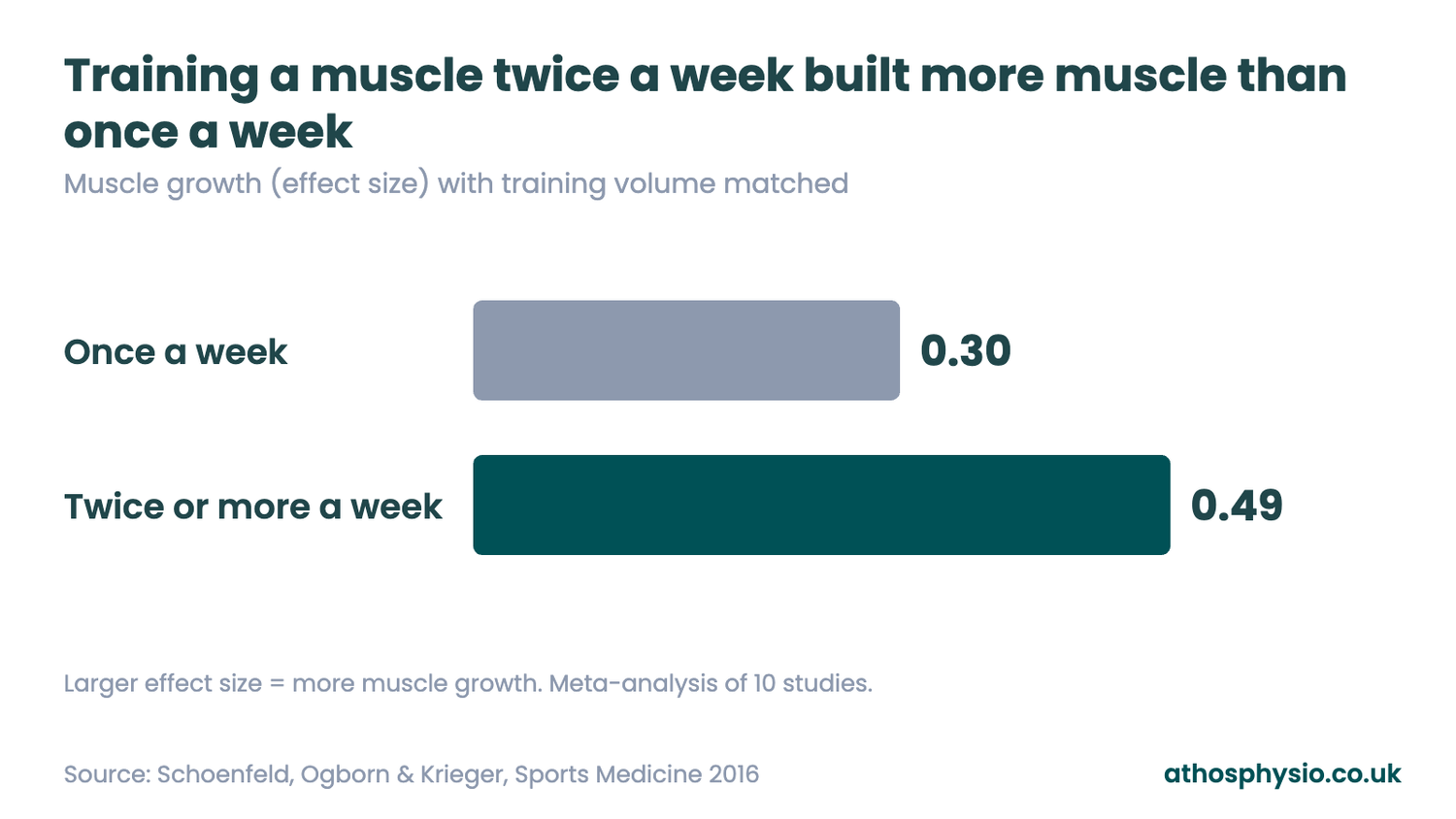
- For muscle, twice a week beats once. Training each muscle group at least twice a week produced more growth in a 2016 meta-analysis.
- Spikes, not volume, cause most trouble. Rapid increases in training load are linked to more soft-tissue injuries; consistent training is protective.
- Sleep is part of recovery. Adolescent athletes sleeping under 8 hours were 1.7 times more likely to have been injured in one study.
Why do you need rest days at all?
Every hard session creates a small amount of fatigue and tissue stress. Your body responds by adapting: muscles get stronger, tendons get stiffer and your heart and lungs get more efficient. That adaptation needs time.
A joint consensus statement from the European College of Sport Science and the American College of Sports Medicine describes a spectrum:
- Functional overreaching: a short dip in performance after hard training that leads to improvement after recovery. This is normal, planned training.
- Non-functional overreaching: when training and recovery are out of balance, performance stays down for weeks.
- Overtraining syndrome: a prolonged, more severe version with fatigue, performance decline and mood changes.
The statement is honest about the limits: telling the last two apart is very difficult, and no single blood test or marker reliably diagnoses overtraining. Other causes, such as low energy intake, iron deficiency or illness, have to be ruled out first.
How many rest days a week do you need?
Guidelines don't give a fixed number of rest days, but they give useful limits:
- The NHS recommends adults do at least 150 minutes of moderate (or 75 minutes of vigorous) activity a week, spread over 4–5 days or every day, plus strengthening activities on at least 2 days.
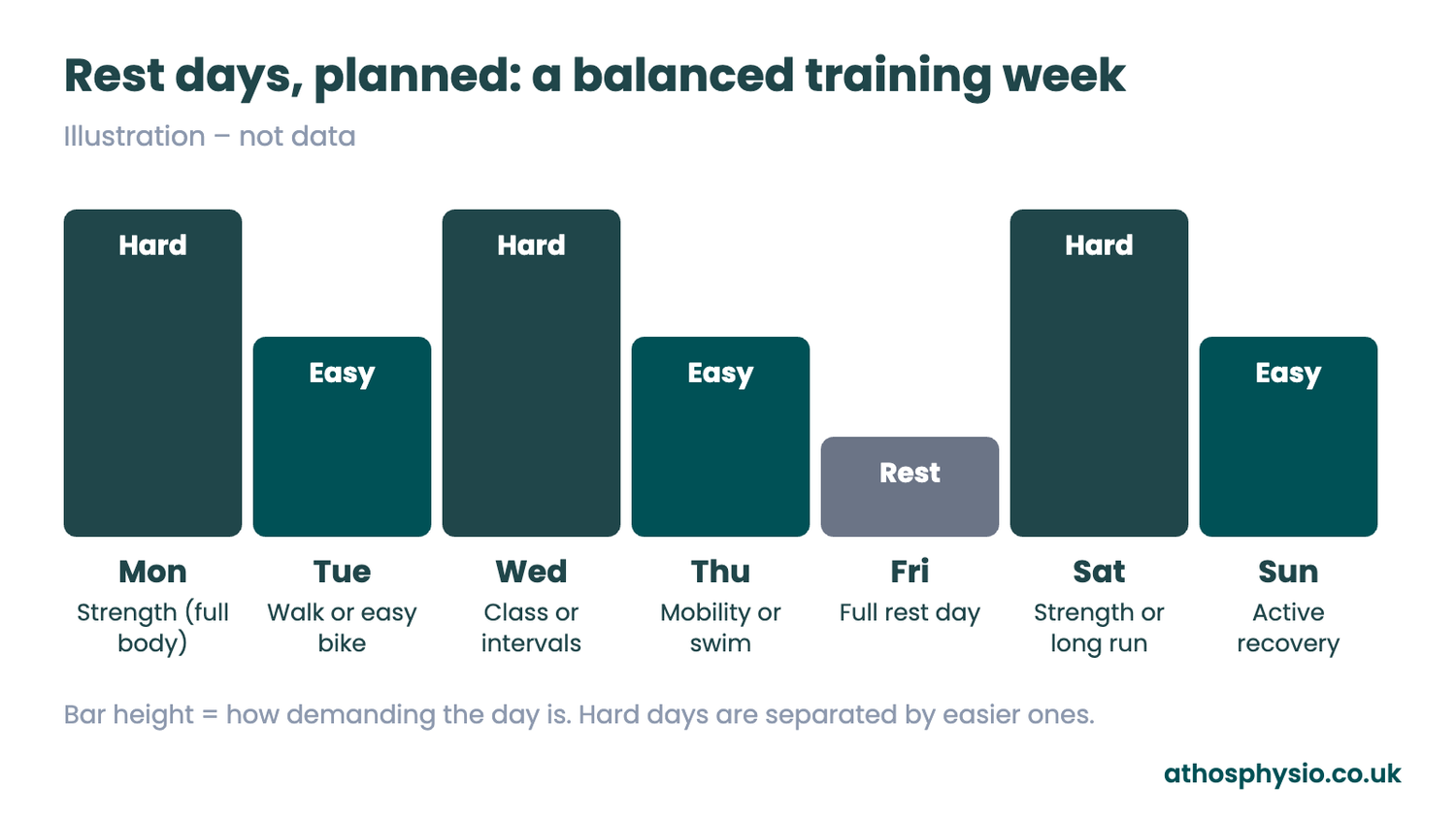
- That means a fully active week can include every day, as long as the hard days are balanced by easier ones.
In practice, the right number depends on your training. As a starting point, many people do well with at least one full rest day and one or two easier days each week, adjusting by how they feel. That's clinical common sense rather than a research finding; the next sections explain how to tell if it's working for you.
How many rest days to build muscle?
A 2016 meta-analysis in Sports Medicine compared resistance training frequencies across 10 studies. When weekly training volume was matched, training each muscle group at least twice a week produced more muscle growth than once a week.
So for building muscle, rest days aren't about avoiding the gym; they're about not hitting the same muscles hard on consecutive days. A full-body routine three times a week, or an upper/lower split over four days, both give each muscle group two sessions with recovery in between.
How strong is this? The meta-analysis was small (10 studies), and the authors couldn't reliably compare different numbers of sessions when each muscle was trained equally often. Treat "twice a week" as a good default rather than a rule.
Myth: "More rest is always the safer option"
Myth vs evidence
Myth: If you want to avoid injury, train less and rest more.
Evidence: In team sport athletes, higher, well-built-up training loads have been linked with fewer injuries, and under-training may increase injury risk. The problem is excessive and rapid increases in load. The International Olympic Committee's consensus on load also says that poor load management is a significant risk factor for illness and overtraining, with rapid changes in training, crowded schedules and psychological stress all part of the picture.
This "training-injury prevention paradox" means the goal isn't to do as little as possible. It's to build up gradually and consistently, so your body is ready for what you ask of it. A sudden jump, such as a first week back at the gym after a long break, a new class five days in a row, or a big jump in running mileage, is riskier than steady hard training. Our guide to doing too much too soon covers this in more detail.
What the evidence can't tell you: most load research comes from elite and team-sport athletes, and the exact "safe" rate of increase for a recreational gym-goer or runner isn't known.
Does sleep affect injury risk?
Sleep is probably the most underrated part of recovery. In a 2014 study of 112 adolescent athletes, those who slept on average less than 8 hours a night were 1.7 times more likely to have been injured than those who slept 8 hours or more.
That's a small, retrospective study in teenagers, so it shows an association, not proof that short sleep causes injury. But it fits with what athletes and coaches see: poor sleep, work stress and illness all reduce how well you recover from the same training.
Signs you need more recovery
You might need an extra rest day, or a lighter week (sometimes called a deload week), if you notice several of these for more than a few days:
| Sign | What it can look like |
|---|---|
| Performance drops | Usual weights feel heavy; easy runs feel hard |
| Persistent fatigue | Tired even after a night's sleep |
| Mood changes | Irritable, flat or losing motivation to train |
| Poor sleep | Trouble falling or staying asleep despite being tired |
| Lingering soreness | Muscle soreness that hasn't eased after 3–4 days |
| Niggles | New aches that are building rather than settling |
One bad session isn't a sign of overtraining. A pattern over one to two weeks is worth acting on.
What should you do on a rest day?
A rest day doesn't have to mean the sofa. Active recovery, meaning gentle movement that leaves you feeling better rather than tired, suits many people:
- an easy walk or relaxed bike ride (you can talk comfortably)
- mobility work or gentle yoga
- an easy swim
- a sports massage, which many people find helps them feel recovered, although it's not a substitute for sleep or sensible loading (see what the research says about sports massage)
Use the pain and effort guide: activity on a rest day should feel easy, and any discomfort should be no more than 3–4 out of 10 and settle within 24 hours.
How a physio can help you train like an athlete
Elite athletes have support staff tracking their load and recovery. You can borrow the same approach. At Athos Physio, Nick writes custom strengthening and training plans around your goals and schedule, whether that's a first 10k, regular F45 classes or getting back to sport after an injury. For runners we also offer Ochy running analysis, and sports massage is available for recovery.
If you're new to training, our guide to starting the gym as a beginner covers how often to train; runners should read how to increase running mileage safely.
When should you get checked?
Stop exercising and call 999 if you have chest pain, severe breathlessness, or feel faint or collapse during exercise.
Go to A&E if you have severe muscle pain and swelling with very dark (cola-coloured) urine after hard exercise.
See your GP if you have fatigue that lasts for weeks despite rest, unexplained weight loss, or frequent illnesses; these need checking before you blame training.
See a physio if you have pain in one spot of a bone that's getting worse with running or jumping, or a niggle that isn't settling after a week or two of reduced training.
FAQs
How many rest days a week should I have?
There's no fixed number. The NHS recommends spreading activity over 4–5 days a week or every day, with strength work on at least 2 days. Many people do well with at least one full rest day and one or two easier days. Adjust by how you're sleeping, feeling and performing.
How many rest days do I need to build muscle?
Rest each muscle group rather than whole days. A 2016 meta-analysis found training each muscle group at least twice a week built more muscle than once a week. Avoid training the same muscles hard on consecutive days, so a full-body routine three times a week works well.
Is it OK to work out every day?
Yes, if the intensity varies. The NHS says activity can be spread over every day of the week. Problems usually come from hard sessions every day with no easier days, or from sudden jumps in training. Keep some days light, sleep well and watch for signs of under-recovery.
What are the signs of overtraining?
Performance that stays down for weeks, persistent fatigue, low mood or irritability, poor sleep and soreness or niggles that keep building. There's no single test for overtraining, so other causes such as illness, iron deficiency or not eating enough need to be ruled out. A GP can check these.
What is a deload week?
A deload week is a planned lighter week, usually with less volume or intensity, to let your body recover and adapt before you build up again. It's widely used by coaches, though there's little direct research on how often to do one. Many people use one when signs of under-recovery appear.
Train smarter in Manchester
If you keep picking up niggles or aren't sure how to balance training and recovery, a physio assessment can help you plan it. Athos Physio is inside F45 Training Studio at 77 Piccadilly, Manchester M1 2BU, open Monday to Friday, 7am–8pm. You don't need a GP referral, and we work with Bupa, WPA, Vitality and Aviva. Book a physio appointment.
This article is general information, not a substitute for an individual assessment.
Sources
- Meeusen R, et al. Prevention, diagnosis, and treatment of the overtraining syndrome: joint consensus statement of the European College of Sport Science and the American College of Sports Medicine. Med Sci Sports Exerc 2013;45(1):186–205. https://doi.org/10.1249/MSS.0b013e318279a10a
- Schoenfeld BJ, Ogborn D, Krieger JW. Effects of resistance training frequency on measures of muscle hypertrophy: a systematic review and meta-analysis. Sports Med 2016;46(11):1689–1697. https://doi.org/10.1007/s40279-016-0543-8
- Gabbett TJ. The training-injury prevention paradox: should athletes be training smarter and harder? Br J Sports Med 2016;50(5):273–280. https://doi.org/10.1136/bjsports-2015-095788
- Soligard T, et al. How much is too much? (Part 2) International Olympic Committee consensus statement on load in sport and risk of illness. Br J Sports Med 2016;50(17):1043–1052. https://doi.org/10.1136/bjsports-2016-096572
- Milewski MD, et al. Chronic lack of sleep is associated with increased sports injuries in adolescent athletes. J Pediatr Orthop 2014;34(2):129–133. https://doi.org/10.1097/BPO.0000000000000151
- NHS. Physical activity guidelines for adults aged 19 to 64. https://www.nhs.uk/live-well/exercise/physical-activity-guidelines-for-adults-aged-19-to-64/
Related: Starting the gym as a beginner · Doing too much too soon? · Sports injury prevention · Strength training in physio · All conditions we treat
Reviewed by Nick Chatziviltsos, PgDip, HCPC-registered physiotherapist (PH114351).
