

Physiotherapy treatments range from exercise and manual therapy to taping, dry needling and machines that buzz or click. They're not equally useful. The research consistently puts exercise therapy in the lead: it's the only one UK guidelines recommend on its own for back pain and osteoarthritis. Most hands-on and gadget-based treatments give, at best, small short-term relief, and NICE advises against some of the most familiar ones, such as ultrasound and TENS, for those conditions. Here's an honest, treatment-by-treatment guide, so you know what you're paying for.
Key takeaways
- Exercise therapy leads. A Cochrane review of 249 trials found it reduces chronic back pain by a clinically important amount compared with no treatment or usual care.
- Manual therapy helps, modestly. Spinal manipulation and mobilisation work about as well as other recommended treatments. NICE says use them only alongside exercise.
- Taping, IASTM and dry needling show small or short-term effects at best, and little evidence of lasting benefit.
- NICE says don't offer ultrasound, TENS or interferential therapy for back pain or osteoarthritis, or acupuncture for either.
- A good physio uses hands-on treatment to support exercise, not replace it.
Which physiotherapy treatment works best?
For persistent musculoskeletal pain, the best-supported treatment is exercise therapy: a programme of strengthening, movement and conditioning exercises, tailored to you and progressed over time.
The biggest review of the evidence is a 2021 Cochrane review of 249 trials in chronic low back pain. Exercise reduced pain by about 15 points on a 0–100 scale compared with no treatment, usual care or placebo, a clinically important difference (moderate-certainty evidence). It did better than non-exercise physical therapy (about 10 points) and education alone (about 12 points). Compared with manual therapy, there was no difference.
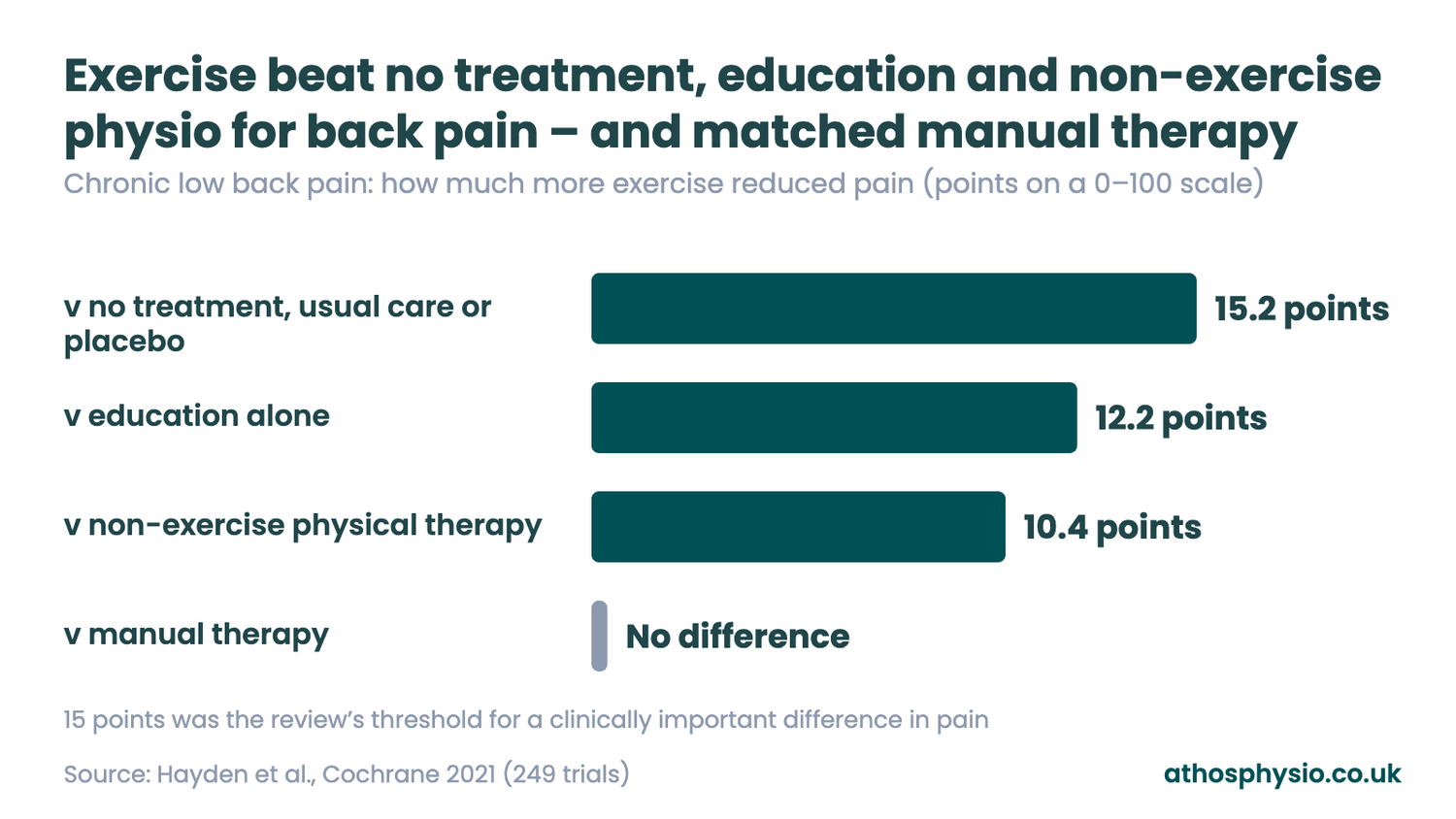
How strong is this? Moderate certainty: there are a lot of trials, but most had some risk of bias, partly because you can't blind people to whether they're exercising. The results also varied a lot between trials, and we still don't know which type of exercise suits which person best. That's why exercise programmes should be tailored rather than copied from a sheet.
NICE's guidance for osteoarthritis goes further: it says to offer therapeutic exercise to everyone with osteoarthritis, such as local muscle strengthening and general aerobic fitness.
What is manual therapy, and does it work?
Manual therapy means hands-on techniques: joint mobilisation (slow, repeated movements of a joint), manipulation (a quick thrust, sometimes with a click) and soft tissue techniques such as massage. Physios, osteopaths and chiropractors all use them.
A 2019 BMJ review of 47 trials with 9,211 people with chronic low back pain found that spinal manipulation and mobilisation had similar effects to other recommended treatments for short-term pain, with a small extra improvement in function. Side effects were mostly mild and temporary, such as soreness. Evidence against sham (fake) treatment was low quality, so we can't be sure how much of the effect is specific to the technique.
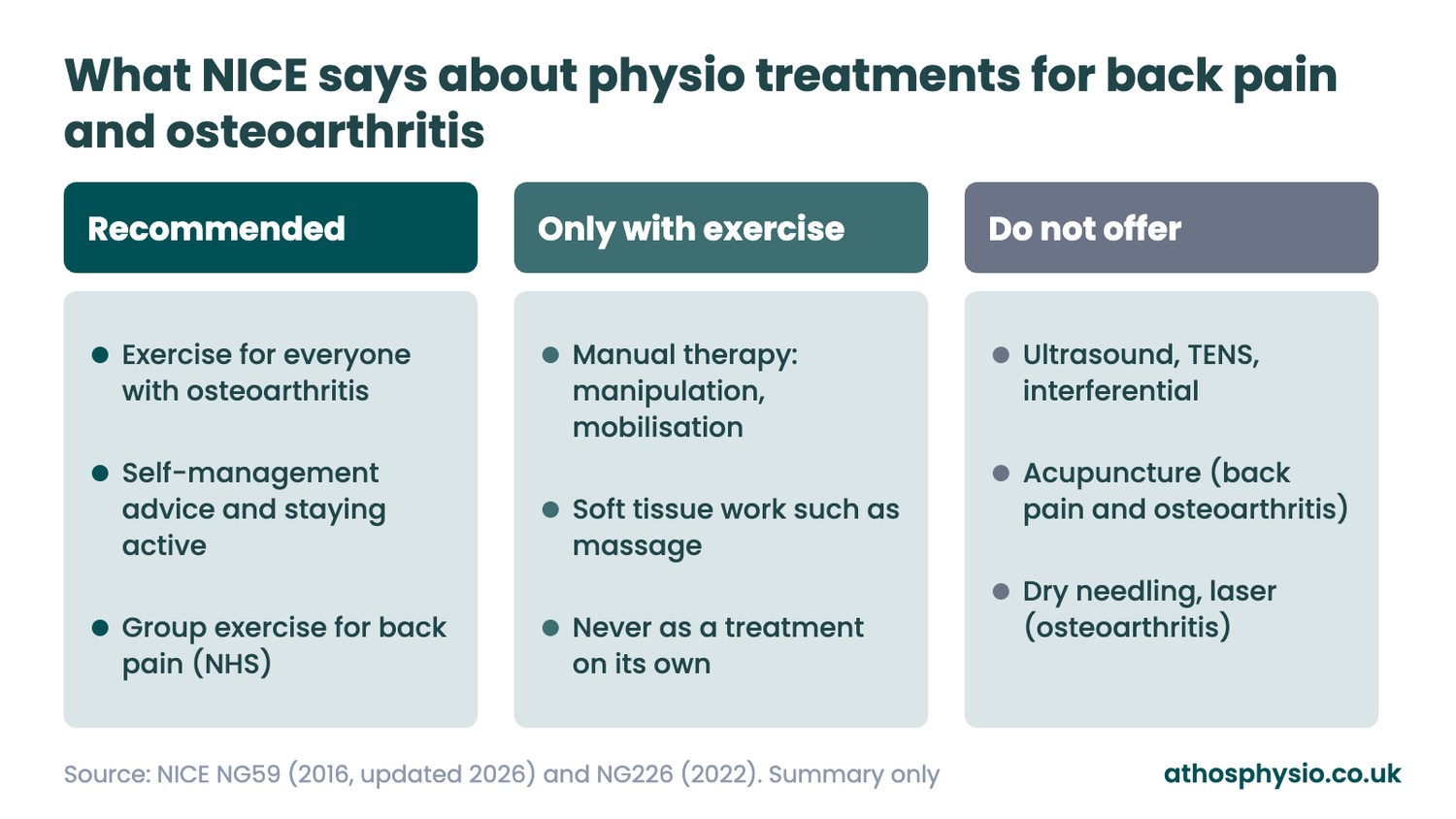
NICE's position is clear for both back pain and hip or knee osteoarthritis: consider manual therapy only as part of a package that includes exercise. For osteoarthritis, it adds that there isn't enough evidence to support manual therapy on its own.
Is manual therapy the same as massage? Not quite. Massage is one type of soft tissue technique; manual therapy also includes joint mobilisation and manipulation. Our posts on deep tissue massage and physio massage vs relaxation massage go into massage in more detail.
Myth: "The machines are the real physio"
Myth vs evidence
Myth: Ultrasound, TENS and other electrotherapy machines are what makes physiotherapy work.
Evidence: NICE says do not offer ultrasound, TENS, PENS or interferential therapy for low back pain or sciatica, and do not offer TENS, ultrasound, interferential, laser or pulsed short-wave therapy for osteoarthritis, because there isn't enough evidence of benefit. They feel like treatment, but the evidence points elsewhere.
IASTM and the Graston technique
IASTM (instrument-assisted soft tissue mobilisation, of which Graston is one brand) uses metal or plastic tools scraped along the skin over muscles and tendons. A 2016 systematic review of 7 randomised trials found that, for musculoskeletal conditions, IASTM did no better than the comparison treatments. There was some evidence that it increases joint range of motion in the short term. The trials were small and varied, so the honest verdict is "unproven" rather than "useless".
At Athos Physio we do use IASTM, as an optional hands-on technique to make a stiff or sore area more comfortable to move and load, always alongside your exercise plan and never as a treatment on its own.
Does kinesiology tape work?
Kinesiology tape is the stretchy, colourful tape you see on athletes. A 2015 review in the British Journal of Sports Medicine pooled 17 trials in people with pain lasting more than 4 weeks. Tape gave slightly better pain relief than minimal treatment, but no clear benefit for disability, and no advantage over other treatments. If it helps you feel more comfortable while you exercise, it's low risk, but it isn't fixing anything on its own.
Dry needling and acupuncture
Dry needling uses fine needles in tight or tender spots in muscle; acupuncture uses similar needles at traditional points. A 2017 JOSPT review of 13 trials of dry needling by physiotherapists found very low to moderate quality evidence that it reduces pain in the short term (up to 12 weeks), but no better function than other physio treatments and no evidence yet of long-term benefit.
NICE says do not offer acupuncture for low back pain, and do not offer acupuncture or dry needling for osteoarthritis.
Shockwave therapy
Radial shockwave delivers pressure waves through the skin to a painful tendon or fascia. Its evidence is strongest for plantar fasciitis and calcific shoulder tendinopathy, and weaker or mixed elsewhere. It's an add-on to a loading programme, not a replacement. Read what shockwave therapy is and where it works.
Physiotherapy treatments at a glance
| Treatment | What it is | What the evidence says | Best role |
|---|---|---|---|
| Exercise therapy | Tailored, progressive exercise | Clinically important pain relief in chronic back pain; NICE: offer for all osteoarthritis | Leads treatment |
| Manual therapy | Mobilisation, manipulation, soft tissue work | Similar to other recommended treatments; small effects | Support, alongside exercise |
| Massage | Soft tissue technique | Counts as manual therapy in NICE guidance | Support, alongside exercise |
| Kinesiology tape | Elastic tape on the skin | Slightly better than minimal treatment for pain; no better than other treatments | Optional comfort aid |
| IASTM / Graston | Tools scraped over soft tissue | No better than comparisons; possible short-term range of motion gain | Unproven |
| Dry needling | Fine needles into muscle | Short-term pain relief (low-quality evidence); no long-term evidence | Short-term option |
| Ultrasound, TENS, interferential | Electrotherapy machines | NICE: do not offer for back pain or osteoarthritis | Not recommended |
| Radial shockwave | Pressure waves to tendons | Best for plantar fasciitis and calcific shoulder | Add-on for specific tendon problems |
How should a good physio combine these?
The pattern across all of this research is the same: active treatment leads, passive treatment supports. Hands-on work, massage or tape can make it easier to move and load a painful area, especially early on. But the lasting change comes from rebuilding strength and capacity, and from understanding your problem well enough to manage it yourself.
At Athos Physio, every patient starts with a 60-minute assessment, and Nick writes a custom rehab and strengthening plan around your goals. Hands-on treatment (including IASTM) and sports massage are used where they help you move and load more comfortably, and radial shockwave is offered where the evidence supports it. If you're curious about other approaches, see our honest look at whether cupping works, and for the bigger picture of what physios do beyond treatment, read what does a physiotherapist do?
A good question to ask any physio: "What's the plan for me to manage this without you?" If the answer is only more passive treatment, ask what the exercise plan is.
When should you see a doctor instead?
Some symptoms need medical attention rather than physiotherapy. Call 999 or go to A&E if back pain comes with numbness around your bottom or genitals, new bladder or bowel problems, or worsening weakness in both legs. Go to A&E if you can't put weight on an injured leg. Contact your GP or NHS 111 if pain comes with fever, unexplained weight loss, a history of cancer, constant night pain or a hot, swollen joint.
While doing exercise therapy: discomfort up to 3–4 out of 10 that settles within 24 hours is usually fine. If pain is sharper or lasts into the next day, drop back a step and tell your physio.
FAQs
What is manual therapy?
Manual therapy is hands-on treatment by a physio or other clinician. It includes joint mobilisation (slow, repeated movements), manipulation (a quick thrust) and soft tissue techniques such as massage. It can ease pain and stiffness in the short term, and NICE recommends using it alongside exercise rather than on its own.
Is manual therapy effective?
Modestly. A 2019 BMJ review of 47 trials in chronic low back pain found spinal manipulation and mobilisation worked about as well as other recommended treatments, with small benefits for function and mostly mild, short-lived side effects. NICE says to consider it only as part of a package that includes exercise.
Does kinesiology tape work?
A little, for some people. A 2015 review of 17 trials found tape gave slightly better pain relief than minimal treatment for pain lasting over 4 weeks, but no clear benefit for disability and no advantage over other treatments. It's low risk, so use it if it helps you exercise more comfortably.
What is IASTM?
IASTM stands for instrument-assisted soft tissue mobilisation: a clinician scrapes a smooth tool over muscles and tendons. The Graston technique is one brand. A 2016 review of 7 small trials found it was no better than comparison treatments for musculoskeletal problems, with some short-term improvement in range of motion. At Athos we use it alongside exercise, not instead of it.
What are the main types of physiotherapy treatment?
The main types are exercise therapy, manual therapy (mobilisation, manipulation and massage), education and self-management advice, and adjuncts such as taping, dry needling, shockwave and electrotherapy. Exercise and advice have the strongest evidence; the others work best, if at all, as add-ons.
Book an assessment in Manchester
Want a plan built on what works? Athos Physio is inside F45 Training Studio at 77 Piccadilly, Manchester M1 2BU, open Monday to Friday, 7am–8pm. You don't need a GP referral, and we work with Bupa, WPA, Vitality and Aviva. Book your physio assessment.
This article is general information, not a substitute for an individual assessment.
Sources
- Hayden JA, et al. Exercise therapy for chronic low back pain. Cochrane Database Syst Rev 2021;9:CD009790. https://doi.org/10.1002/14651858.CD009790.pub2
- Rubinstein SM, et al. Benefits and harms of spinal manipulative therapy for the treatment of chronic low back pain: systematic review and meta-analysis of randomised controlled trials. BMJ 2019;364:l689. https://doi.org/10.1136/bmj.l689
- Lim EC, Tay MG. Kinesio taping in musculoskeletal pain and disability that lasts for more than 4 weeks: is it time to peel off the tape and throw it out with the sweat? A systematic review with meta-analysis. Br J Sports Med 2015;49(24):1558–1566. https://doi.org/10.1136/bjsports-2014-094151
- Gattie E, Cleland JA, Snodgrass S. The effectiveness of trigger point dry needling for musculoskeletal conditions by physical therapists: a systematic review and meta-analysis. J Orthop Sports Phys Ther 2017;47(3):133–149. https://doi.org/10.2519/jospt.2017.7096
- Cheatham SW, et al. The efficacy of instrument assisted soft tissue mobilization: a systematic review. J Can Chiropr Assoc 2016;60(3):200–211. https://pubmed.ncbi.nlm.nih.gov/27713575/
- NICE. Low back pain and sciatica in over 16s: assessment and management (NG59). 2016, updated 2026. https://www.nice.org.uk/guidance/ng59
- NICE. Osteoarthritis in over 16s: diagnosis and management (NG226). 2022. https://www.nice.org.uk/guidance/ng226
Related: Does physiotherapy work? · Active vs passive physiotherapy · What is shockwave therapy? · Benefits of sports massage · All conditions we treat
Reviewed by Nick Chatziviltsos, PgDip, HCPC-registered physiotherapist (PH114351).