

Most people's idea of sports injury prevention is a few static stretches before kick-off. Ironically, that's the one habit the research says does very little. The approaches with the best evidence are strength training, a structured warm-up such as the FIFA 11+, and sensible training load, and the catch is that they only work if you actually do them, week after week. Here's what the trials show, how strong the evidence is, and how to build a routine that fits around real life.
Key takeaways
- Strength training has the strongest evidence. In a review of 25 trials, strength programmes were linked to roughly a two-thirds drop in sports injuries.
- Static stretching before sport doesn't prevent injuries. The same review found no meaningful effect.
- Structured warm-ups work in football. The FIFA 11+ reduced injuries by 39% across four trials.
- The Nordic hamstring exercise roughly halves hamstring injuries in programmes that include it.
- Doing it consistently matters most. Supervised programmes cut injuries by about a third; unsupervised ones showed no clear effect.
What actually prevents sports injuries?
The best single summary is a 2014 meta-analysis of 25 randomised trials involving more than 26,000 athletes. The researchers grouped prevention programmes by type and compared injury rates with teams who trained as normal:
| Type of programme | Change in injury risk | What it means |
|---|---|---|
| Strength training | Risk ratio 0.32 | About 68% fewer injuries |
| Balance (proprioception) training | Risk ratio 0.55 | About 45% fewer injuries |
| Combined programmes | Risk ratio 0.66 | About 34% fewer injuries |
| Stretching | Risk ratio 0.96 | No clear effect |
The review also found that both sudden (acute) injuries and gradual-onset (overuse) injuries were reduced, with overuse injuries almost halved.
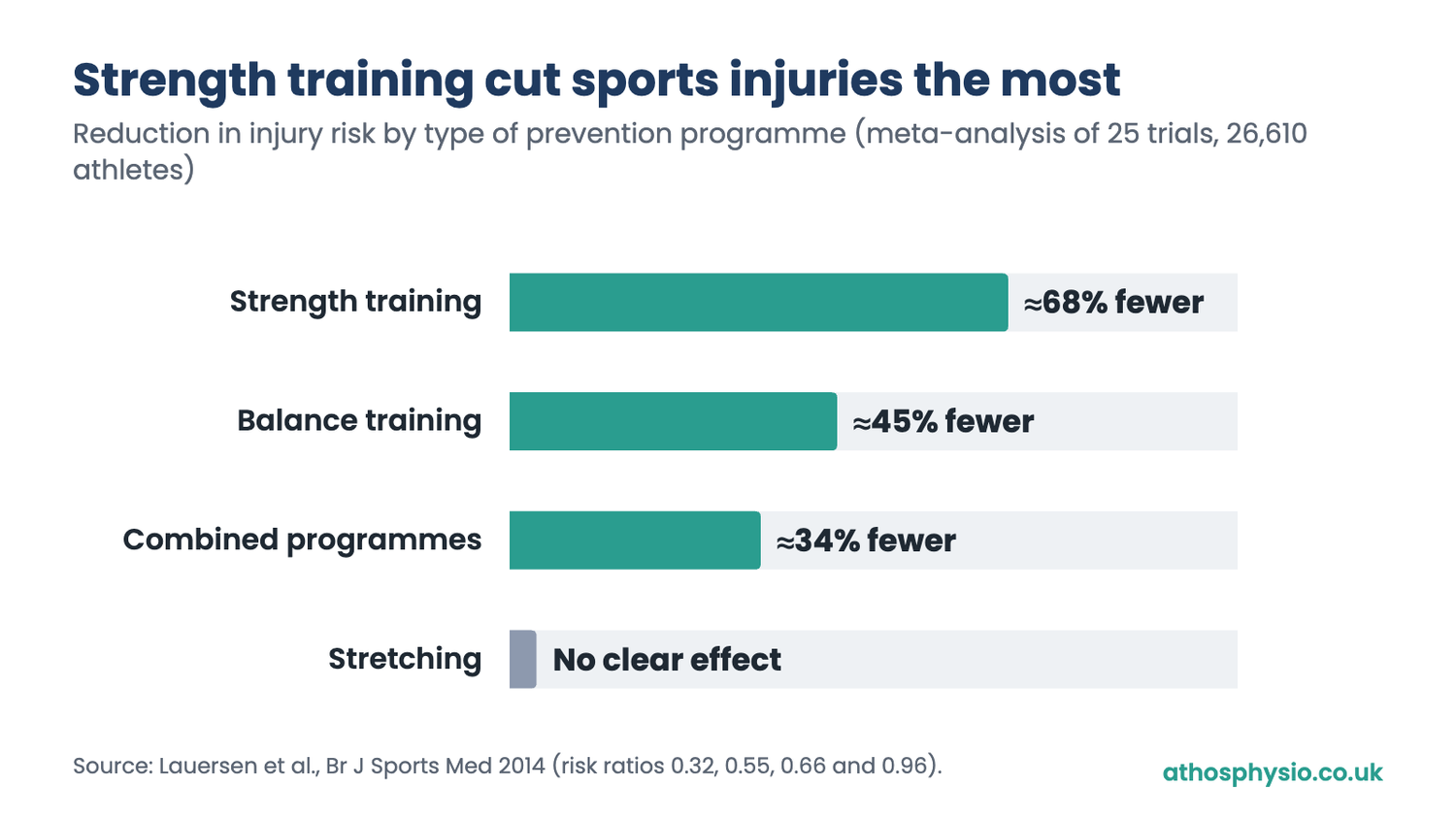
How much should you trust these numbers? The direction is consistent: across many trials, strength and balance work beats doing nothing extra, and stretching doesn't. But the exact percentages come with wide margins of error, the trials covered very different sports and ages, and the programmes themselves varied a lot. Treat "about two-thirds" as "a big effect", not a guarantee.
Myth: "Stretching before sport prevents injuries"
Myth vs evidence
Myth: A good static stretch before training is the key to avoiding pulled muscles.
Evidence: In the 2014 meta-analysis, stretching programmes made no meaningful difference to injury rates (risk ratio 0.96, with a confidence interval crossing 1). Strength and balance training did.
That doesn't mean stretching is harmful or pointless. If you need more range of movement for your sport (dance, gymnastics, martial arts), or you simply like how it feels, keep it. Just don't rely on it as your injury prevention plan. A dynamic warm-up (gradually faster movements that rehearse your sport) followed by some strength work is a better use of the time.
Why does strength training prevent injuries?
The simplest way to think about injury is load versus capacity. Every tissue (muscle, tendon, bone, ligament) has a limit to how much load it can handle. Injuries tend to happen when the demands of your sport exceed that limit, especially when they rise faster than your body can adapt.
Strength training works on the capacity side:
- Muscles and tendons get stronger and stiffer, so they can absorb and produce more force before they're overloaded.
- Control improves. Landing, cutting and decelerating become more stable, which matters for knee and ankle injuries.
- Fatigue resistance increases, so your technique holds up late in a match or a long run, when many injuries happen.
This is also why prevention exercises tend to be specific. The Nordic hamstring exercise loads the hamstrings in a lengthened position, the same position in which sprinters often tear them. A 2019 meta-analysis of 15 studies and 8,459 athletes found that programmes including the Nordic hamstring exercise reduced hamstring injuries by up to 51%. When the higher-risk studies were removed, the effect was a little smaller (about a 45% reduction), but still clear.
Do warm-up programmes like the FIFA 11+ work?
The FIFA 11+ is a 20-minute structured warm-up for footballers: running drills, then strength, balance and jumping exercises, then faster running. A 2017 meta-analysis pooled four randomised trials of the 11+ in recreational and sub-elite football and found it reduced injuries by 39%. The original FIFA 11 programme, which came before it, didn't show a clear effect, a reminder that the content and dose matter.
Newer research adds some useful detail:
- A 2025 meta-analysis of multicomponent programmes in adolescent team-sport athletes found a similar 39% reduction in injuries, with the best results from programmes that combined warm-up, jumping, strength, agility and balance work.
- Programmes under 20 minutes worked at least as well as longer ones, which is good news if your training time is limited.
What we don't know yet: adult recreational athletes
Most prevention trials involve young, organised teams with coaches who can run the programme every session. Evidence for the rest of us is thinner.
A 2024 meta-analysis of 16 trials in adult recreational athletes (think 5-a-side, park runners, gym classes) found that the pooled estimates pointed towards fewer injuries, but they were too imprecise and inconsistent to draw a firm conclusion. One pooled estimate was a risk ratio of 0.94, which would be only a 6% reduction, with a margin of error that included no effect at all.
That's not proof prevention doesn't work for adults. It's a sign that the trials are small and that adults are less likely to stick with a programme. Which brings us to the most important finding of all.
Why consistency matters more than the perfect programme
A 2024 meta-analysis of 44 studies looked at what makes prevention programmes succeed. Its findings were striking:
- Supervised programmes reduced injuries by about 33%.
- Unsupervised programmes showed no clear effect (risk ratio 1.04).
- The better the adherence, the lower the injury rate.
- The benefit was similar for men and women, and age (up to early middle age) didn't change it.
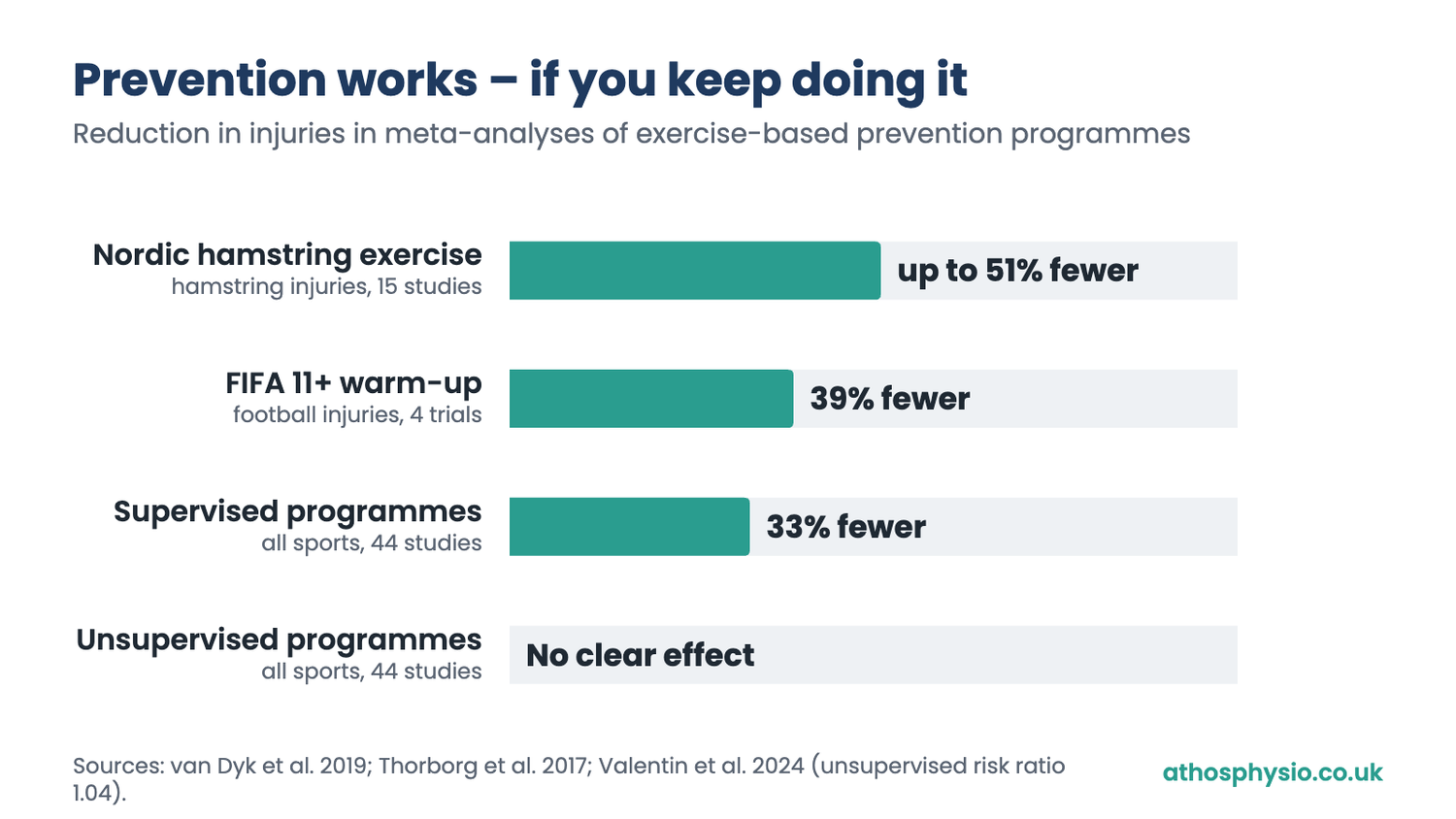
Our reading of this: the specific exercises matter less than doing something sensible, regularly, with someone keeping you accountable. Two short sessions a week that you actually do will beat a perfect hour-long routine you abandon after a fortnight.
A simple injury prevention routine you can stick to
This is a general starting point for healthy adults playing recreational sport. Aim for 2 sessions a week, about 15–20 minutes each, ideally after a warm-up or as part of your gym session.
| Exercise | Sets × reps | Progression |
|---|---|---|
| Split squat or step-up | 3 × 8–10 each leg | Add weight once 10 reps feel easy |
| Single-leg Romanian deadlift | 3 × 8 each leg | Hold a kettlebell or dumbbell |
| Nordic hamstring curl (partner or anchored feet) | 2–3 × 3–6 | Start with a small range; lower more slowly over weeks |
| Calf raise (straight and bent knee) | 3 × 12–15 each leg | Single-leg, then add weight |
| Single-leg balance with reach | 3 × 30 seconds each leg | Eyes closed, or on a cushion |
| Hop and stick landing | 3 × 5 each leg | Increase distance, then add direction changes |
Pain guide: mild muscle soreness for a day or two after starting (especially after Nordics) is normal. Pain up to 3–4/10 that settles within 24 hours is usually fine. Sharp pain, pain that builds session to session, or joint swelling means stop and get it checked.
Before you play: use a dynamic warm-up of 8–10 minutes: easy jogging, leg swings, lunges, skips, then a few faster runs and sport-specific movements. Footballers can use the FIFA 11+ itself.
Alongside this, the other big lever is training load: avoid sudden jumps in how much or how hard you train, especially after a break. Our post on doing too much too soon covers this in more detail, and runners can read how to increase running mileage safely.
Where does sports physiotherapy fit in injury prevention?
A sports physiotherapy assessment is useful when you're coming back from an injury, have had the same niggle more than once, or are stepping up to a new challenge (a marathon, a new sport, a return after pregnancy or a long break). A useful session should:
- look at your injury history and training load, since a previous injury is one of the most consistent risk factors for the next one
- test strength and control on each side (for example hamstring, calf and hip strength, single-leg landing)
- turn the findings into a specific, progressive programme you can do on your own or in the gym
- set clear checkpoints so you know when to progress
Our clinic is inside F45 Manchester NQ at 77 Piccadilly, so we can show you exactly how to do each exercise with the right kit. You don't need a GP referral, and we work with Bupa, WPA, Vitality and Aviva. Book a sports physio assessment.
When should you see a professional?
Get an injury assessed promptly if you have:
- an injury where you can't put weight on the leg, obvious deformity, or rapid swelling within a couple of hours (for example after a knee twist or an ankle roll); go to A&E or an urgent treatment centre
- a "pop" in the knee followed by swelling and the knee giving way
- pain in one spot on a bone that's worse with each session, hurts at night or makes hopping painful, which can be a bone stress injury
- a head injury with any concussion symptoms (headache, dizziness, confusion, feeling "not right"); stop playing and don't return the same day
- calf pain with swelling, warmth and redness: contact your GP or NHS 111 the same day
Call 999 for chest pain, collapse, or severe breathlessness during exercise.
FAQs
How can you prevent sports injuries? The best-supported methods are regular strength training, a structured dynamic warm-up and avoiding sudden jumps in training load. Balance and landing practice help too. Static stretching before sport hasn't been shown to prevent injuries. Above all, keep it consistent: programmes only work if you keep doing them.
What are 5 ways to prevent sports injuries? 1) Strength train twice a week. 2) Warm up dynamically, rehearsing your sport's movements. 3) Increase training gradually, especially after a break. 4) Practise balance and landing. 5) Get niggles checked early rather than playing through worsening pain. Good sleep and recovery between hard sessions also help.
What is injury prevention in sport? It's anything that lowers the chance of getting injured while playing or training. In practice, the best evidence supports exercise-based programmes (strength, balance, jumping and agility work) built into regular training, plus sensible load management and early treatment of minor problems.
Why is injury prevention important in sports? Injuries cost training time, fitness and confidence, and a previous injury is one of the biggest risk factors for another. Preventing the first one is far easier than breaking a cycle of repeat injuries. For recreational athletes, staying injury-free also means staying active, which matters for long-term health.
How do you prevent knee injuries in sports? Programmes that combine strength, balance, jumping and landing practice have the best evidence for reducing knee injuries in team sports. Focus on landing softly with the knee in line with the toes, strong hips and thighs, and controlled cutting. Our ACL rehab guide covers knee injuries in detail.
This article is general information, not a substitute for an individual assessment.
Sources
- Lauersen JB, Bertelsen DM, Andersen LB. The effectiveness of exercise interventions to prevent sports injuries: a systematic review and meta-analysis of randomised controlled trials. Br J Sports Med 2014;48(11):871–877. https://doi.org/10.1136/bjsports-2013-092538
- Thorborg K, et al. Effect of specific exercise-based football injury prevention programmes on the overall injury rate in football: a systematic review and meta-analysis of the FIFA 11 and 11+ programmes. Br J Sports Med 2017;51(7):562–571. https://doi.org/10.1136/bjsports-2016-097066
- van Dyk N, Behan FP, Whiteley R. Including the Nordic hamstring exercise in injury prevention programmes halves the rate of hamstring injuries: a systematic review and meta-analysis of 8459 athletes. Br J Sports Med 2019;53(21):1362–1370. https://doi.org/10.1136/bjsports-2018-100045
- Valentin S, Linton L, Sculthorpe NF. Effect of supervision and athlete age and sex on exercise-based injury prevention programme effectiveness in sport: a meta-analysis of 44 studies. Res Sports Med 2024;32(5):705–724. https://doi.org/10.1080/15438627.2023.2220059
- Liddle N, et al. The effects of exercise-based injury prevention programmes on injury risk in adult recreational athletes: a systematic review and meta-analysis. Sports Med 2024;54(3):645–658. https://doi.org/10.1007/s40279-023-01950-w
- Liu H, Liu X, Yin L. Effects of multicomponent exercise injury prevention programs on adolescent team athletes (10–19 years old): a systematic review and meta-analysis. Front Pediatr 2025;13:1561993. https://doi.org/10.3389/fped.2025.1561993
Related: Strength training in physiotherapy · Doing too much too soon after injury? · Active vs passive physiotherapy · The 5 most common running injuries · All conditions we treat
Reviewed by Nick Chatziviltsos, PgDip, HCPC-registered physiotherapist (PH114351).