

How to find a good physiotherapist? Check three things first: that they're registered with the HCPC (it takes 30 seconds online), that your first appointment includes a proper assessment and a clear explanation, and that the plan puts exercise and self-management at the centre, with hands-on treatment as a support rather than the whole thing. The surprising part is that a smart clinic, a long list of machines or a pre-paid block of 20 sessions tells you very little. Research shows the best predictors of good care are much simpler, and you can check most of them before you pay a penny.
Key takeaways
- "Physiotherapist" is a protected title in the UK. Anyone using it must be on the HCPC Register, which you can search free online.
- Not every physio follows the evidence. A 2019 review of 94 studies found that only around half of physios' treatment choices matched guideline recommendations.
- Good musculoskeletal care looks the same in every high-quality guideline: a thorough examination, education, exercise, selective imaging and hands-on treatment only as an add-on.
- The relationship matters. In a trial of people with chronic back pain, a stronger patient–physio "alliance" predicted better results.
- Be wary of long pre-paid courses before you've been assessed, treatment that's all machines and massage, and promises of a cure.
Why "a good physio" is hard to judge from the outside
Most people choose a physio by location, price and reviews. Those matter: if a clinic is hard to get to, you won't keep going. But they don't tell you whether the care itself is good.
The problem is that physiotherapy varies more than you'd expect. In 2019, researchers in Sydney pooled 94 studies that looked at what physios actually do for problems such as back pain, neck pain and knee pain. When physios were surveyed, the median proportion choosing treatments recommended by guidelines was 54%, and 43% chose treatments the guidelines advised against. Audits of clinical notes were a little better: 63% of patients got recommended treatments and 27% got ones that weren't recommended.
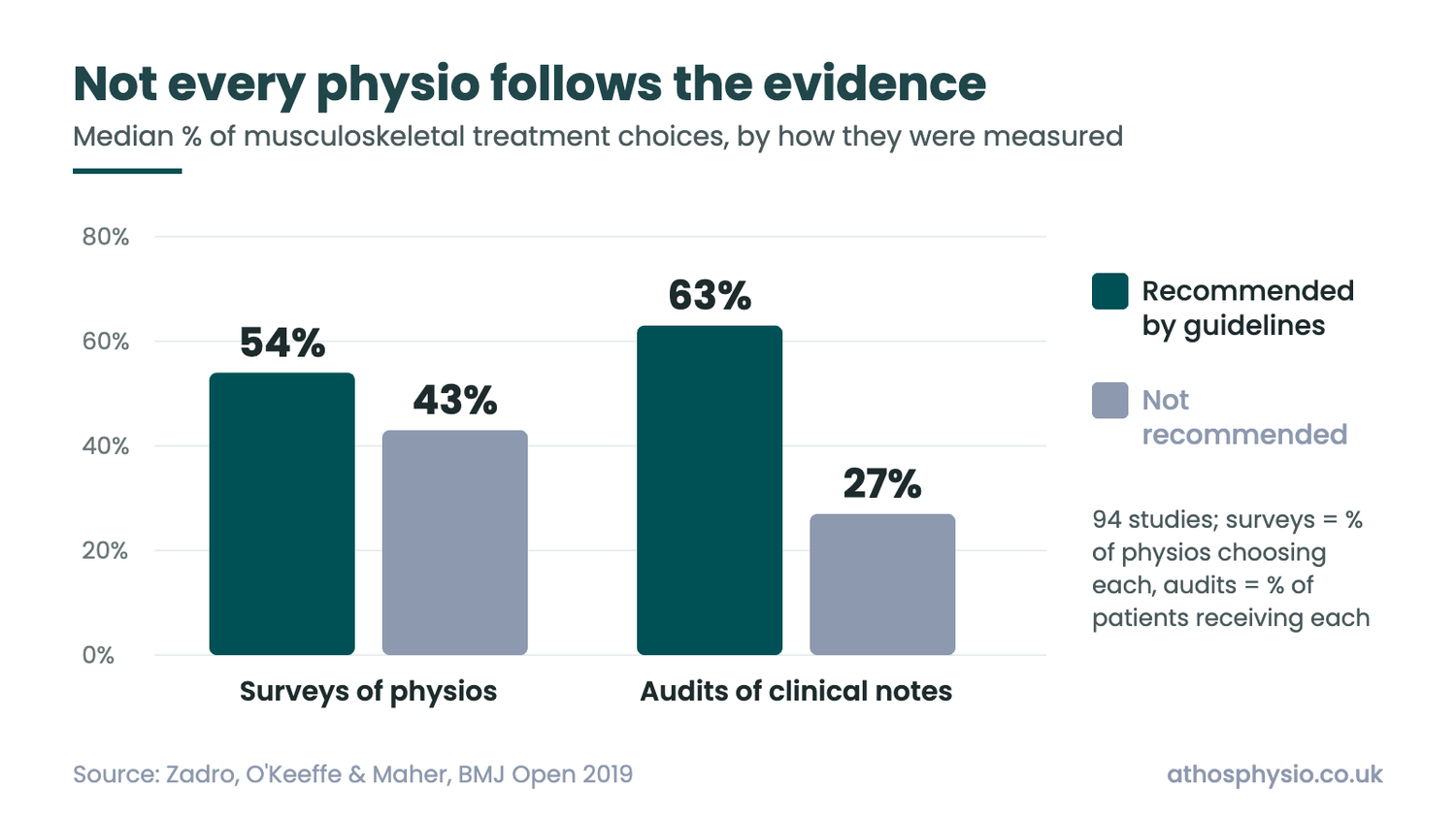
How strong is this evidence? It's a large review, but most of the studies were surveys and audits from several countries, some more than a decade old, so it can't tell you about any one clinic. What it does show is that "seeing a physio" isn't a guarantee of evidence-based care. It's worth knowing what good care looks like.
What does good physiotherapy look like?
A 2020 review in the British Journal of Sports Medicine compared the highest-quality guidelines for back, neck, knee, hip and shoulder pain. They agreed on 11 recommendations. In plain English, a good physio should:
- put you at the centre: listen, ask what matters to you, and agree goals together
- screen for red flags: rule out anything that needs a doctor
- ask about the whole picture: sleep, stress, work and worries, not just the sore bit
- examine you properly: watch you move, test strength and joints
- use scans selectively: only when the result would change the plan
- explain what's going on and what you can do about it
- get you exercising and staying active
- use manual therapy only alongside other treatment, not on its own
- try good non-surgical care before surgery (where appropriate)
- help you stay at work where possible
- check your progress with clear measures
That list is a useful yardstick. If your physio does most of these things, you're probably in good hands.
Myth: "The more treatment you get, the better the physio"
Myth vs evidence
Myth: A good physio sees you twice a week for months, with massage, machines and lots of hands-on time.
Evidence: The guidelines above say manual therapy should be an add-on, not the main event, and the biggest gains usually come from exercise, understanding and staying active. A UK trial of 286 people with back pain found that routine physiotherapy was no more effective at 12 months than a single assessment and advice session from a physio. That doesn't mean one session is always enough, but more appointments don't automatically mean better care.
A good physio should be trying to make you independent. You should leave each session knowing what to do at home and why, and the number of follow-ups should be based on how you're progressing, not a fixed package.
How do you check a physio is HCPC registered?
This is the single most important check, and it's free.
- Go to the HCPC "Check the Register" page (hcpc-uk.org).
- Choose Physiotherapist and type their surname or registration number.
- Check the name matches and the status is Registered.
In the UK, "physiotherapist" is a title protected by law: to use it, a person must be on the HCPC Register. Titles such as "sports therapist", "massage therapist" or "rehab coach" aren't protected in the same way. Some of these practitioners are excellent, but you can't check their training through the HCPC.
The NHS also suggests checking that a private physio is a chartered member of the Chartered Society of Physiotherapy (look for MCSP after their name).
8 things to check before you book
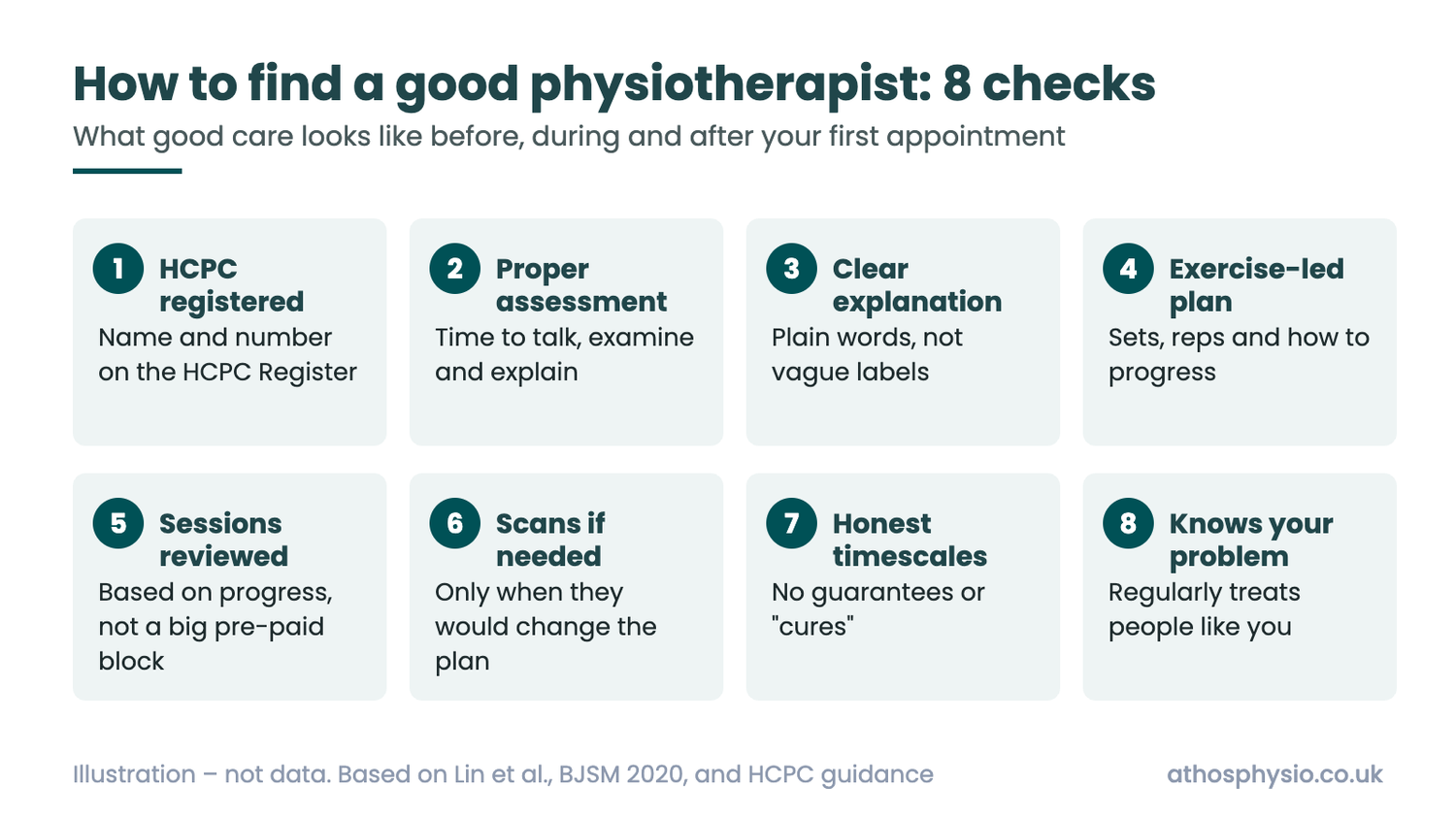
| Check | What good looks like | Warning sign |
|---|---|---|
| Registration | Name and number on the HCPC Register | Can't find them, or "physio" isn't their actual title |
| First appointment | Enough time to talk, examine and explain | Straight onto the couch for treatment |
| Diagnosis | A clear explanation in plain words | Vague labels ("your pelvis is out") with no plan |
| Plan | Exercises with sets, reps and progression | Only passive treatment, nothing to do at home |
| Number of sessions | Based on your progress, reviewed regularly | A large pre-paid block before you've been assessed |
| Scans | Ordered only if they'd change what happens | Scans pushed for most aches and pains |
| Promises | Realistic timescales, honest about uncertainty | "Guaranteed" results or a cure |
| Experience | Regularly treats problems like yours | Unsure, or "we treat everything the same way" |
Experience with your problem matters. If you're a runner with a recurring calf strain, a physio who sees lots of runners will know the return-to-run progressions inside out. If you've just had knee surgery, ask whether they regularly rehab people after that operation. It's a fair question, and a good clinic will answer it honestly.
Why the patient–physio relationship counts
It sounds soft, but there's evidence behind it. In a study nested within a trial of 182 people with chronic low back pain, patients rated their relationship with their physio (the "therapeutic alliance") at the second session. A stronger alliance consistently predicted better pain, function and disability after eight weeks.
How strong is this evidence? It was an observational analysis, so it shows a link, not proof that a better relationship causes better results. But it fits with what guidelines recommend: care that's centred on you, with goals you've agreed.
In practice, a good alliance means you feel listened to, you understand the plan, and you'd be comfortable saying "that exercise flares me up" or "I can't do this three times a day".
Questions to ask at your first appointment
- What do you think is causing my pain, and how sure are you?
- What can I do myself, and what should I avoid for now?
- How will we know it's working, and when will we review it?
- Roughly how long does this usually take to settle?
- Do I need a scan, and why or why not?
- What would make you refer me to a doctor?
If you'd like to know more about what happens in that first session, read what to expect at your first physio appointment. If you're not sure whether you need a physio yet, see when should you see a physiotherapist?. And if you're weighing up NHS and private care, our guide to private physio vs NHS physio covers costs and waiting.
Finding a physiotherapist in Manchester
If you're looking for a physiotherapist in Manchester city centre, Athos Physio is inside F45 Training Studio at 77 Piccadilly, Manchester M1 2BU, a five-minute walk from Piccadilly station, and open Monday to Friday, 7am–8pm. Nick Chatziviltsos is an HCPC-registered physiotherapist (PH114351) with a PgDip in Sports and Exercise Medicine. We specialise in MSK physiotherapy, injury rehabilitation, injury prevention and biomechanics, and Nick writes a custom rehab and strengthening plan for every patient.
You don't need a GP referral, and we work with Bupa, WPA, Vitality and Aviva. Book a physio appointment or browse the conditions we treat.
When do you need a doctor rather than a physio?
Call 999 or go to A&E for:
- numbness around your genitals or bottom, or new problems controlling your bladder or bowels, with back pain
- an injury where you can't put weight on the leg, an obvious deformity or a suspected broken bone
- chest pain, sudden breathlessness, or sudden weakness of the face, arm or leg
Contact your GP or NHS 111 promptly for:
- pain with fever, unexplained weight loss, or a history of cancer
- a hot, red, swollen joint, especially with a temperature
- pain that's severe at night and not eased by any position
A good physio will spot these and refer you on. If yours doesn't ask about them at your first appointment, that's worth noting.
FAQs
How do I find a private physiotherapist for a sports injury?
Look for an HCPC-registered physio who regularly treats your sport or injury, and ask how they guide return to sport. A good sports physio will test strength and function, give you a graded plan and set clear criteria for getting back to training, rather than relying on time or pain alone.
How do I check if a physiotherapist is registered?
Search the HCPC Register online at hcpc-uk.org. Choose "Physiotherapist", enter their surname or registration number, and check the status says Registered. It's free and takes under a minute. You can also check they're a chartered member of the CSP (MCSP).
How many physio sessions should I need?
It depends on the problem and your goals. Many people need a handful of sessions spread over several weeks, with most of the work done at home. Be cautious about committing to a long pre-paid course before you've been assessed; the plan should be reviewed as you progress.
Is a physiotherapist the same as a sports therapist?
No. "Physiotherapist" is protected by law and requires HCPC registration. Sports therapists and massage therapists can be well trained, but those titles aren't regulated by the HCPC, so their training and standards vary more. Check qualifications and insurance either way.
What should a first physio appointment include?
A conversation about your symptoms, health and goals, a physical examination, a clear explanation of what's likely going on and a plan you understand. You should leave with something to do yourself, and know when to come back and what to watch out for.
This article is general information, not a substitute for an individual assessment.
Sources
- Lin I, et al. What does best practice care for musculoskeletal pain look like? Eleven consistent recommendations from high-quality clinical practice guidelines: systematic review. Br J Sports Med 2020;54(2):79–86. https://doi.org/10.1136/bjsports-2018-099878
- Zadro J, O'Keeffe M, Maher C. Do physical therapists follow evidence-based guidelines when managing musculoskeletal conditions? Systematic review. BMJ Open 2019;9(10):e032329. https://doi.org/10.1136/bmjopen-2019-032329
- Ferreira PH, et al. The therapeutic alliance between clinicians and patients predicts outcome in chronic low back pain. Phys Ther 2013;93(4):470–478. https://doi.org/10.2522/ptj.20120137
- Frost H, et al. Randomised controlled trial of physiotherapy compared with advice for low back pain. BMJ 2004;329(7468):708. https://doi.org/10.1136/bmj.38216.868808.7C
- HCPC. Professions and protected titles; Check the Register. https://www.hcpc-uk.org/check-the-register/
- NHS. Physiotherapy. Reviewed April 2025. https://www.nhs.uk/tests-and-treatments/physiotherapy/
Related: When should you see a physiotherapist? · Private physio vs NHS · What does a physiotherapist do? · Active vs passive physio · All conditions we treat
Reviewed by Nick Chatziviltsos, PgDip, HCPC-registered physiotherapist (PH114351).