

Private physio vs NHS physio: the physiotherapists are trained and regulated in exactly the same way, and both should follow the same evidence-based guidelines. The real differences are how quickly you're seen, how long your appointments are and how many you get. NHS physio is free but, as the NHS itself says, there may be a long waiting list. Private physiotherapy costs money, typically paid per session, but you can usually be seen within days. Which is better depends on how much the wait costs you, and the research on waiting is more interesting than most people expect.
Key takeaways
- Same profession, same standards. NHS and private physiotherapists must all be registered with the HCPC.
- The main difference is access: NHS physio is free but waits vary by area; private physio costs money but is usually quick.
- Waiting can matter. A 2021 review of 16 studies found signs that longer waits for physio were linked with worse pain, disability and mood, and higher healthcare costs, although the evidence was mixed.
- More sessions don't always mean better results. A UK NHS trial found routine physio for back pain was no better at 12 months than one assessment-and-advice session.
- You can combine both: you can pay privately while you're on an NHS waiting list.
Is private physio better than NHS physio?
Not in terms of who treats you. Every physiotherapist in the UK, NHS or private, must be registered with the Health and Care Professions Council (HCPC), and the best-quality guidelines for musculoskeletal pain apply to both.
What differs is the system around the physio:
| NHS physio | Private physio | |
|---|---|---|
| Cost | Free | Paid per session, or covered by health insurance |
| How to access | Self-referral in many areas, or via your GP or first contact physio | Book directly; no GP referral needed |
| Waiting time | Varies by area and urgency; can be long | Usually days |
| Appointment length | Set by the service | Often a choice of 30, 60 or 90 minutes |
| Number of sessions | Set by the service and your physio | Agreed between you and your physio |
| Choice of physio | Usually allocated | You choose who you see |
| Group sessions | Offered by some services | Less common |
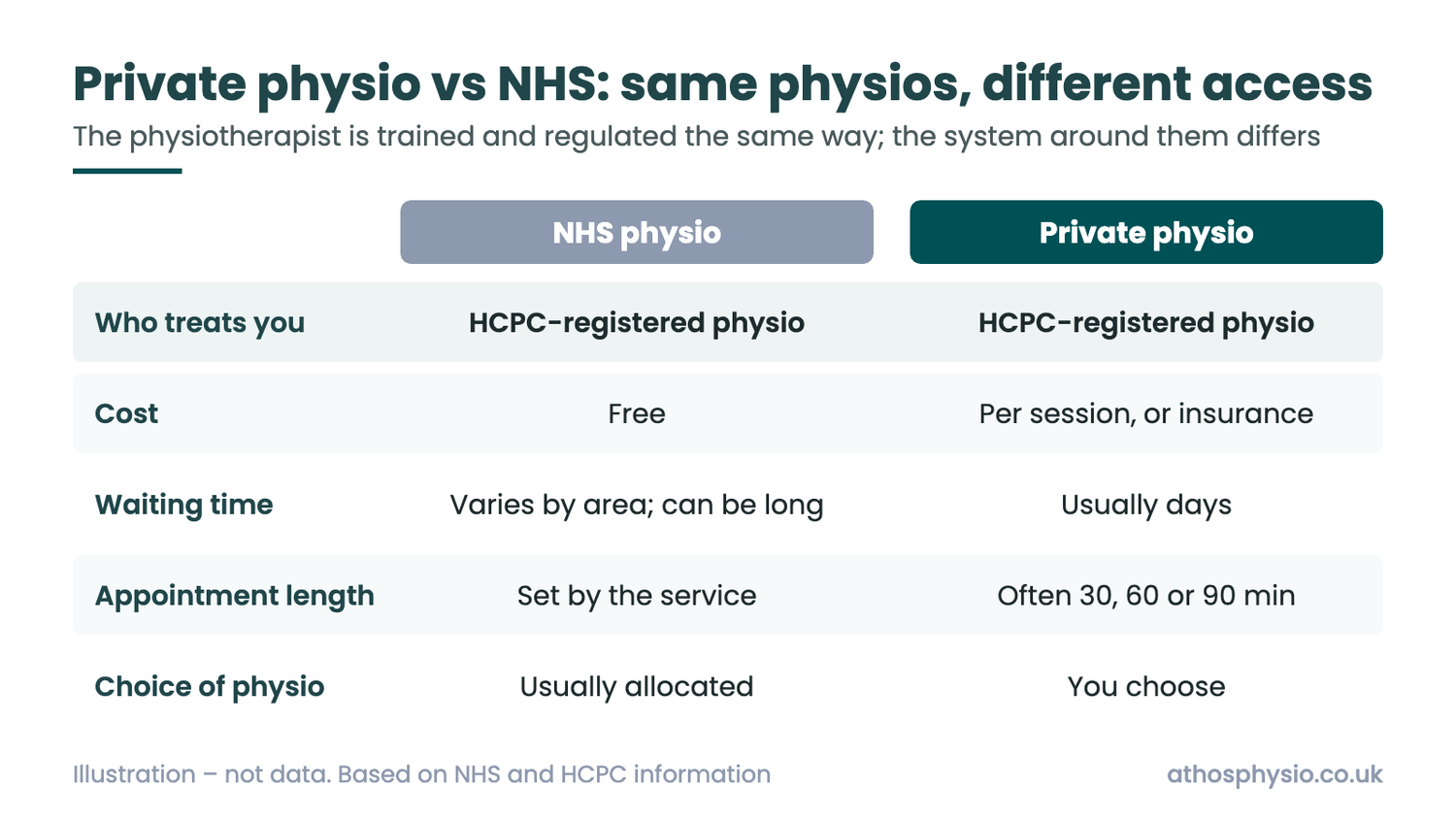
NHS physio has real strengths. It's free, it links directly with GPs, hospital teams and scans, and some services offer group sessions, particularly for common problems like long-term pain. For complex conditions after surgery or a stroke, NHS teams are often the right place to be.
Private physio's strengths are speed and flexibility. You can be seen quickly, choose your physio, book longer appointments and keep seeing the same person throughout.
Does waiting for physio make things worse?
This is the question that matters most when you're deciding, and the honest answer is: sometimes.
A 2021 systematic review pooled 16 studies on the effects of waiting for outpatient physiotherapy in people with musculoskeletal problems. The results were mixed, but several studies suggested that longer waits were linked with more pain, more disability, lower quality of life and more psychological symptoms, as well as more use of other healthcare and higher costs.
How strong is this evidence? Not very. The studies used different designs, settings and definitions of "waiting", and their quality ranged from low to high. The authors called for better research. So the review doesn't prove that waiting harms everyone, but it supports a common-sense point: if your pain is affecting your work, sleep or mood, a long wait has a cost.
It also depends on the problem. A lot of new back pain improves on its own over the first few weeks, so a short wait while staying active is often fine. A knee that keeps giving way, pain that's getting worse, or a problem that's stopping you working is different. (We cover this in more detail in when should you see a physiotherapist?)
Myth: "Private physio means more treatment, so it must work better"
Myth vs evidence
Myth: Paying privately means more sessions and more hands-on time, so you'll get better faster.
Evidence: In a UK trial across seven NHS physiotherapy departments, 286 people with back pain lasting more than six weeks had either routine physiotherapy or one assessment session with advice. Both groups got an advice booklet. At 12 months there was no meaningful difference in disability. People who had routine physio felt it had helped more, but their scores weren't better. The trial is from 2004 and only studied back pain, but the message still holds: the quality of the plan matters more than the number of appointments.
So when you pay for physio, you're mainly paying for speed, time and continuity, not for "more treatment". A good private physio should be getting you independent as quickly as possible, not booking you in indefinitely.
How much does private physiotherapy cost?
Private physiotherapy is usually charged per session, and prices vary by clinic, location and appointment length. When you compare prices, check:
- How long the appointment is. A 30-minute and a 60-minute session aren't comparable.
- Whether the first appointment is longer. A new problem usually needs extra time to assess properly.
- Whether exercises and a written plan are included.
- Whether packages have an expiry date, and whether you can stop if you've recovered.
As an example, at Athos Physio a 30-minute session is £55 and a 60-minute session is £95, with blocks of sessions available. All our prices are on the price list.
Health insurance often covers private physio. Policies differ: some need a GP referral or a pre-authorisation number, and many limit the number of sessions or exclude existing conditions. Our guide to physio on health insurance explains how to check.
Can you get private physio with an NHS referral?
You don't need one. A GP referral letter isn't needed to see a private physiotherapist; you can book directly. If you already have an NHS referral, you can still see a private physio while you wait. If you recover before your NHS appointment comes up, let the service know so the slot can go to someone else. If a GP letter or scan report is relevant, bring it along, as it saves time.
The exception is insurance: some insurers ask for a GP or specialist referral before they'll pay.
Which route is right for you?
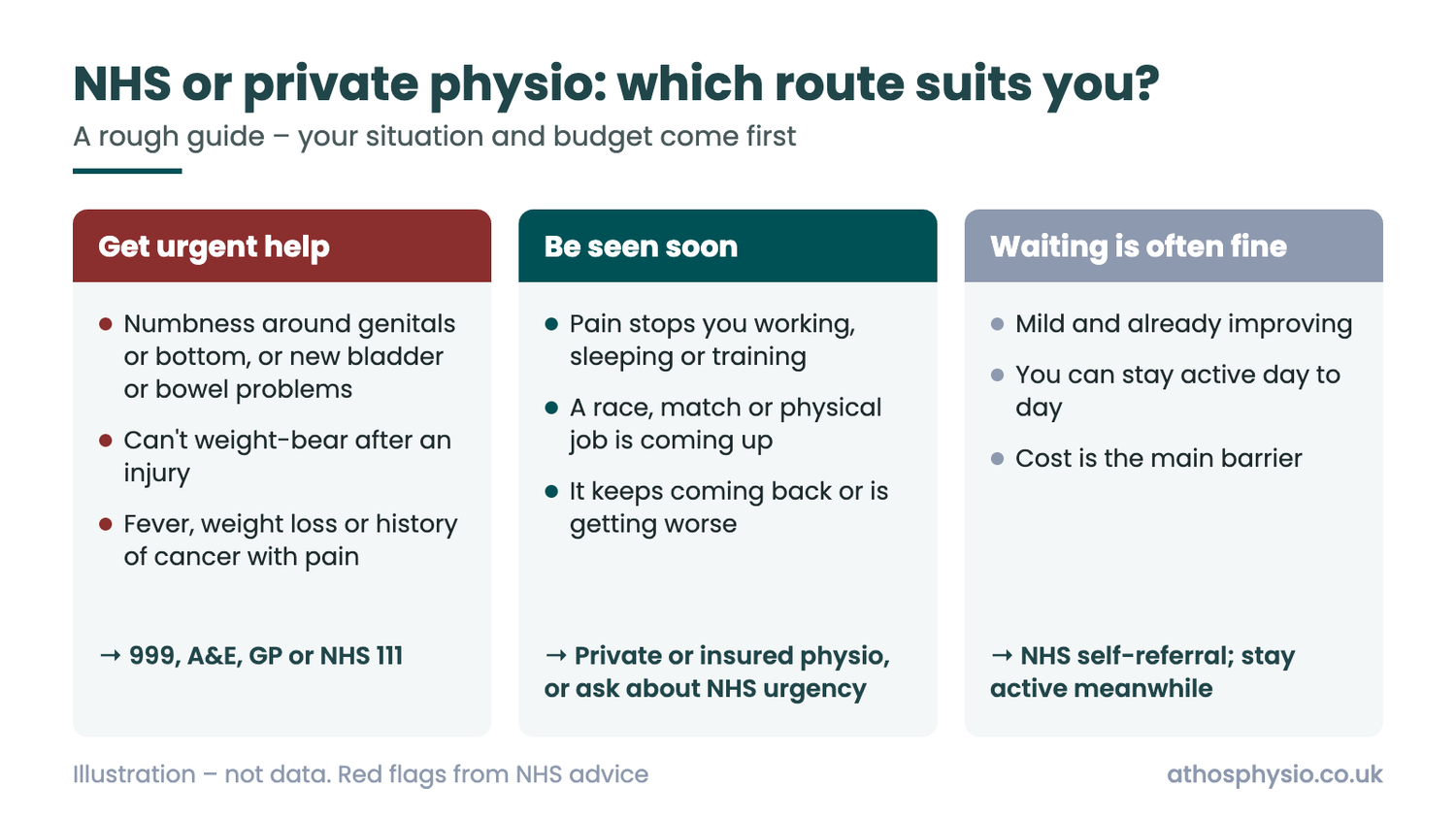
NHS physio may suit you if:
- cost is the main barrier
- your problem is mild and improving, and you're happy to stay active while you wait
- you need care that's closely linked with hospital teams, for example after major surgery or a stroke
- a group class would suit you
Private physio may suit you if:
- pain is stopping you working, sleeping or training
- you have a deadline, such as a race, a match or a return to a physical job
- your problem keeps coming back and you want time to get to the bottom of it
- you'd like to choose your physio and see the same person each time
- you have health insurance that covers it
Whichever you choose, the checks for a good physio are the same. See our guide on how to find a good physiotherapist.
Private physio in Manchester city centre
Athos Physio is inside F45 Training Studio at 77 Piccadilly, Manchester M1 2BU, a five-minute walk from Piccadilly station. We're open Monday to Friday, 7am–8pm, so you can come before or after work. You don't need a GP referral, we work with Bupa, WPA, Vitality and Aviva, and we also offer home visits. Nick Chatziviltsos, HCPC-registered physiotherapist, writes a custom rehab and strengthening plan for every patient. Book a physio appointment or see all the conditions we treat.
When do you need urgent help instead?
Don't wait for any physio appointment, NHS or private, if you have:
- numbness around your genitals or bottom, or new bladder or bowel problems, with back pain: call 999 or go to A&E
- an injury you can't put weight on, an obvious deformity or a suspected broken bone: go to A&E or an urgent treatment centre
- a painful, swollen, red calf, especially after surgery or a long journey: call NHS 111 or go to A&E
- pain with fever, unexplained weight loss or a history of cancer: contact your GP or NHS 111 promptly
FAQs
Can I get private physio with an NHS referral?
Yes, and you don't need one. You can book a private physiotherapist directly without a GP letter. If you're on an NHS waiting list, you can still pay privately in the meantime. Bring any letters or scan reports you have. Some health insurers do require a referral before they'll pay.
Can you pay for physio privately without insurance?
Yes. You can simply pay per session yourself. Ask the clinic about appointment lengths, what the first session includes and whether packages expire. You can stop when you've recovered, so check you won't lose money on unused sessions.
How do I get cheap private physio?
Compare the cost per minute, not just per session, and look at blocks of sessions if you know you'll need several. A good physio will keep follow-ups to what you need and give you a home plan, which keeps the total cost down. Check whether your employer or insurer covers physio.
Can I get private physio for an existing condition?
If you're paying yourself, yes: there's no restriction. If you're claiming on health insurance, many policies exclude conditions you had before you took the policy out, so check your terms or call your insurer before you book.
Is NHS physio as good as private?
The physiotherapists are trained and regulated to the same standards. The differences are waiting times, appointment length and the number of sessions available. For many problems NHS physio works well; private physio mainly offers speed and flexibility.
This article is general information, not a substitute for an individual assessment.
Sources
- Deslauriers S, et al. Effects of waiting for outpatient physiotherapy services in persons with musculoskeletal disorders: a systematic review. Disabil Rehabil 2021;43(5):611–620. https://doi.org/10.1080/09638288.2019.1639222
- Frost H, et al. Randomised controlled trial of physiotherapy compared with advice for low back pain. BMJ 2004;329(7468):708. https://doi.org/10.1136/bmj.38216.868808.7C
- Lin I, et al. What does best practice care for musculoskeletal pain look like? Eleven consistent recommendations from high-quality clinical practice guidelines: systematic review. Br J Sports Med 2020;54(2):79–86. https://doi.org/10.1136/bjsports-2018-099878
- NHS. Physiotherapy. Reviewed April 2025. https://www.nhs.uk/tests-and-treatments/physiotherapy/
- HCPC. Professions and protected titles. https://www.hcpc-uk.org/about-us/who-we-regulate/the-professions/
Related: How to find a good physiotherapist · When should you see a physiotherapist? · Physio on health insurance · Home physiotherapy visits · Prices · All conditions we treat
Written by Nick Chatziviltsos, PgDip, HCPC-registered physiotherapist (PH114351).
