

If you're living with chronic pain, the most useful thing physiotherapy can give you is a plan you can follow on good days and bad days. That usually means three things: a steady baseline of activity you can manage even on a bad day, a gradual build from there, and a flare-up plan so setbacks don't undo your progress. Research on back pain shows talking and education approaches work best combined with physio-led exercise, not on their own. You don't need a GP referral to start.
Key takeaways
- Avoid the boom-and-bust cycle: doing lots on a good day, then paying for it for days afterwards.
- Find your baseline: the amount of activity you can manage even on a bad day, then build up from there in small steps.
- Have a flare-up plan written down before you need it.
- In a 2022 BMJ analysis, psychological approaches for chronic back pain worked best when delivered alongside physiotherapy, mainly structured exercise.
- The evidence for pacing on its own is still weak, so we use it as one tool in a bigger plan, not the whole plan.
Why "push through it" and "rest until it settles" both fail
Most people with persistent pain swing between two approaches:
- Pushing through on good days: catching up on chores, a long walk, a big gym session.
- Resting on bad days, sometimes for days at a time.
This boom-and-bust pattern is exhausting. Each "boom" triggers a flare-up, and each "bust" leaves you a little weaker and more wary of movement. Over months, what you can do often shrinks.
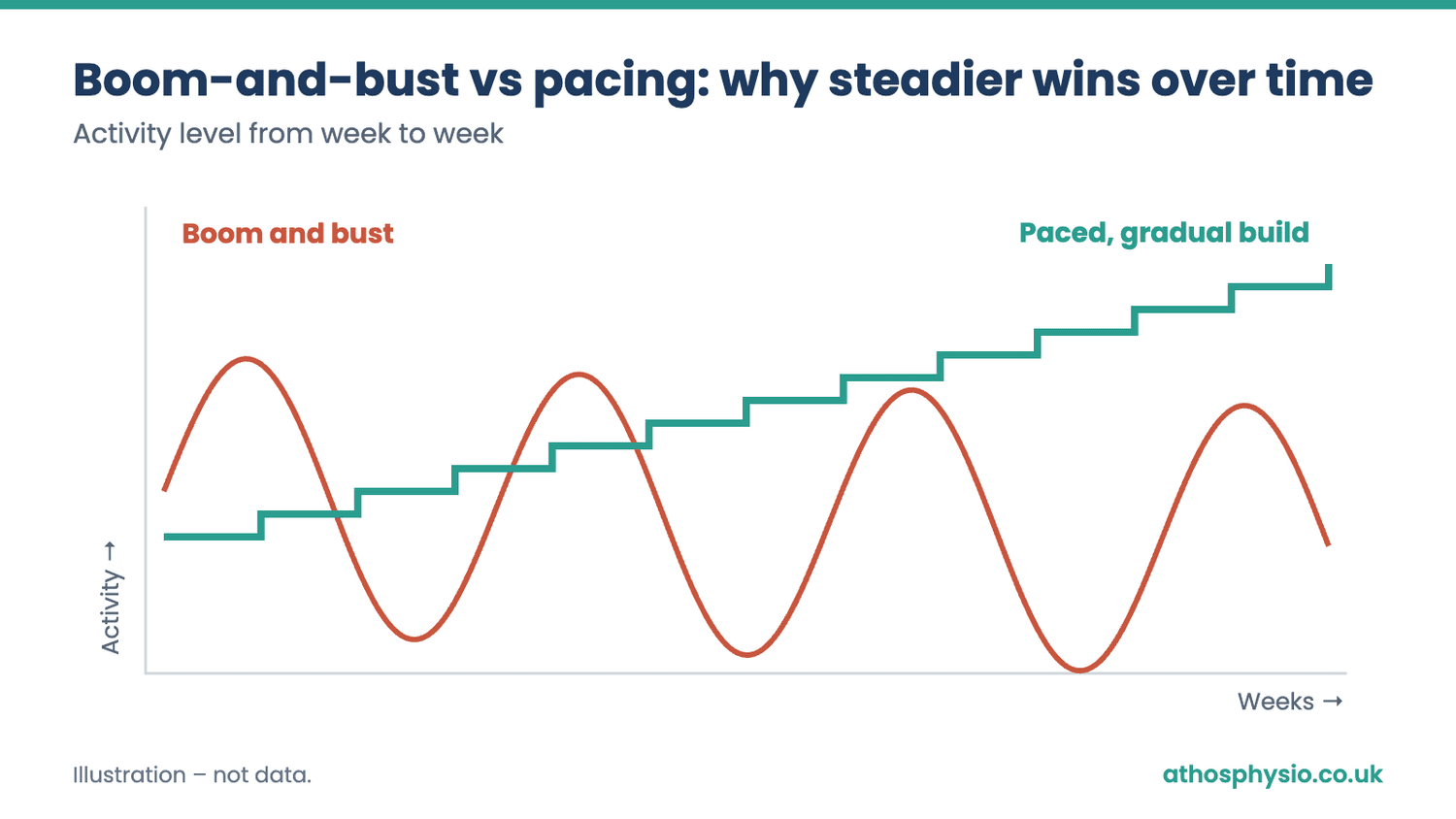
The alternative is to keep activity steadier from day to day, then grow it gradually. It sounds simple, but it takes planning.
Step 1: Find your baseline
Your baseline is how much of an activity you can do on a bad day without a big flare-up afterwards. For example:
- walking: 10 minutes
- sitting at a desk before needing a break: 30 minutes
- gardening or housework: 15 minutes
- an exercise session: 2 sets of 3 exercises
Start a little below that level. It may feel too easy at first. That's the point.
Step 2: Build up gradually
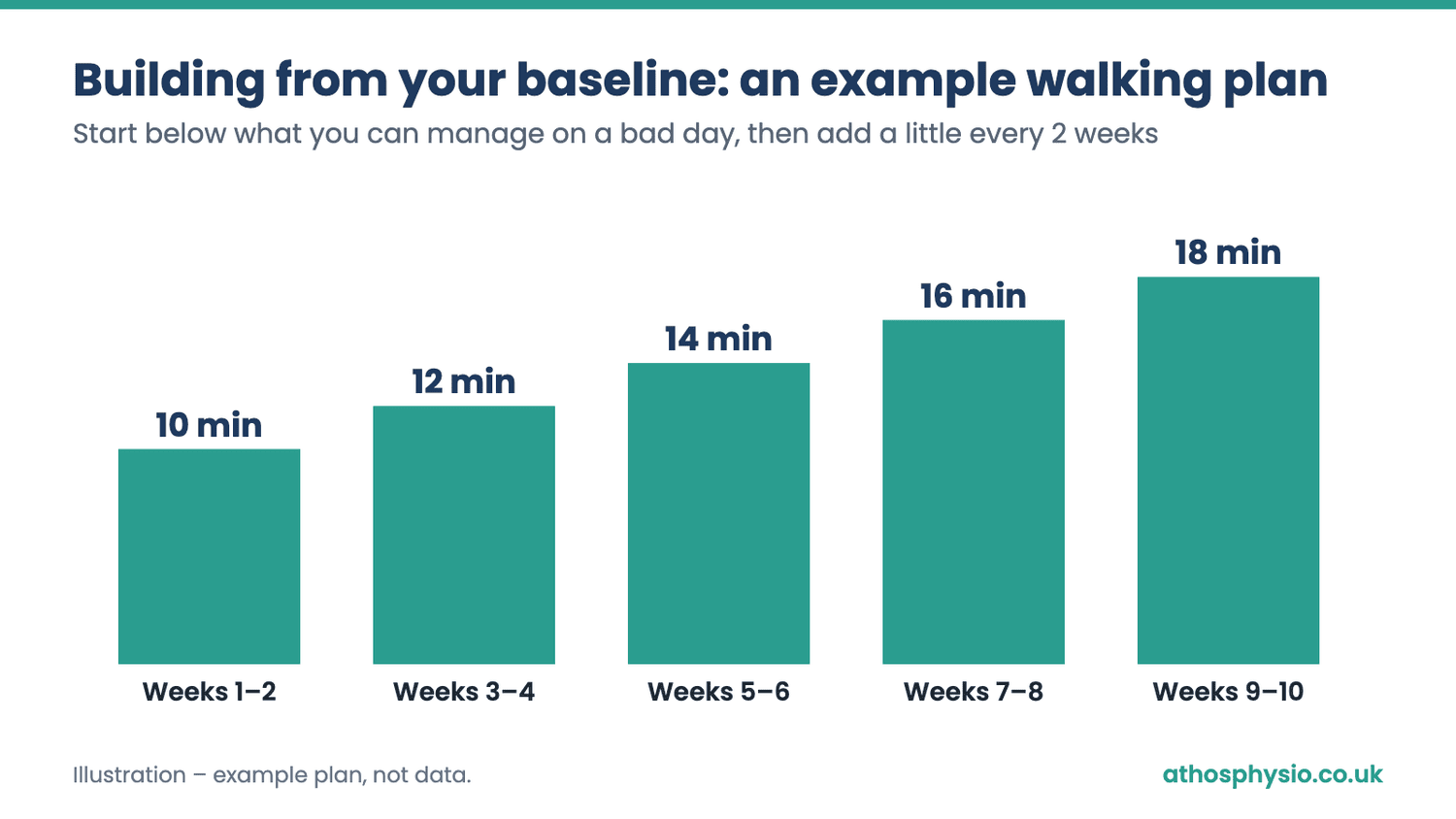
Increase one activity at a time by a small amount, about 10–20% every week or two, as long as your pain settles back to its usual level within a day or so.
| Week | Daily walk | Notes |
|---|---|---|
| 1–2 | 10 minutes | Every day, good day or bad |
| 3–4 | 12 minutes | Only if weeks 1–2 went OK |
| 5–6 | 14 minutes | Add a short hill if you feel ready |
| 7–8 | 16 minutes | Review: is anything else ready to build? |
What about pain while you build? Some extra discomfort is normal and isn't a sign of harm. A useful guide: if pain goes up a little during an activity but settles back to your usual level within 24 hours, that level is OK.
What does the research say?
Exercise: a 2021 Cochrane review of 249 trials found moderate-certainty evidence that exercise reduces pain in chronic low back pain compared with no treatment or usual care. The effects were modest on average, but exercise has few downsides and benefits your general health too. NICE recommends supervised group exercise and staying active for chronic primary pain.
Combining approaches: a 2022 BMJ network meta-analysis of psychological treatments for chronic, non-specific low back pain found they were most effective when delivered alongside physiotherapy care, mainly structured exercise. Pain education and behavioural approaches combined with physio had the most lasting effects on function and pain, although long-term evidence is still limited.
Pacing: a 2026 systematic review of 9 studies of activity pacing found results tended towards better function, but findings for pain and fatigue were mixed, and confidence in the evidence was very low.
The honest summary: no single approach fixes chronic pain. The best-supported plan combines gradual exercise, understanding your pain, and practical strategies like pacing, ideally with support from a physio and, where needed, a psychological therapist.
Step 3: Make a flare-up plan
Flare-ups happen, even when you're doing everything right. Having a plan ready stops panic and the urge to rest for days. Write yours down:
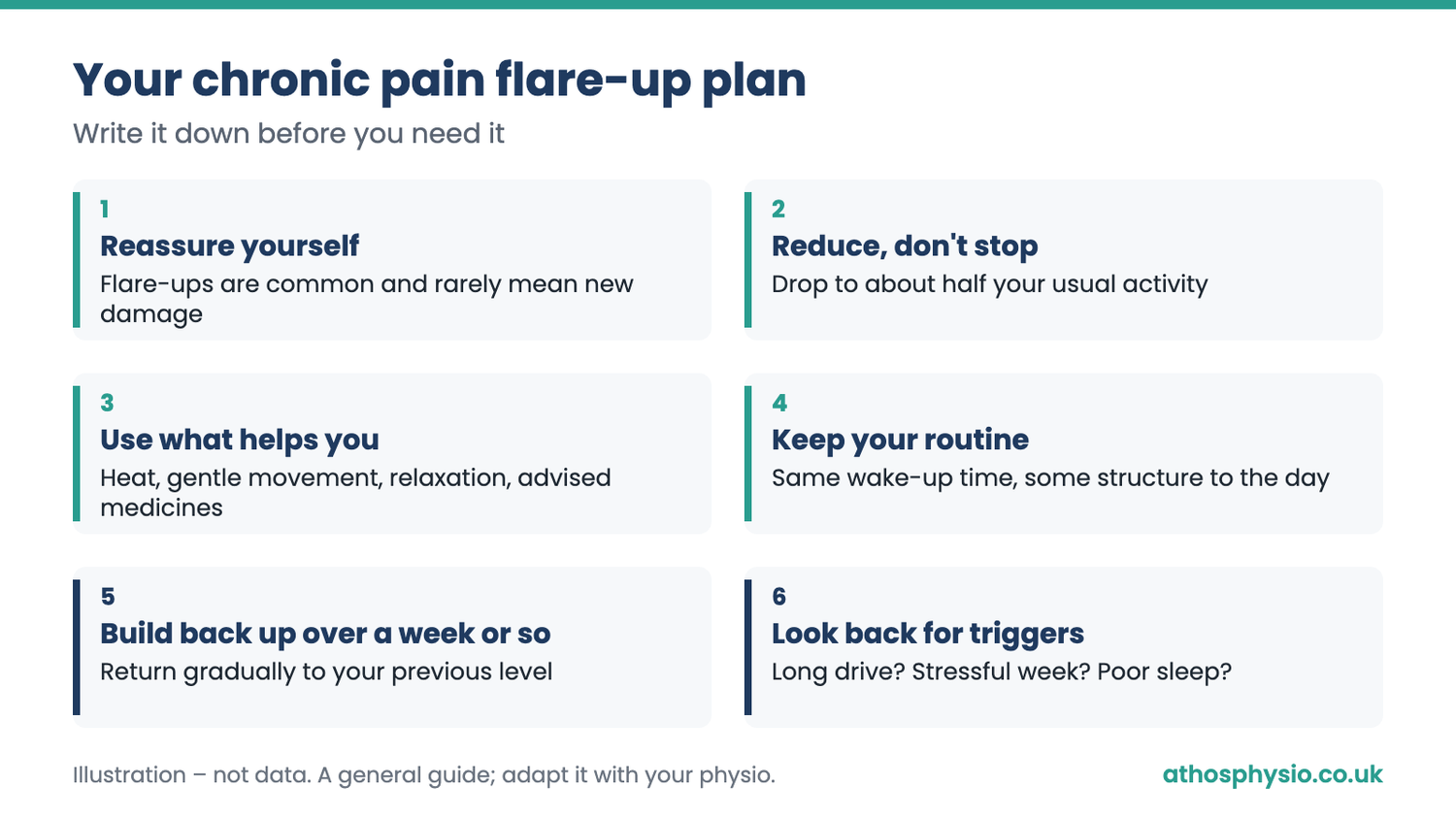
- Reassure yourself: a flare-up is common and doesn't usually mean new damage.
- Reduce, don't stop: drop your activities to around half of your normal level for a few days, rather than stopping completely.
- Use what helps you: heat, a warm shower, gentle movement, relaxation or breathing exercises, and any medicines your GP has advised.
- Keep your routine: get up at your usual time and keep some structure to the day.
- Build back up over a week or so to your previous level.
- Look back: was there a trigger, such as a long drive, a stressful week or poor sleep? It may help next time.
Step 4: Look after the things that turn pain up
Pain is affected by more than your body tissues. These all make the nervous system more or less sensitive:
- Sleep: a regular wake-up time, a wind-down routine and limiting screens late at night.
- Stress and mood: talking therapies such as CBT or ACT are recommended by NICE for chronic primary pain. Your GP can refer you, or you can self-refer to NHS Talking Therapies in many areas.
- Social contact and enjoyable activities: they're part of recovery, not a reward for it.
- General fitness: walking, swimming or cycling at a comfortable level.
When to see a GP or get urgent help
See your GP promptly if your pain changes character, gets steadily worse, or comes with:
- unexplained weight loss, fever or night sweats
- new weakness, numbness or pins and needles
- a history of cancer
Call 999 or go to A&E if back pain comes with numbness around your genitals or bottom, or new problems with bladder or bowel control.
If pain is affecting your mood and you're struggling, speak to your GP. If you feel unable to keep yourself safe, call 999 or NHS 111.
Chronic pain physiotherapy in Manchester
Our clinic is inside F45 Manchester NQ, at 77 Piccadilly in Manchester city centre. We'll help you find your baseline, set goals that matter to you, write a custom rehab and strengthening plan, and plan for flare-ups. If travelling is difficult, we also offer home visits. You don't need a GP referral, and we work with Bupa, WPA, Vitality and Aviva. Book an appointment. To understand why pain persists, read Chronic pain: why hurt doesn't always mean harm.
FAQs
What is activity pacing?
Pacing means keeping your activity steadier from day to day rather than doing a lot on good days and very little on bad days. You start at a level you can manage even on a bad day, take planned breaks, and build up gradually.
Should I rest during a chronic pain flare-up?
A little more rest for a day or two is fine, but complete rest usually makes things worse. Try cutting your activities to about half your normal level, keep moving gently, and build back up over about a week.
How long does it take for physiotherapy to help chronic pain?
Most people need several weeks of consistent, gradual exercise before noticing a clear change, and progress continues over months. Improvements often show first as doing more, sleeping better or feeling more confident, before pain scores change.
Do I need a referral for chronic pain physio in Manchester?
No. You can book directly with Athos Physio. If we think you need input from your GP or a pain specialist, we'll explain why.
This article is general information, not a substitute for an individual assessment.
Sources
- Ho EK, et al. Psychological interventions for chronic, non-specific low back pain: systematic review with network meta-analysis. BMJ 2022;376:e067718. https://doi.org/10.1136/bmj-2021-067718
- Hayden JA, et al. Exercise therapy for chronic low back pain. Cochrane Database Syst Rev 2021;9:CD009790. https://doi.org/10.1002/14651858.CD009790.pub2
- Antcliff D, et al. Operant approach activity pacing interventions for the management of chronic pain: a systematic review. Clin J Pain 2026;42(9). https://doi.org/10.1097/AJP.0000000000001393
- NICE. Chronic pain (primary and secondary) in over 16s (NG193), 2021. https://www.nice.org.uk/guidance/ng193
Related: Chronic pain: why hurt doesn't always mean harm · Active rehabilitation · Lower back pain · Home physio visits · All conditions we treat
Reviewed by Nick Chatziviltsos, PgDip, HCPC-registered physiotherapist (PH114351).