

Here's something most golfer's elbow exercise sheets won't tell you: almost every one of them is borrowed from tennis elbow research. Golfer's elbow is about three times less common, and a 2026 review of its best-known exercise approach (eccentric, or lowering, exercise) found only five small studies. The good news is that the borrowed advice points the same way. The exercises that help most load the tendon steadily, starting with pain-easing holds and building to heavy, slow wrist curls, forearm rotation and grip work over 8–12 weeks. Stretching, straps and rest play supporting roles at best. Here's a 4-stage plan with clear rules for when to move up.
Key takeaways
- Strengthen, don't just stretch. Loading the tendon is the core of treatment. Gentle stretching is optional; stretching hard into pain isn't helpful.
- The research is thin, so be honest about it. A 2026 review found just 5 small studies of eccentric (lowering) exercise for golfer's elbow (143 people), with low certainty. Much of what we know comes from tennis elbow, where exercise beat injections in the long run.
- Progress by symptoms, not the calendar. Pain up to 3/10 during exercise is fine if it has settled by the next morning.
- Keep training, but change your grip. Neutral-grip pulling, lifting straps and less crimping usually let you keep going while the tendon recovers.
- Tingling in your ring and little fingers isn't golfer's elbow. It suggests the ulnar nerve or your neck, and needs a different plan.
What golfer's elbow is, in one paragraph
Golfer's elbow (medial epicondylitis, or medial elbow tendinopathy) is an overloaded, sensitive tendon on the bony bump on the inside of your elbow. That's where the muscles that bend your wrist and fingers and turn your palm down attach. It's rarely caused by golf. Pull-ups, rows, climbing, carrying and gripping tools all day are more common triggers. Our golfer's elbow page covers symptoms and diagnosis in detail; this guide is about the exercises.
Why the research is thinner than you'd think
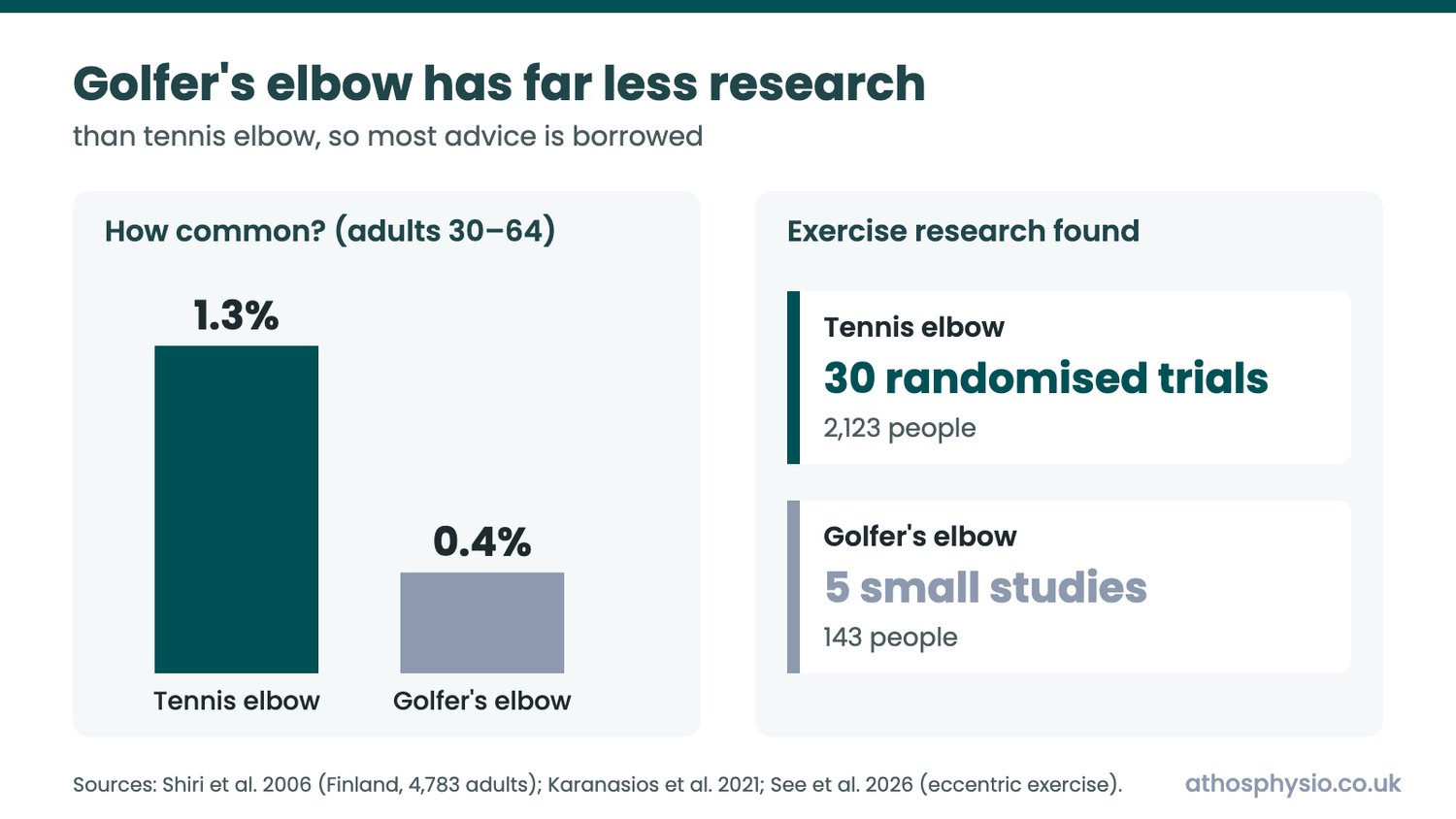
In a Finnish population study of 4,783 adults aged 30–64, 1.3% had tennis elbow and 0.4% had golfer's elbow. Fewer patients means fewer trials:
- Golfer's elbow: a 2026 systematic review of eccentric (lowering) exercise found 5 studies with 143 people in total, a mix of small trials and before-and-after studies. Pain and function improved, but only one trial showed exercise beating its comparison. The authors rated the certainty as low.
- Tennis elbow: a 2021 meta-analysis pooled 30 randomised trials with 2,123 people. Exercise did better than passive treatments and outperformed steroid injections at most time points, but the effects were small and the certainty low to very low.
- An older 2013 review in the British Journal of Sports Medicine set out to cover both conditions and didn't find a single randomised exercise trial for golfer's elbow.
What this means for you: the case for exercise in golfer's elbow rests on small studies plus a reasonable assumption that the same tendon-loading principles apply on the inside of the elbow as on the outside. That's sensible, but it isn't proof. Nobody has tested which exercises, doses or timelines work best for golfer's elbow specifically, so the plan below is a well-reasoned starting point, adjusted to how your elbow responds.
The 4-stage golfer's elbow exercise plan
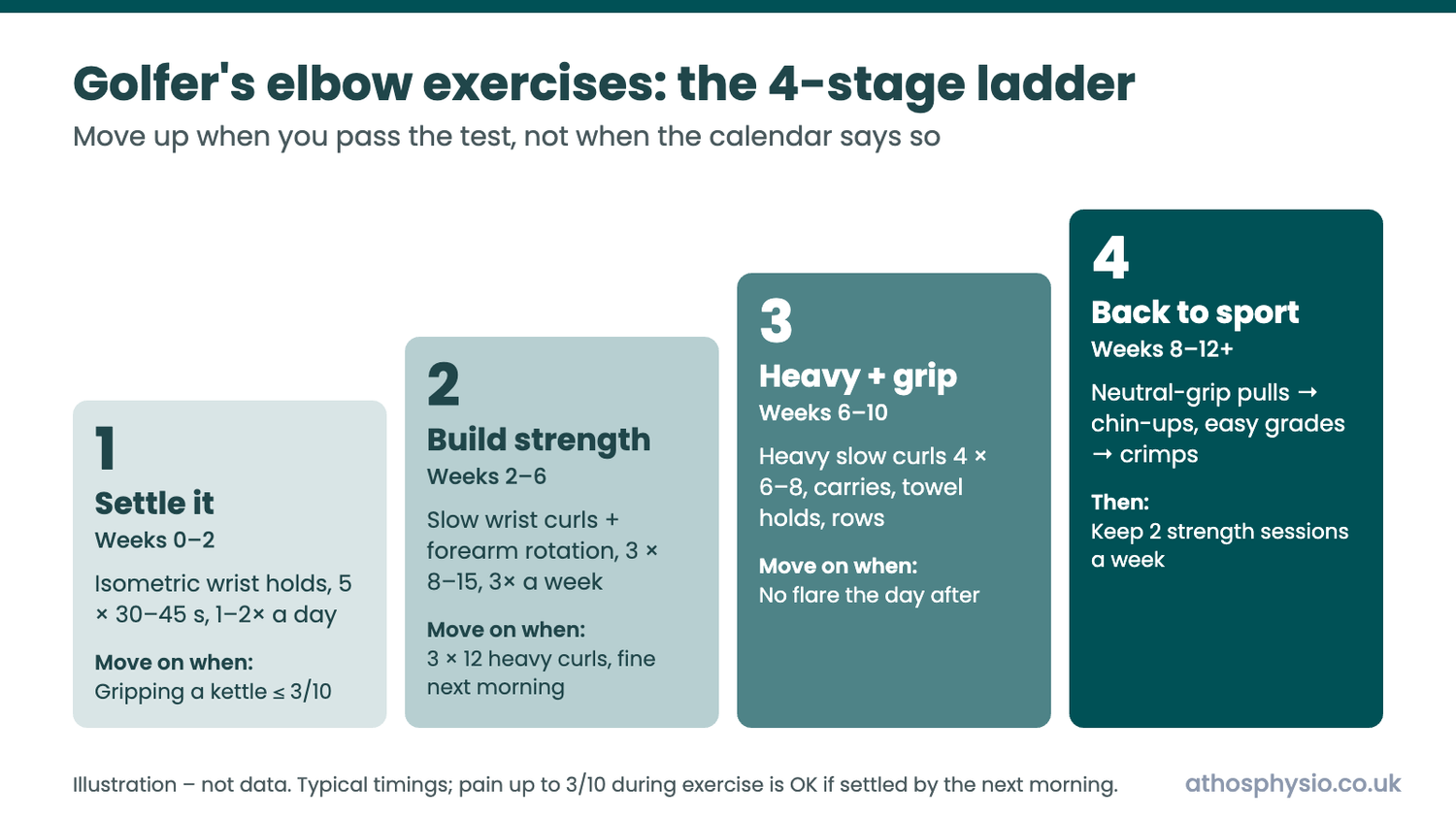
Tendons respond to load that's heavy enough and slow enough to make them adapt, repeated over weeks. Each stage has a goal and a test for moving on. The timings are typical, not fixed.
Stage 1: Settle it (usually weeks 0–2)
- Isometric wrist flexion: forearm on a table, palm up, hold a dumbbell or push your palm up into your other hand without moving. Hold 30–45 seconds, 5 times, at a strength that feels moderately hard. Once or twice a day.
- Isometric pronation: hold a hammer by the handle, or a dumbbell at one end, and resist it rolling outwards. Same dose.
- Move on when: gripping a full kettle or a bag of shopping is no worse than 3/10.
Stage 2: Build strength (usually weeks 2–6)
- Slow wrist curls, palm up: 3 seconds up, 3 seconds down. Start with 3 sets of 15, building to 3 sets of 8–12 with a heavier weight.
- Forearm rotation (pronation): hold a hammer or a dumbbell at one end, rotate slowly palm up to palm down. 3 sets of 10–15.
- Do these 3 times a week, not daily. Tendons need recovery days to adapt.
- Move on when: you can do 3 × 12 slow curls with a weight you'd call heavy, without the next morning being worse.
Stage 3: Heavy and functional (usually weeks 6–10)
- Heavy slow curls: 4 sets of 6–8 with a weight you could just about lift 10 times.
- Grip work: farmer's carries for 30–40 metres, towel or thick-handle hangs or holds for 20–30 seconds.
- Shoulder and upper back: rows, face pulls and push-ups, so the elbow isn't doing all the work.
- Move on when: your grip feels close to the other side and the elbow tolerates the session without a flare the next day.
Stage 4: Back to your sport (usually weeks 8–12 and beyond)
Rebuild the movement that caused the problem in small steps: neutral-grip pull-ups before palms-up chin-ups, easy climbing grades before small crimps, chipping and half swings before a full range session. Keep 2 strength sessions a week going after you're back. That's what stops it returning.
How much pain is OK?
| Pain during exercise | What it means | What to do |
|---|---|---|
| 0–3/10 | Acceptable | Carry on, as long as it has settled by the next morning |
| 4–5/10 | Borderline | Reduce the weight, reps or range, then try again next session |
| 6/10 or more, or worse the next morning | Too much | Drop back a stage for a few days |
Pain on its own doesn't mean you're damaging the tendon. What matters is the trend: the same load should feel easier from week to week.
Myths that slow recovery
Myth 1: "Stretch it out and it'll loosen up."
Stretching feels like it should help, but tendons get better by getting stronger, not longer. In tennis elbow trials, stretching worked when it was combined with strengthening. Hanging off a bar or pulling your wrist back hard into pain mostly irritates a sensitive tendon. A gentle 20–30 second stretch is fine if it feels good; it isn't the main treatment.
Myth 2: "A golfer's elbow brace will fix it."
A strap may take the edge off pain while you grip, but it won't build strength. A Cochrane review of braces for tennis elbow found too few good trials to draw any conclusion, and braces for golfer's elbow haven't been properly studied at all. Use one if it helps you work or train, alongside your exercises.
Myth 3: "An injection is the quick fix."
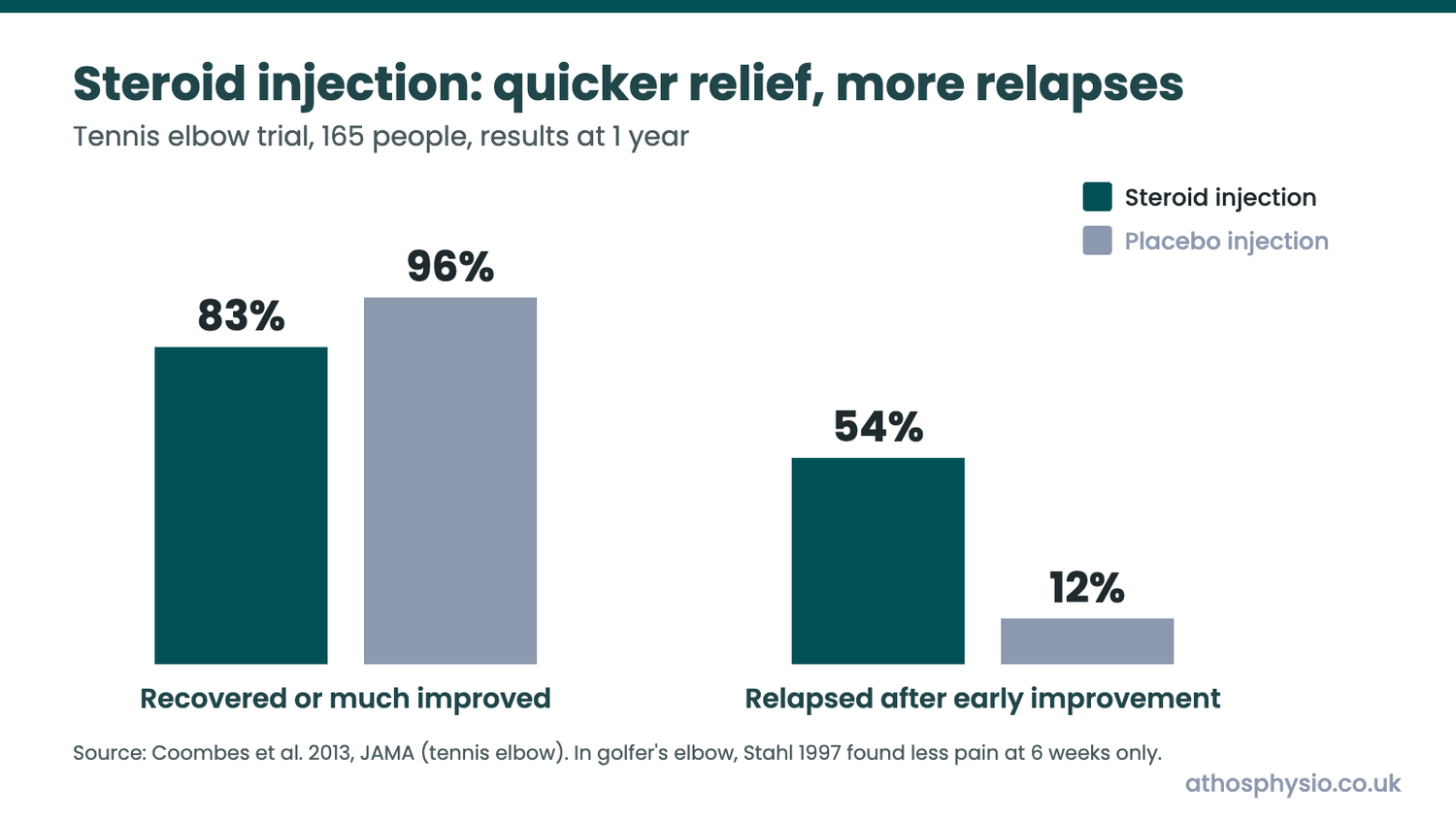
The one placebo-controlled trial of steroid injection for golfer's elbow (60 elbows) found less pain at 6 weeks but no difference at 3 months or a year. In the biggest tennis elbow trial, people given a steroid injection were less likely to be recovered or much improved at one year (83% vs 96% with a placebo injection) and far more likely to relapse (54% vs 12%). Different tendon, same lesson: short-term relief can come at a long-term cost.
Keep training: simple swaps for the gym, climbing and golf
| Activity | Usually aggravates it | Try instead for now |
|---|---|---|
| Chin-ups and pull-ups | Palms-up grip, high reps | Neutral grip, fewer reps, or lat pulldown |
| Rows and deadlifts | Heavy holds with a full grip | Lifting straps for the heaviest sets |
| Bicep curls | Straight bar, palms up | Hammer curls or an EZ bar |
| Climbing and bouldering | Small crimps, steep routes, campus boards | Easier grades, open-hand holds, shorter sessions |
| Golf | Long range sessions | Short game first, fewer balls, build up gradually |
This isn't forever. As you move through stages 3 and 4, you add the aggravating version back in.
How long does golfer's elbow last?
Most people notice clear improvement after 8–12 weeks of consistent loading. Long-standing cases can take 4–6 months. Being slower than that isn't failure, but it is a reason to check the diagnosis and the plan.
Things that tend to slow recovery include continuing the trigger at full volume, doing the exercises inconsistently, smoking and carrying extra weight. Smoking and obesity were both linked to golfer's elbow in the Finnish population study.
When it isn't (only) golfer's elbow
Inner elbow pain isn't always the tendon:
- Tingling or numbness in the ring and little fingers, worse with the elbow bent, points to the ulnar nerve.
- Neck pain with pins and needles down the arm may come from the neck. In one clinic's records, 55 of 102 people with C6/C7 nerve-root irritation in the neck also had golfer's elbow. It's a small, retrospective study, so treat it as a reason to check the neck, not proof that one causes the other.
- A pop during throwing, then pain and instability, needs checking for a ligament injury.
When to see a professional
Book an assessment if you've had 6 weeks of exercise without improvement, the pain is getting worse, or you're not sure it's golfer's elbow. If it's dragging on, options such as shockwave are sometimes added to exercise, though very few trials have tested shockwave in golfer's elbow specifically. See our guide to what shockwave can and can't do.
Get urgent help (A&E or 999) after a fall or blow with severe pain, swelling, deformity or an elbow you can't move. Contact your GP or NHS 111 if the elbow is hot, red and swollen, or the pain comes with fever or feeling unwell. See a professional soon if your grip is getting weaker or numbness is spreading.
How we treat golfer's elbow at Athos Physio
Your first 60-minute session finds out what's overloading the tendon, checks the nerve and neck, and starts your loading programme the same day. We write a custom plan built around your training, and because we're inside F45 Training Studio at 77 Piccadilly, Manchester M1 2BU, we can rebuild rows, pull-ups and carries on the gym floor. Hands-on work such as soft tissue massage and IASTM can help settle pain alongside the exercise.
- No GP referral needed. We work with Bupa, WPA, Vitality and Aviva.
- Open Monday to Friday, 7am–8pm, a 5-minute walk from Piccadilly station.
- Book your assessment
FAQs
How do you fix golfer's elbow fast?
There's no proven shortcut. The quickest reliable route is to cut back the aggravating grip or pull, start isometric holds to ease pain, and build to slow, heavy wrist and forearm strengthening 3 times a week. Steroid injections ease pain faster but are linked to more relapses in tennis elbow research.
How long does golfer's elbow last?
Most people improve clearly over 8–12 weeks of consistent exercise. Long-standing cases can take 4–6 months. If you're not improving after about 6 weeks of a good programme, get the diagnosis and the plan checked, as nerve or neck problems can mimic or add to it.
How do you wear a golfer's elbow strap?
Place it around the upper forearm, a couple of finger-widths below the bony bump on the inside of the elbow, snug but not tight enough to cause tingling. Wear it during gripping or training that hurts, not all day. It may ease pain but doesn't treat the tendon.
What causes golfer's elbow?
Loading the wrist and finger flexor tendon more than it's ready for, usually through a sudden increase in gripping, pulling or throwing. Common triggers are chin-ups, rows, climbing, golf and manual work. A Finnish population study also linked it to smoking, obesity, repetitive movements and forceful activities.
Should I stop going to the gym with golfer's elbow?
Usually not. Legs, core and most pushing exercises rarely bother it. Swap palms-up pulling for neutral grips, use straps for heavy holds and drop the reps, then add the harder versions back as the tendon gets stronger. Complete rest tends to leave the tendon weaker.
This article is general information, not a substitute for an individual assessment.
Sources
- See ZH, Loo CE, Jaafar Z. Eccentric exercise therapy for medial epicondylitis: a systematic review of clinical outcomes. Complement Ther Med 2026;98:103364. https://doi.org/10.1016/j.ctim.2026.103364
- Karanasios S, et al. Exercise interventions in lateral elbow tendinopathy have better outcomes than passive interventions, but the effects are small: a systematic review and meta-analysis of 2123 subjects in 30 trials. Br J Sports Med 2021;55(9):477–485. https://doi.org/10.1136/bjsports-2020-102525
- Hoogvliet P, et al. Does effectiveness of exercise therapy and mobilisation techniques offer guidance for the treatment of lateral and medial epicondylitis? A systematic review. Br J Sports Med 2013;47(17):1112–1119. https://doi.org/10.1136/bjsports-2012-091990
- Stahl S, Kaufman T. The efficacy of an injection of steroids for medial epicondylitis: a prospective study of sixty elbows. J Bone Joint Surg Am 1997;79(11):1648–1652. https://doi.org/10.2106/00004623-199711000-00006
- Coombes BK, et al. Effect of corticosteroid injection, physiotherapy, or both on clinical outcomes in patients with unilateral lateral epicondylalgia: a randomized controlled trial. JAMA 2013;309(5):461–469. https://doi.org/10.1001/jama.2013.129
- Struijs PA, et al. Orthotic devices for the treatment of tennis elbow. Cochrane Database Syst Rev 2002;(1):CD001821. https://doi.org/10.1002/14651858.CD001821
- Shiri R, et al. Prevalence and determinants of lateral and medial epicondylitis: a population study. Am J Epidemiol 2006;164(11):1065–1074. https://doi.org/10.1093/aje/kwj325
- Lee AT, Lee-Robinson AL. The prevalence of medial epicondylitis among patients with C6 and C7 radiculopathy. Sports Health 2010;2(4):334–336. https://doi.org/10.1177/1941738109357304
Related: Golfer's elbow · Tennis elbow · Elbow and wrist pain · What is shockwave therapy? · Starting the gym as a beginner · All conditions we treat
Written by Nick Chatziviltsos, PgDip, HCPC-registered physiotherapist (PH114351).